
The First Monday in May: A Night Where Fashion Meets Fine Art
The first Monday in May always guarantees a spectacle, but the 2026 Met Gala elevated the intersection of clothing and high art to an entirely new echelon. Celebrities descended upon the iconic steps of the Metropolitan Museum of Art in New York City on May 4, 2026, to fundraise for the museum’s Costume Institute and celebrate the year’s highly anticipated exhibition, “Costume Art.” With a dress code appropriately billed as “Fashion Is Art,” attendees were invited to treat the red carpet—which was creatively reimagined this year with patches of overgrown grass, white wisteria dangling from the roof, and manicured shrubs—as their own personal gallery space.
The event, co-chaired by fashion stalwarts and cultural icons including Anna Wintour, Nicole Kidman, Beyoncé, and Venus Williams (alongside controversial honorary chairs Jeff Bezos and Lauren Sánchez Bezos), required a level of creative commitment that separated the casual fashion enthusiasts from the true sartorial artists. In a sea of celebrities who took the theme to literal and metaphorical extremes, few understood the assignment quite as profoundly as 24-year-old internet-sensation-turned-fashion-darling Emma Chamberlain. Returning as a red-carpet correspondent for Vogue, Chamberlain proved that she is no longer just a digital creator, but a bona fide muse of the high-fashion world.
Emma Chamberlain’s Transformation into a “Living Canvas”
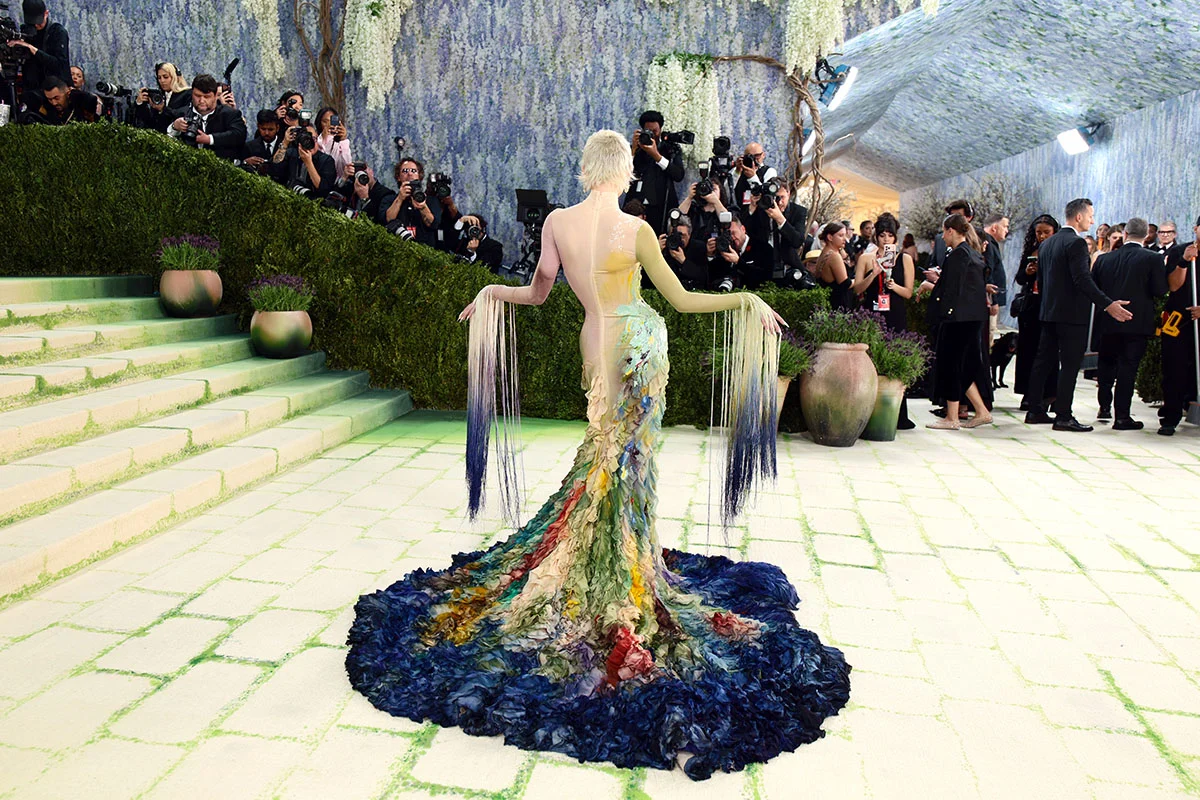
For her 2026 appearance, Emma Chamberlain eschewed the traditional red carpet formula, fully embracing the idea of becoming a walking, breathing masterpiece. Chamberlain approached the evening with a renewed sense of gravity, telling Vogue prior to the event, “I’m taking it really seriously in a way that I feel like I haven’t in the past.” This dedication culminated in a jaw-dropping custom Mugler bodycon gown that immediately set the internet ablaze and dominated fashion conversations worldwide.
Designed by Mugler’s creative director, Miguel Castro Freitas, and styled by her trusted collaborator Jared Ellner, the dress was envisioned as a literal “living canvas.” The silhouette itself was a masterclass in architectural garment construction, featuring a nude illusion base with a body-hugging fit that stayed fiercely defined through the torso before exploding into an expansive, rippling train. Fashion historians and eagle-eyed fans were quick to note the structural nods to archival Thierry Mugler—specifically Look 56 from the Haute Couture Fall/Winter 1997 collection, echoing the engineered silhouette, second-skin fit, and elongated, fringe-like sleeves of Mugler’s legendary La Chimère and Butterfly dresses.
However, it was not just the silhouette that made Chamberlain’s gown the talk of the evening. It was what laid on top of the masterful construction that transformed the dress into an unforgettable head-turning spectacle.
The 40-Hour Masterpiece: Anna Deller-Yee’s Artistic Process
To achieve the “Fashion Is Art” mandate, the Mugler team enlisted the extraordinary talents of artist and print designer Anna Deller-Yee. Beginning her career as a print designer for Italian apparel brand Marni in 2021, Deller-Yee specializes in hand-painted prints and was tasked with the monumental challenge of painting Chamberlain’s entire gown completely by hand. The directive was clear, as Deller-Yee explained: “There was a lot of materiality in the work, and that’s what Emma wanted: to literally feel like she’s a painting.”
The execution of this vision was nothing short of painstaking. The entire piece was painted from hem to neckline relying exclusively on real fine-art supplies—absolutely no standard fashion-based dyes or fabric paints were utilized. Deller-Yee spent a grueling 40 hours meticulously applying paint to the fabric, a process that demanded an additional four full days just for the garment to dry completely.
Deller-Yee began by mounting the dress on a massive cardboard form to separate the voluminous skirt into workable planes. To create the illusion of melting, watercolor-like transitions, she heavily sprayed the lower half of the gown with water before applying highly pigmented acrylic inks. Using light brushstrokes, she built the colors from lighter, acid-yellow hues, transitioning through vibrant greens, and culminating in deep, inky blues at the hem of the expansive train. Deller-Yee continuously re-sprayed the piece between layers to ensure each section of the skirt seemingly melted into the next.
Moving to the upper half of the gown, the artist switched mediums, mixing acrylic paint with a thickening gel to create chunky, sculptural impasto brushstrokes. This technique produced a dramatic yellow-blue swirl that traveled up the flank of the gown and across the chest. The final, breathtaking details included a series of tiny, almost imperceptible white flowers delicately painted at the neckline, and cascading, fringe-like sleeves painted in a rich, dark blue. The finished product was so massive that it required a custom six-foot-long shipping crate to safely transport the dry gown from Deller-Yee’s studio in Paris across the Atlantic to New York City.
Also read:
What the 2026 Met Gala Theme Means for the Intersection of Fashion and Fine Art
Sabrina Carpenter Takes Over the 2026 Met Gala: Secret Wardrobe Changes and a Surprise Performance
2026 Met Gala Red Carpet: All the Celebrity Looks Celebrating “Fashion Is Art”
The 2026 Met Gala: A Night Where Fashion Collides With Fine Art
Inspirations Drawn from Family and Fine Art Legends
The conceptual depth of Chamberlain’s Met Gala look drew heavily from a rich tapestry of artistic history. Rather than merely mimicking a single piece of art, the dress synthesized various influences from Impressionist and Expressionist movements, capturing their raw focus on visible brushstrokes and atmospheric emotion. Observers and fashion critics drew immediate parallels between the gown’s swirling, impasto textures and the legendary works of Vincent Van Gogh—most notably “The Starry Night”—as well as the emotive strokes of Edvard Munch.
On a deeply personal level, the theme and the dress resonated with Chamberlain’s own upbringing. “My dad is an oil painter and a watercolor painter, and I grew up in a very creative household with art all over my house,” Chamberlain shared. “I really am someone who enjoys fashion the most when I get to be a complete blank canvas.” This deeply rooted appreciation for fine art allowed her to carry the heavy, sculptural gown not just as a model, but as an active participant in the artistic narrative. The clash between watery, runny paint at the hem and the thick, glossy impasto strokes on the bodice was a deliberate reflection of Deller-Yee’s personal portfolio, tailored perfectly to reflect Chamberlain’s artistic lineage.
Watercolor Glam: Beauty on the Green Carpet
No Met Gala look is complete without a beauty look that seamlessly ties the conceptual threads together. While the gowns often receive the lion’s share of the hype, the 2026 red carpet saw hair and makeup taking center stage. Chamberlain’s beauty team took the “living canvas” concept to heart, ensuring her face and hair matched the energy of the Mugler gown.
Chamberlain debuted a striking, painterly makeup look that has since been dubbed “watercolor-dripping glam.” Her makeup artist crafted a dreamy, ethereal eye look featuring a mix of rich plum and mauve tones, brilliantly interrupted by flashes of iridescent yellow that perfectly mirrored the acid-yellow acrylic ink on her bodice. This artistic approach to her makeup elevated her features without overpowering the intricate details of the dress.
For her hair, Chamberlain leaned into her signature edgy aesthetic. She sported a platinum pixie cut that had been grown out just enough to allow the ends to flip outward, creating a halo-like shape around her face. The combination of the sharp, modern hair with the soft, expressive makeup cemented her status as a walking masterpiece, proving that true red carpet magic lies in the harmony between garment and glam.
Public Reception: From Reddit Critics to Fashion Historians
The reaction to Chamberlain’s look was swift and largely unanimous in its praise for the artistry involved. Art historians like Nancy Hall-Duncan commended the ensemble, noting, “It looked like an artist’s palette and it’s just stunning, colorful and interesting… It’s addressing the whole concept of color in artistic work.” It stood out starkly as a pop of vibrant color in a sea of celebrities who opted for safer, monochromatic black looks.
Online, the response was fervent. On forums like Reddit’s r/Fauxmoi, where users are notoriously critical of celebrity culture and the lavishness of events like the Met Gala, Chamberlain’s dress managed to break through the cynicism. While some users debated the morality of the gala itself—especially regarding its billionaire sponsors—comments overwhelmingly acknowledged the sheer beauty of the gown. Users called it “spectacular,” noting that while they may hold mixed feelings about influencer culture, “this indeed is art.” Some even proclaimed it to be Chamberlain’s best Met Gala appearance to date, an impressive feat considering she has attended every year since her debut in 2021.
The Underlying Drama: A Soundtrack of Ex-Boyfriends
While Chamberlain was busy conquering the physical red carpet in New York, a different kind of spectacle was unfolding on the digital carpet of TikTok. Just as images of her stunning Mugler gown were going viral, her 25-year-old rumored ex-boyfriend, musician Peter McPoland, decided to make waves of his own, sparking a frenzy of online feud rumors.
On Monday, May 4—the exact day of the Met Gala—McPoland uploaded a new cover video to his TikTok account. The song he chose to sing was none other than “Sally, When the Wine Runs Out,” a viral track originally released by the artist Role Model (whose real name is Tucker Pillsbury). For those unfamiliar with the tangled web of internet celebrity dating, Role Model is Emma Chamberlain’s other highly publicized ex-boyfriend.
Chamberlain and Role Model had a high-profile relationship that began in 2020. They made their red-carpet debut at the Vanity Fair Oscar Party in March 2022 and dated for three years before reports of their split surfaced in October 2023. Following that breakup, Chamberlain was linked to McPoland. The two were first rumored to be dating in July 2024 after being spotted looking cozy together in Paris during the Olympics. They were later seen in coordinating Halloween costumes and were last photographed publicly in April 2025. By November 2025, Chamberlain confessed on her podcast that she was “going through a breakup” from a relationship that had lasted roughly two years.
McPoland’s decision to cover a song by Chamberlain’s former long-term partner on the very day she was dominating global headlines was perceived by fans as a highly calculated move. Although McPoland did not tag Chamberlain or Role Model, nor did he mention them in his caption, the comment section immediately erupted. Fans pointed out the heavy implications of the cover, with comments reading, “The amount of screen time it takes to understand the weight of this,” and “I’m crying what is your problem.” The bizarre crossover between her past relationships added an unexpected layer of modern internet drama to an evening otherwise dedicated to high-brow fine art.
A Night to Remember
Ultimately, the 2026 Met Gala will be remembered as a triumphant night for Emma Chamberlain. She successfully navigated the complex “Costume Art” theme by transforming herself into a tangible piece of fine art, honoring her father’s creative legacy, and pushing the boundaries of what red carpet fashion can achieve with a 40-hour hand-painted Mugler masterpiece. Whether she was trending for her stunning watercolor glam, the sheer architectural wonder of her dress, or the inescapable TikTok drama involving Peter McPoland and Role Model, one thing was abundantly clear: Emma Chamberlain knows exactly how to capture the world’s attention, and she does it with undeniable style.