
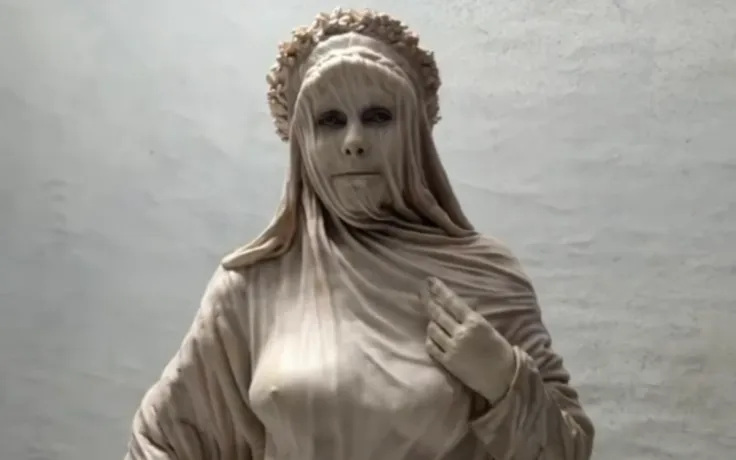
The Metropolitan Museum of Art’s iconic steps have played host to an endless array of unforgettable, headline-making spectacles over the decades, but rarely have they been graced by a walking piece of 18th-century masonry. On Monday, May 4, 2026, the intersection of high fashion, fine art, and theatrical performance art reached a stunning new pinnacle. Supermodel, television host, and undisputed “Queen of Transformation” Heidi Klum arrived at the 2026 Met Gala wrapped in an elaborate, hyper-realistic illusion that completely shifted the boundaries of red-carpet dressing.
The 52-year-old Project Runway host and globally renowned fashion icon opted to shed traditional haute couture glamour in favor of something far more monumental. Arriving as a literal “living statue,” Klum appeared as though she had been plucked directly from a neoclassical pedestal inside the museum’s hallowed halls and placed onto the red carpet. By blending her well-documented love for dramatic, prosthetic-heavy transformations with the refined elegance of classical sculpture, Klum cemented her status as a red-carpet legend, treating the star-studded event not merely as a gala, but as a live performance art exhibition.
Decoding the 2026 Met Gala Theme: ‘Costume Art’
To truly understand the magnitude and brilliance of Heidi Klum’s living statue ensemble, one must first look at the thematic framework of the evening. The 2026 Met Gala was held in celebration of the Metropolitan Museum of Art’s latest Costume Institute exhibition, curated by the visionary Andrew Bolton. The exhibition, officially titled “Costume Art,” was accompanied by a clear and inspiring dress code for the evening: “Fashion is Art.”
This year’s deeply analytical and visually ambitious theme focused heavily on “the centrality of the dressed body” throughout the extensive, intertwined histories of both art and fashion. It was a prompt that encouraged attendees and their designers to look beyond mere aesthetics and explore the philosophical boundaries that separate clothing meant for daily wear from garments meant for museum display. The gala challenged the world’s most recognizable celebrities to blur the lines between design and exhibition, asking them to consider how the human body acts as a canvas for high art.
The high-stakes event was overseen by a powerful roster of co-chairs, including the legendary Vogue editor-in-chief Anna Wintour, music icon Beyoncé, acclaimed actress Nicole Kidman, and tennis superstar Venus Williams. Adding to the immense prestige of the evening, billionaire entrepreneur Jeff Bezos and his partner Lauren Sánchez served as the gala’s honorary chairs.
While many attendees interpreted the “Fashion is Art” dress code by wearing avant-garde couture, archival museum pieces, or literal translations of famous paintings, Klum’s approach was brilliantly literal and structurally unprecedented. Rather than simply wearing art, Klum chose to become art. Her commitment to the theme resulted in an appearance that was hailed by fashion critics and onlookers as one of the most dramatic, ambitious, and conceptually flawless looks of the evening.
The Anatomy of a Masterpiece: Crafting the Living Statue
The execution of Klum’s 2026 Met Gala look was nothing short of a technical and artistic marvel. It was a massive undertaking that required the expertise of legendary Oscar-nominated makeup and prosthetic artist Mike Marino. Marino is well-known to Klum’s fans as her longtime collaborator and the architect behind her most viral and mind-bending Halloween moments. Together, the duo worked tirelessly to ensure that the living statue piece not only captured the eerie, permanent stillness of carved marble but also remained functional enough for Klum to walk the daunting Met Gala steps.
Drawing direct inspiration from breathtaking classical artworks—most notably Raffaele Monti’s iconic 19th-century sculpture Veiled Vestal and the breathtaking Veiled Christ—the ensemble was designed to replicate the impossible illusion of delicate, flowing fabric carved entirely out of solid stone. In these classical masterpieces, sculptors managed to make hard marble look like sheer, translucent cloth draped over a human face and body. For the Met Gala, Marino and Klum reversed this process: they used soft materials to recreate the illusion of heavy, unforgiving stone.
Klum was virtually unrecognizable beneath layers of chalky grey body paint and textured latex. Marino meticulously crafted a custom look that mimicked carved marble from head to toe. The construction of the “draped” robes involved a clever combination of foam, latex, and spandex. This allowed Klum mobility while maintaining the rigid, heavy appearance of a masonry statue.
“She looks hard, but I’m soft,” Klum joked during a red carpet interview, playfully gesturing to the foam construction of her statuesque robes.
Every single detail of the supermodel’s appearance was calibrated to enhance the stone illusion. Fine detailing recreated the delicate veil effect associated with Monti’s carved marble, giving the distinct, uncanny impression that fabric and skin had merged into a single, continuous stone surface. Over her face, Klum wore a stunning prosthetic facial veil designed to look exactly like translucent stone resting over her features.
To complete the monochromatic, head-to-toe stone palette, Klum did not overlook a single millimeter of her body. She wore chalky grey contact lenses that gave her eyes a blank, statuesque, and slightly unsettling stare. In a testament to her legendary commitment to a bit, Klum even had her teeth painted to perfectly match the grey, weathered hues of the surrounding “stone.” She finished the jaw-dropping ensemble with flat, ancient-looking sandals and a simple floral wreath resting upon her head.
The sheer precision of the illusion transformed her from a celebrity attendee into a walking artifact. As Klum explained on Instagram, Marino “transformed fabric into sculpture, manipulating latex and spandex with extraordinary precision to mirror the stillness, delicacy, and illusion of carved marble.”
Klum’s Philosophy on Fashion, Art, and Performance
For Heidi Klum, the 2026 Met Gala wasn’t just another red carpet; it was an opportunity to showcase her deeply held beliefs about the intersection of creativity, fashion, and performance art. Her Instagram captions and red-carpet quotes from the evening painted a picture of a woman wholly devoted to the craft of transformation.
“I love fashion, I love art, and I especially love when the two collide,” she shared with her millions of followers. For Klum, the “Costume Art” theme was the ultimate playground. She recognized that the gala was the perfect stage to showcase the kind of boundary-pushing creativity she usually reserves for late October.
Describing the intricate nature of her living statue ensemble, Klum noted, “Every fold, every contour, every detail is intentional, capturing both strength and softness in a way that feels almost impossible. A one-of-a-kind design that doesn’t just dress the body, but elevates it into art itself.”
In an era increasingly dominated by digital manipulation, Klum views her elaborate, physical costumes as an important form of live, tangible art. Reflecting on her commitment to these massive undertakings, she has previously stated her disdain for taking shortcuts. “I never take the easy way out,” Klum explained. “People say, ‘Why the heck are you doing this?’ I do it for the art of it, of transformation, of surprising people also. It’s like a life performance art thing in a way because you see so much AI and things are being photographed, repatched, this, that and the other.”
Her goal, ultimately, is to spark joy, awe, and inspiration in those who watch her. “I always try to come up with something that is giving people an ‘ooh’ and ‘ahh’ and a wow because I want to inspire people to also do something creative.” By blurring the line between fashion and fine art, Klum proved that the most memorable red-carpet moments are those that challenge our perceptions of what clothing can be.
A Legacy of Bold Transformations: From Halloween to High Fashion
Heidi Klum’s triumphant living statue moment at the 2026 Met Gala cannot be fully appreciated without looking back at her unparalleled history of visual transformations. Klum is globally celebrated as the “Queen of Halloween,” famous for throwing one of Hollywood’s most exclusive annual Halloween parties and debuting costumes that defy logic and gravity. Over the years, she has treated her costume design as a serious, high-stakes performance, shifting seamlessly from traditional high fashion into the realm of special effects cinema.
Her past Halloween recreations are the stuff of pop-culture legend. She has completely disguised her supermodel figure to become a massive, hyper-realistic rain worm; she has donned heavy prosthetics to become the lovable ogre Shrek; and she has morphed into the glowing, wrinkled form of E.T. the Extra-Terrestrial.
However, her 2026 Met Gala look shares a particularly poetic and fascinating connection to her 2025 Halloween costume. Just months prior to the Met Gala, Klum transformed into Medusa, the terrifying, tragic figure from Greek mythology whose gaze turned onlookers to solid stone. For that costume, Klum was outfitted with a prosthetic forked tongue, bright green contact lenses, reptilian scales covering her face and body, and a mesmerizing headpiece featuring fake, moving snakes.
In a brilliant complementary move at that 2025 Halloween bash, Klum’s husband, musician Tom Kaulitz, accompanied her dressed as one of Medusa’s unfortunate victims: a frozen, petrified stone figure. Fast forward to the first Monday in May 2026, and Klum has effectively taken on the stone mantle herself. It is a brilliant thematic evolution, moving from the mythical monster who creates statues to becoming the beautifully carved statue herself on the grandest fashion stage in the world.
Elevating the Red Carpet Standards
While Heidi Klum is no stranger to the Met Gala, her 2026 appearance marked a significant and exciting shift from her previous, more traditional high-fashion choices at the event. In past years, she has reliably delivered stunning glamour, but the “living statue” ensemble firmly cemented her status as one of the exceedingly rare celebrities willing to completely sacrifice conventional beauty and traditional glamour for absolute thematic commitment.
This dramatic appearance also follows her recent experimental streak on major red carpets. Earlier in the year, at the 2026 Grammy Awards, Klum made waves by arriving in a unique, second-skin dress that was molded perfectly to her exact proportions. But while her Grammys look was a bold exploration of modern, fitted silhouettes, critics and fashion historians are already hailing her 2026 Met Gala living statue as her most ambitious, cerebral, and conceptually flawless look to date.
By treating the “Fashion is Art” dress code with the utmost respect and utilizing the unparalleled skills of Mike Marino, Heidi Klum provided the 2026 Met Gala with exactly what it asked for: a living, breathing exhibition of costume art. She did not merely walk the steps of the Metropolitan Museum of Art; she belonged on them, indistinguishable from the timeless artifacts housed within the museum’s walls. In doing so, Klum has undoubtedly carved her name—in stone—into the history books of the Met Gala’s most unforgettable moments.