
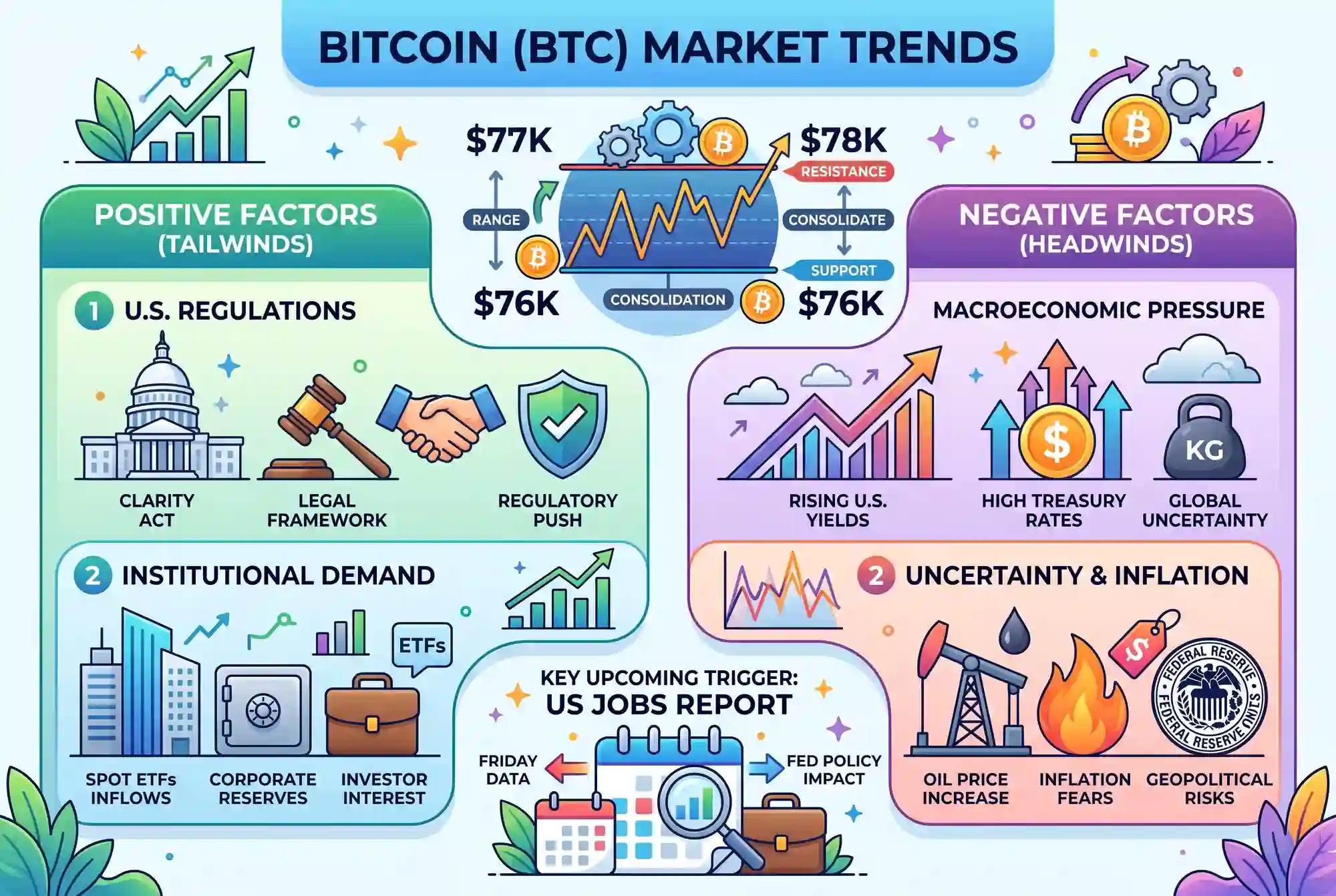
The Current Market State: Consolidation Under $78K
Entering early September 2026, Bitcoin is trading in a tightly range-bound market, oscillating between $77,500 and $78,000 following a volatile late-summer rally. The broader cryptocurrency market is currently absorbing a complex macroeconomic backdrop, halting the momentum that previously carried Bitcoin from below $63,000 to a brief high of approximately $81,400.
Institutional demand, heavily channeled through spot exchange-traded funds (ETFs), previously provided a massive tailwind. U.S. spot Bitcoin ETFs recently completed a nine-day streak of consecutive inflows totaling approximately $3.04 billion through August 27, marking their longest streak of positive flows since April 2026. However, that momentum broke at the end of the month, with ETF flows becoming highly volatile and alternating between substantial inflows and withdrawals as Bitcoin consolidated near the $78,000 threshold.
Market analysis indicates that underlying network profitability remains robust. Vikram Subburaj, CEO of the cryptocurrency exchange Giottus, reported that approximately 68% of Bitcoin’s circulating supply is currently held in profit. Furthermore, the short-term holder cost basis sits near $71,000, placing the majority of recent institutional and retail buyers in positive territory despite the current price stall.
The Political Tailwinds: The Clarity Act and Institutional Demand
Providing a strong price floor for Bitcoin is a wave of optimism surrounding the United States’ regulatory framework. The most critical legislative driver of 2026, the Digital Asset Market Clarity Act (CLARITY), is scheduled for a pivotal Senate procedural cloture vote on September 15 at 2:15 p.m. ET.
The bill, which previously passed the House of Representatives with a 294–134 bipartisan majority in July 2025 and cleared the Senate Banking Committee by a 15–9 vote in May 2026, requires 60 votes to advance to formal debate. The legislation explicitly establishes statutory legal definitions for digital assets, placing those classified as securities under the oversight of the Securities and Exchange Commission (SEC), while granting the Commodity Futures Trading Commission (CFTC) full regulatory jurisdiction over spot markets for digital commodities.
Current SEC Chairman Paul Atkins expressed strong support for the bill, telling Fox Business that he expects the CLARITY Act to advance through the Senate and ultimately reach the President’s desk.
“We can’t fool ourselves. American investors in the age of the internet can send their money anywhere,” Atkins stated in his televised remarks. “So we need to make sure that they can do it here in the United States under United States law.” Signaling proactive shifts within the agency, Atkins also confirmed that the SEC submitted a modernized crypto custody proposal to the White House Office of Management and Budget on August 25 to clarify how investment advisers can hold digital assets for clients.
Industry leaders view the impending framework as a catalyst for institutional legitimization. Vikaas M. Sachdeva, CEO of BitDelta India, stated that the CLARITY Act’s core value lies in answering fundamental business questions regarding asset classification and intermediary obligations. “The CLARITY Act actually reduces regulatory risk premium,” Sachdeva observed.
This institutional confidence is already materializing in corporate treasury strategies. On August 31, MicroStrategy resumed its aggressive corporate accumulation strategy after a two-month pause, executing a $370 million purchase of 4,603 Bitcoin at an average price of $80,318 per coin. Funded by a recent stock offering, this transaction solidified the technology firm’s position as the world’s largest corporate holder of the asset, bringing its total reserves to 845,050 BTC. The market responded positively to the resumption of Michael Saylor’s strategy, with MicroStrategy’s stock (MSTR) rising 4.4% to close at $132.94 following the disclosure.
The Macro Headwinds: Rising Yields and Geopolitical Tensions
While regulatory developments have bolstered long-term sentiment, severe macroeconomic headwinds are actively suppressing a breakout above $80,000.
Financial markets are currently grappling with renewed inflation fears and tightening financial conditions. Following U.S. military strikes on Iranian targets near the Strait of Hormuz on September 1, geopolitical tensions pushed Brent crude oil prices to $95.91 per barrel, marking a five-week high.
This energy market shock, coupled with statements from Federal Reserve Chair Kevin Warsh reinforcing his focus on inflation at the recent Jackson Hole symposium, triggered a significant spike in bond yields. The U.S. 10-year Treasury yield surged above 4.81%, reaching its highest level in nearly three years, while the U.S. Dollar Index climbed to a two-week high. Higher energy prices and rising yields on safe-haven assets traditionally increase the opportunity cost of holding non-yielding risk assets like Bitcoin, creating immediate downward pressure on the market.
The Friday Forecast: Jobs Report and Fed Uncertainty
Market analysts universally point to the upcoming Friday U.S. employment report as the definitive short-term catalyst that will dictate whether Bitcoin retests its $81,400 local high or breaks down into the lower $70,000s.
Economists project a gain of 53,000 nonfarm payroll jobs for August, with the unemployment rate expected to hold steady at 4.1%. This data is critical for the Federal Reserve’s immediate policy trajectory. Following a weaker-than-expected July jobs report and a soft private payrolls print showing just 38,000 jobs added in August, markets are pricing in roughly a 66% to 68% probability of a policy rate move from the central bank in September.
Giottus CEO Vikram Subburaj noted that this level of uncertainty is actively capping risk appetite. Looking forward based on current market structures, Subburaj advised traders to avoid aggressive leverage ahead of the data release. He identified $76,200 to $76,500 as the immediate structural support zone for Bitcoin, with $77,700 to $78,300 serving as the near-term resistance band.
Despite the cautious spot market, derivatives traders are positioning for a potential late-September breakout. Weekly options data from Coincall revealed $303.83 million in volume, with heavy concentration on the September 25 expiry. Notably, the $88,000 strike price emerged as the most active contract of the week, generating more than $46 million in trading volume as institutions build positions anticipating that regulatory clarity will ultimately outweigh macroeconomic friction.
Sources: Bitbo (SEC Chair Atkins), LiveMint (Vikaas M. Sachdeva), GuruFocus & Bit2Me (MicroStrategy corporate filings), KuCoin & CryptoRank (Vikram Subburaj market analysis), and Coincall & DMarketForces (Treasury yields, oil prices, and options data) published between August 31 and September 3, 2026.