
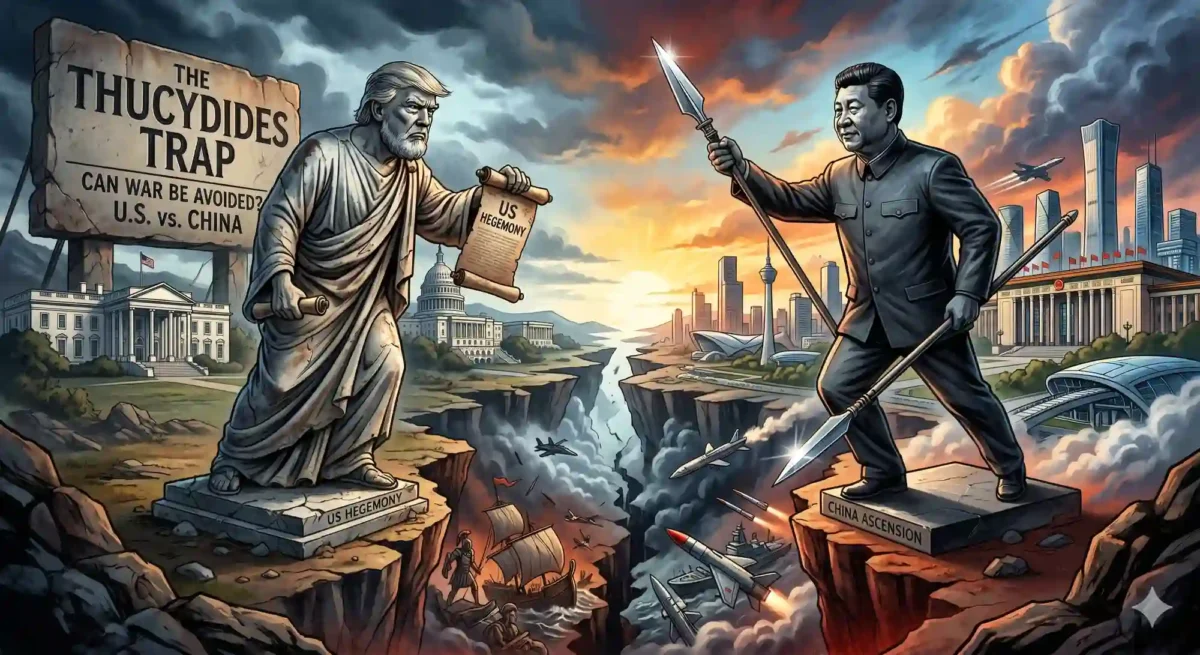
The Global Stage is Set in Beijing
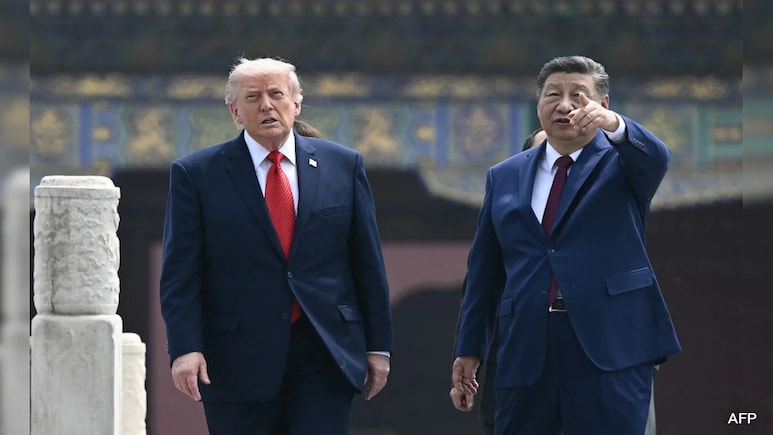
On the morning of May 14, 2026, the world watched as a high-stakes geopolitical drama unfolded inside the Great Hall of the People in Beijing. The long-awaited Trump-Xi summit had officially begun.
U.S. President Donald Trump, arriving with a delegation of top American business leaders, struck a tone of personal camaraderie and optimism. He openly praised Chinese President Xi Jinping, calling him a “great leader” and declaring, “It’s an honor to be your friend.”
However, beneath the pageantry of the state visit and the warm diplomatic platitudes, a darker, more historic warning was issued by the Chinese leader.
Xi Jinping opted for a deeply analytical and cautionary tone. Instead of merely reciprocating the praise, Xi asked a profound question that immediately sent ripples through global foreign policy circles: Can the United States and China transcend the Thucydides Trap?
This ancient concept, thrust into modern headlines during the latest Trump China visit, serves as a grim reminder of the historical realities of superpower competition. But what exactly was Xi Jinping referencing, and why did this obscure historical theory take center stage at the most important diplomatic meeting of the decade?
What is the Thucydides Trap?
To understand the gravity of the Trump-Xi meeting, one must first ask: what is the Thucydides Trap?
The Thucydides Trap meaning is rooted in international relations theory. It describes the extreme danger, structural stress, and high likelihood of war that occurs when a rapidly emerging power threatens to displace an existing, established great power as an international hegemon.
The concept suggests that conflict between the two powers is not necessarily born out of deliberate, malicious aggression. Instead, it is the result of natural “discombobulation.” The established power experiences intense fear and insecurity regarding its declining status, while the rising power feels entitled to greater influence and respect.
This toxic combination of fear, pride, and shifting power dynamics creates a combustible environment. In such an environment, even minor misunderstandings, third-party alliances, or regional crises can quickly spiral into a devastating, uncontrollable war.
Origins and Thucydides Pronunciation
The theory is named after Thucydides, an ancient Athenian historian and military general who lived in the 5th century BCE.
Before diving into his historical impact, it is helpful to clarify the Thucydides pronunciation, which often trips up modern readers. The correct Thucydides pronunciation is thoo-SID-ih-deez (/θuˈsɪdɪdiːz/).
Thucydides is best known for authoring the History of the Peloponnesian War, a meticulous account of the devastating conflict between the city-states of Athens and Sparta. Unlike previous historians who relied on the whims of the gods to explain human events, Thucydides applied political realism.
His most famous, chilling observation remains the bedrock of modern geopolitical strategy: “It was the rise of Athens and the fear that this instilled in Sparta that made war inevitable.”
In 2012, American political scientist and Harvard University professor Graham Allison coined the term “Thucydides Trap” to apply this ancient wisdom to the modern rivalry between the United States (the established Spartan equivalent) and China (the rising Athenian equivalent).
The May 2026 Trump-Xi Summit: A Clash of Tones
During the May 2026 summit, the contrast between Donald Trump and Xi Jinping was stark. Trump’s agenda was heavily focused on immediate economic victories. He sought a reset in the Trump China trade dynamic, advocating for American companies to enter the Chinese market more freely.
Trump brought along heavyweights of American industry, including Nvidia CEO Jensen Huang and SpaceX CEO Elon Musk, to emphasize business diplomacy.
Xi Jinping, however, framed the relationship in a civilizational and historic context. He acknowledged the structural rivalry inherent in the Thucydides Trap but signaled a desire to avoid direct military confrontation.
According to official readouts, Xi proposed a new framework dubbed “constructive strategic stability.” This paradigm relies on cooperation as the primary pillar, manageable differences, and controlled competition.
Yet, Xi also delivered a stern warning behind closed doors. He explicitly stated that if the Taiwan issue was mishandled, the two nations could face “clashes and even conflicts, putting the entire relationship in great jeopardy.”
Deeper Technical Analysis: The 16 Historical Cases
To truly grasp the Thucydides Trap meaning, we must look at the hard data. When Graham Allison popularized the term, he didn’t just rely on ancient Greek history. He led a comprehensive case study at Harvard University’s Belfer Center for Science and International Affairs.
The research team analyzed the last 500 years of global history to identify instances where an emerging power threatened to displace a ruling power. They found 16 specific historical cases that fit this paradigm.
The data points are alarming: out of those 16 cases, 12 ended in war.
One of the most catastrophic examples cited is the outbreak of World War I. At the dawn of the 20th century, the United Kingdom was the established global hegemon. However, a rapidly industrializing and militarizing Germany emerged as a direct challenger. The resulting structural stress, exacerbated by complex alliances and a minor assassination in the Balkans, triggered a global slaughter.
Another historical example is the rise of the Japanese Empire in the mid-20th century, which ultimately clashed with the established United States power in the Pacific Ocean, leading to the attack on Pearl Harbor and the Pacific theater of World War II.
Escaping the Trap: The Four Exceptions
While 12 cases ended in bloodshed, four did not. These exceptions provide a blueprint for how the US and China might navigate their current predicament.
The most prominent peaceful transition occurred in the early 20th century when the rising United States surpassed the established United Kingdom. Cultural similarities, geographic distance, and the UK’s need for American support against Germany allowed for a peaceful handover of global hegemony.
The Cold War between the US and the Soviet Union is another case that avoided direct war, largely due to the doctrine of Mutually Assured Destruction (MAD) created by nuclear weapons.
Xi Jinping’s invocation of the Thucydides Trap at the Trump-Xi meeting is essentially a plea to study these four exceptions. By proposing “constructive strategic stability,” Beijing is attempting to institutionalize communication channels to prevent the 12-out-of-16 historical average from repeating itself.
Contrasting Viewpoints: Is China Actually a “Peaking Power”?
While the Thucydides Trap has become a canonical explanation for US-China tensions, injecting new academic viewpoints provides a deeper understanding of the crisis. Not all foreign policy experts agree with Graham Allison’s framework.
A highly influential counter-theory has been proposed by foreign policy scholars Hal Brands and Michael Beckley. They argue that the Thucydides Trap fundamentally misdiagnoses China’s current trajectory.
According to Brands and Beckley, the true danger does not stem from a continuously rising power smoothly overtaking a hegemon. Instead, the highest risk of war occurs when an emerging power realizes that its rapid rise is stalling. This is known as the “Peaking Power Syndrome.”
They argue that China is currently facing immense internal headwinds. Scholars like Arthur Waldron and Ian Buruma point to China’s severe demographic crisis (an aging population), economic vulnerabilities, massive debt bubbles, and capital flight as evidence that China’s peak power may be in the rearview mirror.
If China is indeed a peaking power, the psychological dynamic shifts. A peaking power, terrified that its window of opportunity to reclaim Taiwan or secure regional dominance is rapidly closing, becomes far more likely to lash out aggressively. In this contrasting view, it is China’s impending stagnation—not its unstoppable rise—that makes the current Trump China dynamic so highly combustible.
The Economic Paradox: AI Chips and Business Diplomacy
The May 2026 summit highlighted a fascinating paradox within the modern Thucydides Trap. Even as Xi Jinping warned of military conflict over Taiwan, the economic ties between the two nations remain deeply intertwined.
Ahead of the summit, Xi Jinping signaled to American CEOs that China’s doors to the outside world “will only open wider.” The presence of US tech leaders underscored the reality that both nations still rely on each other for economic prosperity.
The United States has restricted the export of advanced AI chips to China, a move designed to maintain American technological hegemony. Yet, Chinese manufacturing and consumer markets remain vital for American corporate growth.
This economic interdependence is what makes the current US-China relationship unique compared to historical Thucydides Trap examples like Athens and Sparta, or the US and the Soviet Union. The ancient Greeks did not share a multi-trillion-dollar supply chain.
Conclusion: Can We Forge a New Paradigm?
The Trump-Xi summit of May 2026 will likely be remembered as a critical inflection point in modern history.
Donald Trump’s push for favorable trade terms and his transactional diplomacy met head-on with Xi Jinping’s grand historical narrative. By bringing the Thucydides Trap directly to the negotiating table, Xi openly acknowledged the existential danger of the current geopolitical climate.
Whether the relationship falls victim to the violent tendencies of history or whether these two powers can forge a “new paradigm of major-country relations” remains the defining question of our time. The world watches, hoping that the structural stress of this modern rivalry will result in the fifth peaceful exception, rather than the thirteenth tragic war.
Frequently Asked Questions (FAQ)
In simple terms, the Thucydides Trap is a political theory that explains the high risk of war when a new, rising superpower threatens to take the place of an older, established superpower. The fear and insecurity caused by this shift in power often lead to violent conflict, even if neither side originally wanted a war.
The correct Thucydides pronunciation is “thoo-SID-ih-deez” (/θuˈsɪdɪdiːz/). He was an ancient Greek historian whose writings on the Peloponnesian War inspired the modern geopolitical theory.
During their May 2026 summit in Beijing, Chinese President Xi Jinping asked U.S. President Donald Trump if their two nations could overcome the Thucydides Trap. Xi warned that mishandling the Taiwan issue could lead to clashes and conflicts, but he also proposed building a “constructive strategic stability” to avoid the historical trap of war.
The modern term was coined by American political scientist and Harvard University professor Graham Allison around 2011-2012. However, the core concept is based on the writings of the ancient Athenian historian Thucydides from the 5th century BCE.
No, war is not inevitable. While a Harvard study found that 12 out of 16 historical cases matching the Thucydides Trap ended in war, 4 cases resulted in a peaceful transition of power. Both Donald Trump and Xi Jinping have publicly stated their desire for cooperation and partnership to avoid conflict, despite deep structural rivalries.
A contrasting viewpoint to the Thucydides Trap is the “Peaking Power” theory, proposed by scholars like Hal Brands and Michael Beckley. This theory suggests that China is not an unstoppable rising power, but rather a nation facing economic and demographic stagnation. They argue that the true danger of war comes from China realizing its window of opportunity is closing, causing it to act aggressively before its power declines.