Remember when self-checkout felt like a gift from the future? For years, major retailers pushed self-checkout lanes as the fastest, most efficient way to move customers through stores while simultaneously cutting labor costs. It was billed as a win-win: shoppers got to skip the small talk and bag their own groceries exactly how they wanted, while big-box stores saved millions on cashier wages.
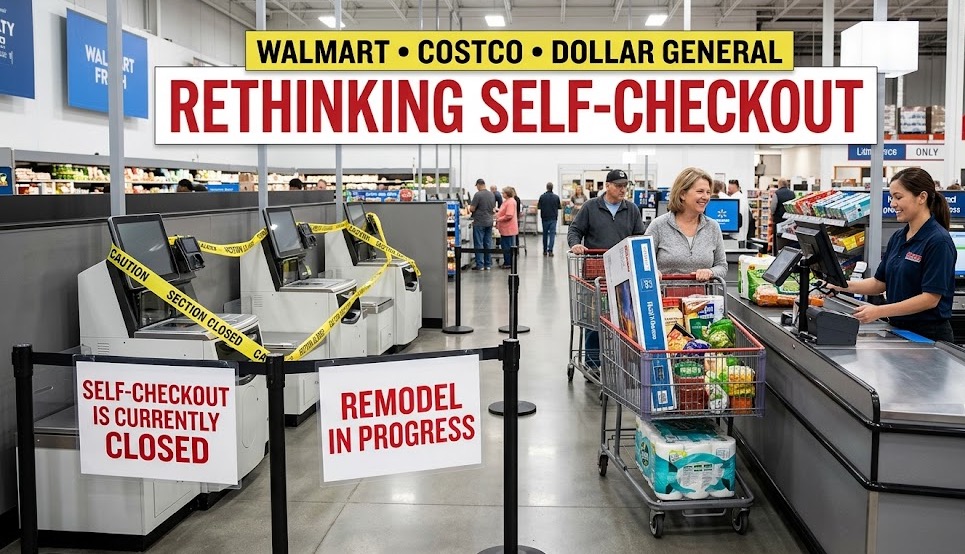
But as we push further into 2026, that once-unstoppable trend is abruptly shifting into reverse. Across the United States, the very machines that were supposed to save the retail industry are being unplugged, roped off, or entirely hauled away. Several of the largest chains in the nation—including Walmart, Target, Costco, and Dollar General—are quietly scaling back or outright removing self-checkout systems from their store layouts.
The widespread pullback is raising a crucial question across the retail landscape: Did this automation technology ultimately create far more problems than it managed to solve? By analyzing recent store remodels, financial shrink data, and emerging legislative regulations, the answer is becoming overwhelmingly clear. The era of unchecked expansion for self-checkout is officially over, and the retail industry is currently undergoing a massive operational reset.
The “Official” Reason vs. The Ugly Reality of “Shrink”
If you ask the corporate public relations departments why self-checkout machines are disappearing, the answer is almost universally centered on “customer experience.” When Walmart recently removed self-checkout kiosks from a store in Shrewsbury, Missouri—a suburb of St. Louis—a company spokesperson stated that the change was intended to “improve the in-store shopping experience and give our associates the chance to provide more personalized and efficient service.” The official line often cites customer feedback, local shopping patterns, and the desire to build stronger community loyalty.
While it is true that many shoppers have developed a love-hate relationship with the technology—often frustrated by the dreaded “unexpected item in the bagging area” alert—retail experts and analysts point to a much darker and more expensive reality: shrink.
In retail terminology, “shrink” refers to inventory that mysteriously vanishes through theft, administrative errors, or damage. And self-checkout, as the data now proves, is an absolute shrink factory. The numbers surrounding self-service kiosks are staggering and financially unsustainable for stores operating on razor-thin grocery margins. Studies have shown that self-checkout lanes experience shrink rates hovering around 3.5% to 4% of total sales. To put that into perspective, the shrink rate at traditional, staffed registers is approximately 0.21%.
This is not a small discrepancy; it is a massive financial chasm. Theft at self-checkout can be up to 65% higher than at traditional cashier lanes. Analysts note that the combination of human error, a complete lack of oversight, and intentional theft has made self-checkout drastically less profitable than initially projected. The financial damage from missing inventory is now forcing these retail giants to realize that the savings garnered from reduced staffing are entirely wiped out by the staggering cost of stolen and unscanned goods. Bringing back staffed lanes may be more expensive in terms of hourly wages, but it significantly reduces theft, improves inventory accuracy, and ultimately protects the bottom line.
Walmart’s Strategic Retreat and Store Remodels
Walmart, the undisputed giant of American retail, is leading the charge in this operational pivot, though they are executing it with surgical precision rather than a blanket nationwide ban. The company officially called an end to self-checkouts at numerous stores as it proceeds with plans to remodel roughly 650 locations.
Instead of a total surrender, Walmart is taking a highly targeted approach. They are actively pulling machines from store locations that suffer from the highest theft rates. Shoppers in high-theft areas such as Cleveland, Ohio; Albuquerque, New Mexico; Los Angeles, California; and various locations in Missouri have watched self-checkout lanes vanish overnight, replaced by traditional cashier-operated lanes.
According to retail expert Bryan Gildenberg, “Walmart regularly reviews stores based on theft and customer experience and takes self-checkout out of their highest-theft stores.”
Interestingly, Walmart is also experimenting with using self-checkout as a premium perk rather than a universal right. In some test markets, Walmart has begun reserving the remaining self-checkout kiosks exclusively for Walmart+ subscription members or Spark delivery drivers. If you are a frequent Walmart shopper who values speed over human interaction, the company is subtly making their paid subscription model look far more attractive by gating the express technology behind a paywall.
Target and Dollar General Implement Drastic Reductions
Walmart is far from alone in this massive course correction. Target, another massive player in the American retail space, has opted for strict operational limits rather than total removal in most of its locations. Target recently announced and enforced a strict 10-item limit for all self-checkout lanes. If you have 11 items or a full cart of groceries, you are now forced to wait in a traditional, staffed line. This targeted restriction is designed specifically to mitigate the massive losses the company was incurring from full-cart self-checkout transactions, where the likelihood of unscanned items—both accidental and intentional—skyrockets.
Meanwhile, Dollar General has taken some of the most drastic measures in the entire industry. Facing catastrophic inventory shrink, Dollar General removed self-checkout machines from approximately 12,000 stores in 2024. In the 300 store locations most heavily impacted by shoplifting and organized retail crime, the company eliminated the self-checkout option entirely. For a discount retailer where staffing is traditionally kept to an absolute bare minimum, the decision to pull the plug on automated checkout across 12,000 locations highlights just how devastating the financial losses had become.
Costco’s Innovative “Hybrid” Scan-and-Go Model
Costco Wholesale has historically operated with a slightly different business model, heavily reliant on membership verification and exit-door receipt checks. However, even the warehouse giant was forced to admit that shrink had increased—in part due to the wide rollout of self-checkout kiosks. Costco executives discovered that non-members were successfully sneaking into stores and using membership cards that didn’t belong to them at the automated registers.
Rather than fully abandoning the technology, Costco is implementing a fascinating “hybrid” approach to the self-checkout dilemma. In recent tests and store updates, Costco has added significantly more staff to the self-checkout corrals. Instead of relying entirely on the customer to pull items out of bulk carts and scan them, Costco employees armed with handheld scanners walk through the lines, scanning items while the customers are still waiting in their carts.
By the time the shopper actually reaches the payment terminal, their entire cart has already been recorded and verified by an employee. The customer simply scans their membership card to verify their identity and taps their credit card to pay. This hybrid model successfully reduces wait times while completely neutralizing the risk of scan-theft and membership sharing. It proves that retailers aren’t entirely giving up on modernization; they are simply evolving it into something much more controlled, heavily supervised, and financially secure. Sam’s Club, Costco’s primary rival, is taking a similar technological route, aggressively replacing traditional self-checkout with AI-powered “Scan & Go” technology that verifies purchases dynamically.
Lawmakers Step In: The Push to Regulate Self-Checkout
If the massive financial losses weren’t enough to force a change, retailers are now facing pressure from local and state governments. Lawmakers across the country are stepping into the fray, drafting bills that would strictly regulate—or outright limit—how automated checkout machines can operate within their jurisdictions.
In New York City, Councilmember Amanda Farías introduced a highly publicized amendment to the city code aimed directly at reigning in supermarket and pharmacy kiosks. The proposed bill mandates a strict 15-item limit for all self-checkout transactions. Furthermore, it aggressively targets the labor reduction aspect of the technology by requiring stores to staff at least one employee for every three self-checkout kiosks in operation.
The political pushback against self-checkout isn’t solely about preventing theft; it is heavily focused on protecting workers’ jobs and ensuring accessibility for all demographics. Rhode Island Senate President Valarie Lawson, who has supported similar regulatory frameworks, framed the legislation as a vital protection for both retail workers and elderly customers. “We’ve all experienced frustration at a self-service checkout, and this experience can be far more challenging for elderly members of the community,” Lawson noted, capturing a widespread public sentiment.
These legislative proposals across various states seek to mandate a minimum number of staffed checkout lanes at all times, set caps on the number of automated items, and restrict how many self-checkouts a single, over-worked employee is legally allowed to monitor.
The Psychology of Retail Theft: Accidental vs. Intentional
Why did self-checkout fail to live up to its utopian promises? A look at consumer psychology and recent survey data paints a highly concerning picture. When the physical barrier of a cashier is removed, the moral barrier for many shoppers seemingly evaporates alongside it.
According to a survey conducted by Lending Tree, a staggering 70% of shoppers who utilize self-checkout lines believe that the technology makes stealing significantly easier. The anonymity of the machine provides a psychological cover that human interaction actively discourages.
The statistics surrounding actual theft are even more shocking. Over 25% of surveyed individuals admitted that they have purposefully slipped an item into their bag without paying for it while using a self-checkout kiosk. Even more problematic for retailers is the rate of accidental theft; over 35% of people admitted that they have accidentally walked out of a store with an item they genuinely forgot to scan. Whether the shrink is born of malicious intent or simple human error, the financial result for the retailer remains exactly the same.
To combat this, stores that are choosing to keep their self-checkout lanes are investing heavily in aggressive security measures. Safeway, for instance, has installed receipt-scanning security gates at the exits of their self-checkout areas in multiple California locations. Customers cannot physically leave the store without scanning a valid receipt to open the turnstile. Other stores are investing in overhead computer vision cameras and weighted shelf sensors capable of tracking inventory in real-time with 99% accuracy.
The Future of Retail Checkout
The retail industry has officially reached a turning point. Self-checkout is no longer viewed by executives as a magical, one-size-fits-all solution to labor costs. As Neil Saunders, managing director of retail at GlobalData, succinctly explained: “They are trying to see how does this play a role in the future, but it’s not going to be the same thing they’ve done for decades, where it’s a free-for-all, and anyone could use it. There is a lot more caution.”
Going forward, the consumer experience will change dramatically. Shoppers should expect to see longer lines in the short term as retailers physically remove kiosks and attempt to re-staff traditional lanes in an incredibly tight labor market. The 10-to-15 item limit will likely become the universal, permanent standard for automated checkout, formally transforming these areas back into the “express lanes” they were originally modeled after.
Ultimately, the pullback from self-checkout reflects much deeper challenges facing the modern economy: rising retail theft, the unyielding demand for operational efficiency, and rapidly changing consumer behavior. While the flashing red light of a self-checkout scanner isn’t disappearing from our lives entirely, its role is being strictly redefined. For frustrated shoppers, it might mean fewer technical glitches and a return to basic human interaction. For the retail giants, it is a necessary, multi-billion-dollar adjustment to protect their survival in a rapidly shifting landscape.