
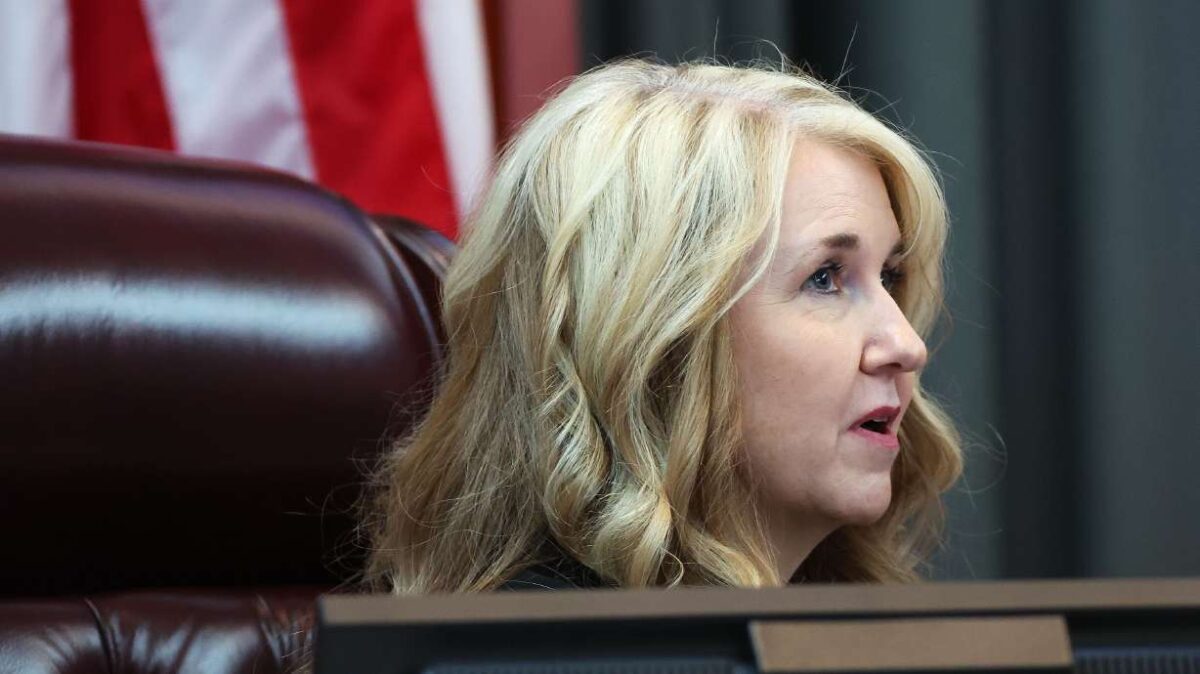
On Friday, May 8, 2026, Utah Supreme Court Justice Diana Hagen announced her immediate resignation from the bench.
The sudden departure comes amidst swirling controversies that have gripped the state’s political and legal spheres.
Hagen faced allegations of an improper relationship with a prominent attorney who had argued high-profile cases before the state’s highest court.
Her resignation letter was submitted directly to Utah Governor Spencer Cox.
The decision ends her tenure on the Utah Supreme Court, a position she had held since 2022.
The resignation has sent shockwaves through the state’s judicial and political landscapes.
The core of the controversy stems from allegations brought forward regarding Hagen’s personal life.
The claims centered around an alleged inappropriate relationship with David Reymann.
Reymann is an attorney well-known for his involvement in a major Utah redistricting lawsuit.
The allegations were initially sparked by Hagen’s ex-husband, Tobin Hagen.
Tobin Hagen suspected that the justice began an inappropriate relationship with Reymann around the time their marriage was deteriorating.
According to reports, the ex-husband cited text messages as the basis for his suspicions.
The formal complaint, however, was not submitted by her ex-husband directly.
Instead, another attorney, Michael Worley, submitted the complaint to the Judicial Conduct Commission (JCC) after communicating with Tobin Hagen via a Facebook message.
In her heartfelt resignation letter, Hagen made it clear why she chose to step down.
She did not admit to any wrongdoing, maintaining that her actions were ethical and professional throughout her career.
Instead, she cited the immense toll the public scrutiny was taking on her loved ones.
“It is with deep sadness that I tender my immediate resignation as a justice of the Utah Supreme Court,” Hagen wrote.
She expressed profound love and respect for her colleagues, referring to them as brilliant jurists and dedicated public servants.
“I sincerely regret the disruption my sudden departure will cause the court and the parties who come before it,” she continued.
Hagen reflected on her 26 years as a public servant, acknowledging the sacrifices required to hold a position of public trust.
She emphasized that while public officials are rightfully held to higher standards, her family did not choose the public life.
“They do not deserve to have intensely personal details surrounding the painful dissolution of my thirty-year marriage subjected to public scrutiny,” Hagen stated.
She noted she would have loved to continue serving the people of Utah but could not do so at the expense of her family’s privacy and well-being.
The identity of the attorney involved in the allegations added a thick layer of political complexity.
David Reymann represented progressive voting rights groups and plaintiffs in a high-profile challenge to Utah’s congressional maps.
The redistricting case was highly controversial, challenging a Republican-friendly map that maintained four red congressional seats.
Because of this connection, the allegations against Hagen quickly escalated from a personal matter to a political flashpoint.
Hagen, however, had taken steps to distance herself from potential conflicts of interest.
She had previously recused herself from all cases involving Reymann.
Her recusal was formally reflected in the court’s September 2025 opinion in the League of Women Voters case.
In previous statements, Hagen noted her last involvement in the redistricting case was in October 2024.
She cited a “renewed friendship” with Reymann as the reason for stepping back from his cases.
Both Hagen and Reymann have categorically denied the allegations of an extramarital affair.
Reymann publicly called the allegations within the complaint “false.”
Before the political uproar reached its peak, the Judicial Conduct Commission had already reviewed the matter.
The JCC is an independent body made up of state lawmakers, judges, and members of the public.
An investigator for the JCC conducted a preliminary review of the complaint submitted against Hagen.
The investigator found that the message sent to the complaining attorney was “speculative, overstated, and misleading.”
According to the preliminary report, there was “very little credibility to this complaint.”
The investigator concluded there was insufficient evidence to support the allegation of an affair.
The report also noted that further investigative steps, such as subpoenaing text messages or interviewing Hagen’s adult children, would be highly intrusive and embarrassing.
Following these recommendations, the JCC voted against opening a full investigation.
The matter was essentially dismissed by the body constitutionally designed to handle judicial discipline.
Despite the JCC’s findings, the allegations leaked to the public.
The preliminary report came to light after the Utah House released the document to a local news outlet following an open records request.
The Utah Supreme Court pushed back, issuing a statement that the documents were confidential and inappropriately released.
The House Speaker defended the release, arguing his office followed state law.
The public revelation prompted immediate action from Utah’s top Republican leaders.
Gov. Spencer Cox, Senate President Stuart Adams, and House Speaker Mike Schultz publicly called for an independent investigation.
They expressed dissatisfaction with how the JCC handled the preliminary probe.
Gov. Cox called the allegations “serious” during a press conference in late April.
The leaders were prepared to potentially launch a special investigative committee.
This pressure campaign continued to mount in the weeks leading up to Hagen’s resignation.
Following her decision to step down, state leaders shifted their focus.
With Hagen no longer on the bench, the planned independent investigation appears to be canceled.
Speaker Schultz and President Adams issued a joint statement confirming they would not pursue the matter further.
“We appreciate Justice Hagen’s resignation and her willingness to step aside in the best interest of the institution,” they wrote.
They considered the specific allegations related to Hagen concluded.
However, the political leaders signaled that their scrutiny of the judiciary is not over.
Gov. Cox, Chief Justice Matthew Durrant, Adams, and Schultz released a united statement regarding the JCC.
They committed to working together across the judicial, executive, and legislative branches on potential reforms.
Their goal is to ensure the JCC upholds the highest standards of accountability.
They want to ensure the commission earns and maintains the full confidence of the people of Utah.
Not everyone viewed the resignation as a necessary step for accountability.
Some legal professionals and advocacy groups saw it as a dangerous precedent.
Co-Equal Utah, a group formed to protect state courts from political interference, condemned the events.
They called the circumstances leading to Hagen’s departure “deeply troubling.”
The group emphasized that the JCC, the constitutional body designated for this exact purpose, had already dismissed the complaint as misleading.
“That should have been the end of it,” the group stated.
Instead, they argued, a sitting justice was subjected to a coordinated political pressure campaign until she was forced to resign.
Co-Equal Utah warned that this sends an unmistakable message to every judge in the state.
They argued that the implicit threat is clear: rule against the Legislature, and political retaliation will follow.
The group cautioned that this dynamic is how judicial independence gradually dies.
They noted that sustained pressure makes the personal cost of impartiality too high for judges to bear.
Despite the controversy surrounding her exit, Hagen leaves behind a notable legal legacy.
Before her appointment to the Supreme Court, she spent years as a dedicated prosecutor.
She famously prosecuted the man responsible for the 2002 kidnapping of Elizabeth Smart.
She built a reputation for fighting relentlessly for justice for crime victims.
Chief Justice Matthew Durrant expressed deep sadness over her resignation.
He described Hagen as a valued member of the court with unmatched intellect and abilities.
“Justice Hagen has dedicated her legal career to public service,” Durrant said.
He praised her kindness, generosity, and willingness to mentor young lawyers.
Durrant noted her frequent efforts to meet with school groups and connect with the public.
“This is a loss for the judiciary,” the Chief Justice added, expressing confidence that she will continue to uplift others in the future.
Kim Cordova, the president of the Utah State Bar, echoed these sentiments.
Cordova stated that the entire legal community held Hagen in the highest regard.
She also defended the work of the JCC and criticized the public release of the confidential complaint.
Hagen’s immediate departure creates a significant vacancy on the Utah Supreme Court.
She was slated to be up for a retention election this coming fall.
Now, Gov. Spencer Cox will be tasked with appointing her replacement.
The governor’s office stated that details regarding the process to fill the vacancy will be announced soon.
Complicating matters is the recent expansion of the state Supreme Court.
The Utah Legislature recently approved adding two new justices, bringing the total to seven.
The Appellate Judicial Nominating Commission announced 12 nominees for those new seats just last month.
It remains unclear if the governor can select Hagen’s replacement from that existing pool of nominees.
If not, the commission may need to initiate a new search and make additional recommendations.
In the interim, judges from lower appellate courts may be called upon to fill in.
This will ensure the Supreme Court has the necessary number of justices to hear pending cases.
The resignation of Justice Diana Hagen marks a dramatic chapter in Utah’s judicial history.
It highlights the intense intersection of personal privacy, political pressure, and judicial accountability.
While the immediate controversy surrounding the allegations may subside, the ripple effects will be felt for years.
The push for reforms to the Judicial Conduct Commission will undoubtedly spark further debates.
The balance of power between the state’s legislative and judicial branches remains a contentious issue.
As Utah prepares to fill the empty seats on its highest court, the public will be watching closely.
The legacy of this event serves as a stark reminder of the intense scrutiny faced by those in public service.
Whether this leads to a more accountable judiciary or a compromised, politicized court remains to be seen.
One thing is certain: the Utah Supreme Court is entering a period of significant transition.