
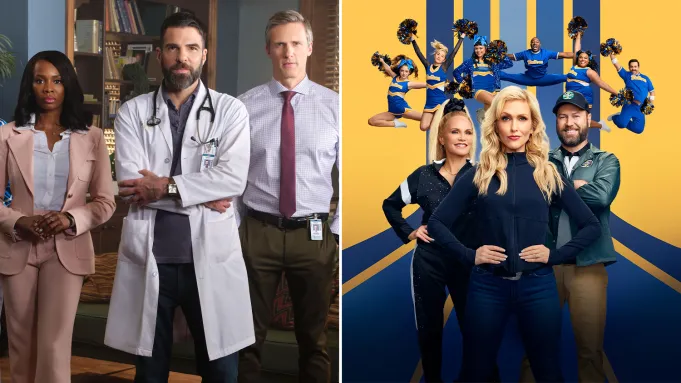
As the television industry gears up for its annual upfront presentations in May 2026, the harsh realities of network viewership have officially set in for a pair of NBC shows. In a sweeping move that reflects the ongoing challenges of traditional broadcast television, NBC has officially canceled the sophomore medical drama Brilliant Minds and the freshman mockumentary comedy Stumble. Both programs fell victim to the unforgiving metrics of linear television, unable to secure the necessary audiences to justify a continuation into the 2026-2027 television season.
While network television has always been a competitive arena, the recent cancellations highlight the widening gap between critical acclaim, strong concepts, and the brutal reality of Nielsen ratings in a streaming-dominated era. For fans of these shows, the news is a bitter pill to swallow, but industry insiders have seen the writing on the wall for months. The decisions mark NBC’s first official scripted cuts for the upcoming broadcast cycle, setting a precedent as the network firm up its primetime slate and clears room for new pilot orders.
The Rise and Fall of ‘Brilliant Minds’
When Brilliant Minds first premiered in September 2024, it was heralded as a fresh, cerebral take on the traditional network medical procedural. Starring Zachary Quinto, best known for his iconic turn as Spock in the Star Trek franchise, the show sought to blend medical mysteries with profound character studies.
Quinto delivered a widely praised performance as Dr. Oliver Wolf, a neurodivergent neurology physician dealing with complex personal limitations, including face blindness. Loosely inspired by the life, work, and legacy of the legendary British neurologist Dr. Oliver Sacks, the series followed Dr. Wolf’s compassionate, avant-garde approaches to treatment. The show centered around Bronx General Hospital, where Wolf, having been dismissed from a previous position due to his unorthodox methods, led a bright team of young interns. Together, they tackled some of the world’s most puzzling psychological cases while navigating the bureaucratic red tape and interpersonal politics inherent to hospital life.
The ensemble cast was formidable, featuring talents like Tamberla Perry, Ashleigh LaThrop, Alex MacNicoll, Aury Krebs, Spence Moore II, Teddy Sears, Donna Murphy, John Clarence Stewart, Brian Altemus, and Al Calderon. The dynamic between Quinto’s Dr. Wolf and his supporting interns created a compelling narrative that even earned the series an impressive 88% critical score on Rotten Tomatoes.
However, despite a successful first season that ran from September 2024 to January 2025, the series found itself on unstable ground during its sophomore outing. Season 2 debuted in September 2025, but the momentum it had meticulously built began to falter. The cast experienced significant mid-season shakeups, including the high-profile departures of main characters Dr. Van Markus (played by Alex MacNicoll) and Jacob Nash (played by Spence Moore II). These creative shifts, combined with an unforgiving broadcast landscape, paved the way for an insurmountable ratings collapse.
Dissecting the ‘Brilliant Minds’ Rating Declines
To understand why NBC pulled the plug on Brilliant Minds, one must look at the brutal mathematics of network television in 2026. In the entertainment industry, ratings are the ultimate arbiter of fate, and Brilliant Minds suffered a collapse that made its cancellation widely anticipated by industry analysts.
Airing on Monday nights, the series occupied a coveted time slot directly following NBC’s reality juggernaut, The Voice. Historically, a lead-in from a massive unscripted hit is considered prime real estate, designed to funnel millions of viewers directly into the scripted show that follows. Unfortunately, Brilliant Minds failed to capitalize on this advantage.
By the time Season 2 rolled around, the medical drama was averaging a paltry 0.14 rating in the all-important 18-49 demographic. Its total viewership plummeted to just 1.87 million viewers, a figure that includes DVR playback through 3:00 AM. When placed side-by-side with its first season, the year-over-year drops were staggering. The show experienced a massive 40% decline in the demographic rating and a 37% drop in overall viewership.
These double-digit drops cemented Brilliant Minds as the network’s lowest-rated scripted series of the season in the demographic. It suffered the steepest year-over-year declines on NBC’s entire network. The writing was on the wall as early as February 2026, when NBC quietly removed the series from its schedule right after the Winter Olympics. Instead of returning the show to its primetime post-Olympics slot, NBC opted to expand The Voice into two-hour broadcasts on Monday nights. This move effectively signaled a lack of faith in the medical drama’s ability to draw an audience, effectively sidelining the show and making its long-term prospects look disastrously shaky long before the official axe fell.
A Bittersweet Conclusion: Burning Off the Final Episodes
For fans who invested their time in Dr. Oliver Wolf and the medical team at Bronx General, the cancellation arrives with a small but significant silver lining. Unlike shows that are abruptly pulled from the airwaves mid-season, leaving audiences with permanent cliffhangers and unresolved plotlines, Brilliant Minds will be granted a conclusion.
Because the series was pulled from the schedule earlier this year, NBC has six fully produced, unaired episodes remaining in the vault. The network has announced that these final chapters will be broadcast as a summer “burn-off” run. The remaining six episodes are slated to begin airing on Wednesday, May 27, 2026. The series finale is projected to air on July 1, 2026.
While it is undoubtedly disappointing that these episodes will serve as the definitive end to the series rather than a bridge to a potential Season 3, it offers the creative team and the audience a chance to say goodbye. Viewers will finally see the culmination of Dr. Wolf’s medical and emotional journey, providing a proper, albeit bittersweet, sense of closure for a show that fought hard to bring mental health and neurodivergence to the forefront of network television.
The Swift Demise of the Comedy ‘Stumble’
Brilliant Minds was not the only casualty of NBC’s pre-upfront housecleaning. The network also formally cut ties with its freshman comedy series, Stumble, bringing its run to a swift conclusion after just one season consisting of 13 episodes.
Stumble was an ambitious swing for NBC—a mockumentary-style comedy set against the high-energy, fiercely competitive backdrop of junior college cheerleading. The show starred the talented Jenn Lyon as Courteney Potter, an elite and celebrated cheerleading coach whose life is flipped upside down after a very public, humiliating scandal where she is caught drinking with her team. Disgraced and fired from her prestigious post, she is forced to start over, landing at a junior college in Oklahoma. There, she is tasked with transforming a lovable but wildly untalented squad of misfits into a team capable of winning the national championship.
Lyon was supported by a strong comedic ensemble that included Taran Killam as Boone E. Potter, Ryan Pinkston as Stevie, and Jarrett Austin Brown as Dimarcus, alongside Anissa Borrego, Arianna Davis, Taylor Dunbar, and Georgie Murphy. Stage and screen icon Kristin Chenoweth even made recurring guest appearances, adding a dash of Broadway flair to the production. Behind the scenes, the show had serious pedigree. It was created by writers and executive producers Jeff Astrof and Liz Astrof, with Jeff Blitz—who directed the pilot—also serving as an executive producer. Notably, real-life cheerleading personality Monica Aldama from Netflix’s documentary hit Cheer served as an executive producer, lending the show a sense of authenticity.
Despite mostly positive reception from critics who appreciated the show’s quirky humor and mockumentary format, Stumble simply could not find a wide enough audience to survive the cutthroat broadcast landscape. Premiering in November 2025 and concluding in March 2026, the comedy averaged a meager 2.24 million viewers during its first week of pre-streaming data. NBC initially scheduled Stumble on Friday nights, placing it directly behind Reba McEntire’s traditional multi-camera sitcom Happy’s Place. The hope was to create a cohesive comedy block, but pairing a traditional laugh-track sitcom with a single-camera mockumentary proved to be a disjointed strategy. Despite network executives reportedly having strong internal support for the show’s creative direction, and even attempting to shuffle its time slot to broaden its reach, the viewership numbers never scaled to a level that justified a second season. Thus, the door for Stumble has closed definitively.
Shows Still Waiting in Limbo
With the fates of Brilliant Minds and Stumble officially sealed, the dust is beginning to settle on NBC’s 2026-2027 television season, but a few major question marks remain. As the network prepares to pitch its upcoming schedule to advertisers, several high-profile shows are still hovering precariously “on the bubble,” awaiting their renewal or cancellation orders.
The most notable scripted comedy awaiting news is the midseason entry The Fall and Rise of Reggie Dinkins. Starring heavyweight comedic talent Tracy Morgan alongside Daniel Radcliffe, the show carries immense star power but is currently awaiting the final verdict on a potential second season.
On the drama side, the network is closely analyzing the performance of The Hunting Party, a sophomore series that has yet to secure its future. Even more surprisingly, discussions are reportedly ongoing regarding the flagship Law & Order mothership series. While Dick Wolf’s procedurals are historically the safest bets on network television, the changing economics of broadcast TV mean that nothing is guaranteed until the contracts are signed and the schedules are released.
To offset these cancellations and potential departures, NBC is leaning heavily into development. In anticipation of the coming television year, the network has reportedly ordered eight new pilot episodes, signaling a desire to refresh its lineup and find new breakout hits that can capture the elusive modern audience.
The Changing Landscape of Network Television
The cancellations of Brilliant Minds and Stumble are symptomatic of a much larger, systemic shift occurring within the television industry. Broadcast networks are no longer just competing with one another; they are locked in a relentless, seemingly unwinnable war for viewership against massive streaming conglomerates.
In years past, a show with a recognized intellectual property, a built-in audience, or an A-list star like Zachary Quinto would be given ample time to find its footing and build an audience. A drop in ratings might result in a time-slot shift, but networks were generally more forgiving. Today, the margins for error are practically nonexistent. Audiences are fundamentally changing how they consume media. They prefer to binge-watch entire seasons on their own schedules rather than tune in weekly at a designated hour to endure commercial breaks.
While streaming metrics can sometimes offer a secondary lifeline to underperforming broadcast shows—often via next-day availability on platforms like Peacock or Hulu—linear viewership remains the primary driver of advertising revenue for networks like NBC. When linear viewership drops by 40%, as was the case for Brilliant Minds, the financial model breaks down rapidly. Despite the heavy involvement of acclaimed producers and undeniable critical success, the bottom line is that the numbers must make sense.
For now, the television landscape continues to evolve at a breakneck pace. As NBC readies its presentation for the upcoming broadcast year, the network’s strategy is clear: trim the underperforming weight, honor the remaining commitments to the fans by airing final episodes where possible, and continuously pivot toward new intellectual properties in hopes of striking ratings gold. Brilliant Minds and Stumble may be gone, but their struggles offer a vital lesson in the high-stakes, ruthless game of modern television programming.