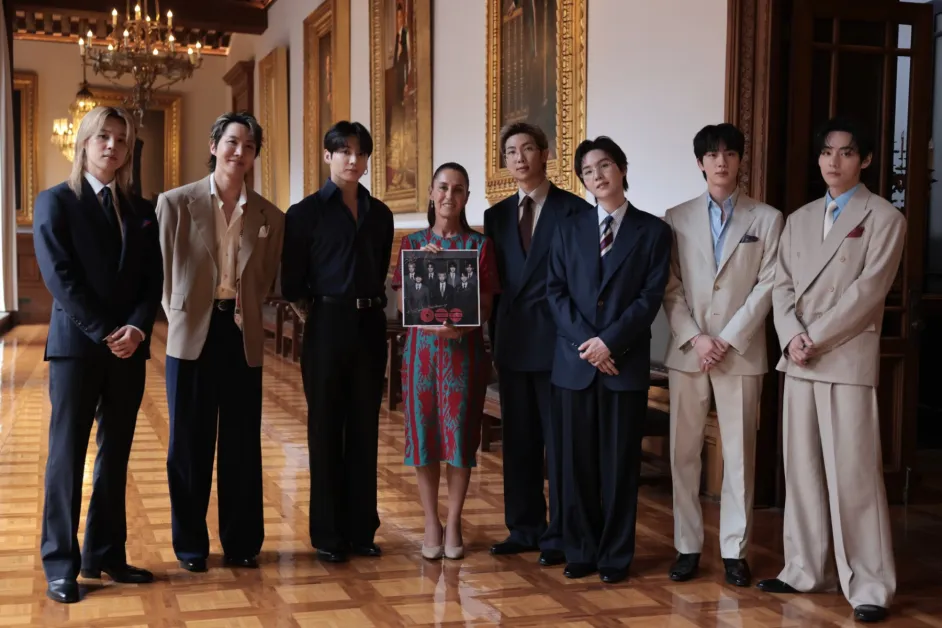
In a breathtaking display of global cultural power and the unifying force of music, the South Korean supergroup BTS was welcomed as royalty in Mexico City this week. On Wednesday, May 6, 2026, the seven members of the world’s biggest boy band visited the National Palace ahead of their highly anticipated, sold-out “ARIRANG” world tour concerts. What began as a formal diplomatic meeting with Mexican President Claudia Sheinbaum quickly transformed into a monumental public spectacle, as the artists and the President stepped out onto the iconic balcony of the National Palace to greet an estimated 50,000 ecstatic fans gathered in the historic Zócalo Square.
This unprecedented convergence of pop culture and international diplomacy not only highlighted BTS’s unwavering global dominance following their military service but also cemented Mexico’s status as a powerhouse in the global K-pop landscape. From the deafening cheers of the devoted “ARMY” to the heartfelt praises sung by a sitting head of state, the event was a masterclass in soft power and a testament to the band’s message of universal love and unity.
The Presidential Seal of Approval: Claudia Sheinbaum Welcomes BTS
The magnitude of BTS’s visit to Mexico was evident from the early hours of Wednesday morning. During her regular daily press briefing, Mexican President Claudia Sheinbaum officially confirmed the scheduled meeting, setting the stage for what would become one of the most talked-about events in recent Mexican entertainment history.
Sheinbaum, who has been a vocal supporter of the group’s positive global influence, spoke warmly of the artists. She described BTS as a musical force that “always carries messages of friendship, peace, and love.” For the President, welcoming BTS was more than just a nod to popular culture; it was an acknowledgment of the band’s role as global ambassadors for youth and their remarkable ability to transcend language and cultural barriers.
This welcoming stance was not a new development. Back in January 2026, when the dates for the Mexico City leg of the “ARIRANG” tour were first announced, Sheinbaum publicly lauded the scheduling as a “historic moment,” acutely aware of how eagerly the younger generations of Mexicans had been waiting for the band’s return.
Following the meeting inside the National Palace, President Sheinbaum took to social media to share her joy with the world. Posting a photograph of herself with the band members, she wrote, “With their beautiful and sincere demeanor, BTS welcomed approximately 50,000 ‘ARMYs’ who gathered at Zócalo Square to celebrate them. Music and values are uniting Mexico and South Korea. I am truly happy to have been able to create this joyful moment.”
The Balcony Moment: A Scene Out of a Movie
The true climax of the day occurred when the heavy doors to the National Palace balcony opened, and the members of BTS stepped out into the Mexican sunlight. Flanked by President Sheinbaum, members including RM, V, Suga, and Jimin looked out over a literal sea of humanity. The sheer scale of the gathering was breathtaking; Zócalo Square, one of the largest city squares in the world and the historic heart of Mexico City, was completely flooded with fans draped in the fandom’s signature color, purple.
The roar of 50,000 voices echoing off the colonial architecture of the square was deafening. Fans who had camped out for hours—some even overnight—wept openly as the band members smiled, waved, and bowed in appreciation. BTS leader RM was seen speaking to the crowd, prompting visible reactions of joy from President Sheinbaum, who stood nearby taking in the electric atmosphere.
Below, the crowd became a living mosaic of devotion. Fans held aloft thousands of handmade signs, with prominent messages translating to “BTS will always be in the heart of Mexico” and “Welcome to Mexico.” The emotional weight of the moment was palpable. For many fans, this was the culmination of years of waiting, particularly given the group’s recent hiatus to fulfill South Korea’s mandatory military service requirements. Seeing all seven members reunited and standing on the balcony of their nation’s most important governmental building was a validating, deeply moving experience.
The Pre-Concert Fan Frenzy: Painting the Capital Purple
While the balcony greeting was the undisputed highlight, the “BTS fever” had been gripping Mexico City for days leading up to the event. According to reports from the Associated Press and local news outlets, the city’s streets had been transformed into a massive, decentralized festival.
Earlier in the week, thousands of fans congregated along the famous Paseo de la Reforma for a massive promotional event. Traffic slowed as fans took over pedestrian walkways, dancing in synchronized perfection to BTS’s complex choreographies, trading photocards, and showing off temporary tattoos designed with the band’s logos. It was a vibrant, peaceful takeover of the city’s public spaces.
“We do these types of events to emotionally and psychologically prepare ourselves, and to prepare the energy and vibe of the place,” said Jude Pelaez, a devoted fan who attended the Paseo de la Reforma gathering. “That makes Mexico different.”
This distinct passion is exactly why Mexico is such a crucial stop for the group. According to BigHit Music, the agency behind BTS, Mexico officially ranks as the fifth-largest market for K-pop music globally. BTS, naturally, is the undisputed king of that market. The Latin American fanbase has always been known for its unparalleled volume and intense loyalty, but the current “ARIRANG” tour has pushed this devotion into overdrive.
The “ARIRANG” World Tour: A Triumphant Return
The context of this massive Mexican welcome cannot be fully understood without looking at the “ARIRANG” world tour itself. The tour marks BTS’s grand return to the global stage following their highly publicized military service, which concluded for all members by June of last year.
After reuniting, the group decamped to Los Angeles to prepare for their comeback album, also titled Arirang. Released in March 2026, the album is a deeply introspective project that explores themes of return, longing, and national identity, drawing its title from the most famous Korean folk song. The album immediately shattered streaming records, and the accompanying world tour was destined to be a blockbuster.
The Mexico City leg features three consecutive shows at the massive Estadio GNP Seguros, scheduled for Thursday, Saturday, and Sunday. Unsurprisingly, all three shows sold out mere minutes after tickets went live, leaving hundreds of thousands of fans in virtual queues.
The tour has already been making headlines globally, not just for the sheer spectacle of the production, but for the setlist. The group has been treating fans to surprise “gems” from their earlier eras alongside fresh choreography for their new tracks. Fans in Mexico are buzzing with speculation about which surprise songs they will witness, with many hoping to hear fan-favorite tracks like “Anpanman” or older, emotionally charged ballads. The 2.5-hour shows are a physical and emotional marathon, proving that the group has not lost a single step during their time away.
Cultural Diplomacy and the Power of K-Pop
The image of a foreign pop group standing on the balcony of the Mexican National Palace is striking, and it speaks volumes about the evolution of K-pop from a niche musical genre into a formidable tool of cultural diplomacy. South Korea has spent decades investing in its cultural exports, a strategy known as Hallyu, or the Korean Wave. BTS is the crown jewel of that strategy.
By officially receiving BTS, President Sheinbaum is acknowledging the geopolitical reality of modern soft power. The youth of Mexico are deeply influenced by South Korean culture—from music and television dramas to food and fashion. By embracing the figures that her country’s youth admire, the President is fostering goodwill not just with the younger demographic at home, but strengthening the diplomatic and cultural bridge between Mexico and South Korea.
This isn’t the first time BTS has engaged in high-level diplomacy. They have previously spoken at the United Nations General Assembly and visited the White House to discuss anti-Asian hate crimes with U.S. officials. However, the optics of the Mexico visit—the massive public crowd, the historic balcony, the sheer festivity of the occasion—felt less like a solemn political duty and more like a joyous celebration of international friendship.
Economic Impact and the “BTS Effect”
Beyond the cultural exchange, the arrival of BTS in Mexico City brings a massive economic windfall, a phenomenon commonly referred to as the “BTS Effect.” Whenever the group travels, they bring with them an army of tourists. Fans from across Latin America—including Brazil, Argentina, Colombia, and Chile—have descended upon the Mexican capital for the concerts.
Local businesses, hotels, and restaurants around Estadio GNP Seguros and the city center have reported record-breaking surges in revenue. Street vendors have pivoted to selling purple merchandise, unauthorized band t-shirts, and Korean snacks. The city’s public transportation networks have extended their hours to accommodate the concertgoers. The influx of capital generated by these three nights of concerts is a stark reminder of why governments are eager to court mega-artists of this caliber.
Looking Forward: Three Nights of Magic
As the sun sets on Zócalo Square and the crowds slowly disperse, all eyes now turn to the Estadio GNP Seguros. Over the next few days, nearly 200,000 lucky ticket holders will witness the culmination of this massive build-up. For the fans who didn’t manage to secure tickets, the memories of the National Palace balcony will have to suffice—but given the historic nature of the event, it is a memory they will cherish for a lifetime.
BTS’s visit to Mexico City in May 2026 will undoubtedly go down in the history books. It was the day a boy band from Seoul turned a political stronghold into a sanctuary of pop culture, the day a President played host to the kings of K-pop, and the day 50,000 voices sang out in unison, proving once again that music is, indeed, the most powerful universal language.