
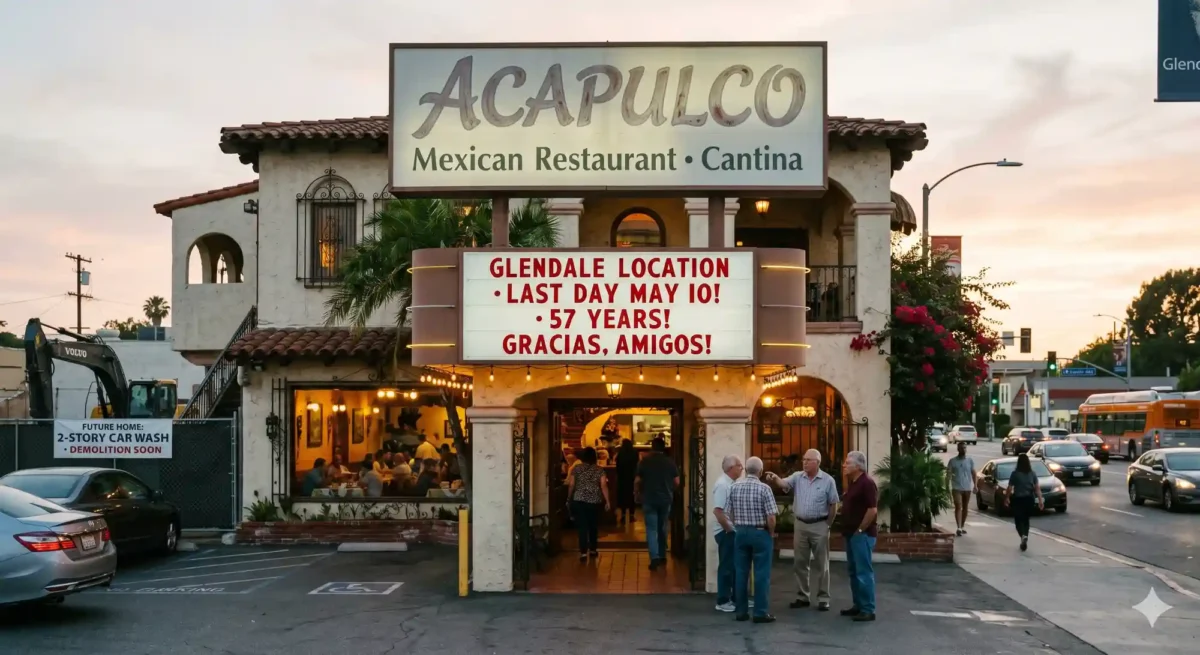
The casual dining landscape across California is experiencing a seismic shift, and the recent news regarding Acapulco restaurant closing locations is at the forefront of this transformation.
Once a thriving powerhouse in the Mexican dining sector with 39 bustling locations, the beloved Acapulco Restaurant and Cantina chain has seen its empire shrink dramatically.
Over the past few years, the brand has systematically shuttered its doors, succumbing to the harsh realities of the post-pandemic economy, soaring inflation, and shifts in consumer dining behavior.
Most recently, the spotlight fell on the impending Acapulco restaurant Glendale location closing, a move that sparked intense community outrage.
For 57 years, the Glendale site at 722 N. Pacific Avenue has been a neighborhood anchor, hosting countless family gatherings, birthdays, and celebrations.
When news broke that this historic site was slated for demolition to make way for a two-story self-service car wash, longtime patrons rallied in an unprecedented display of loyalty.
This article delves into the technical and economic realities driving the Acapulco Mexican restaurant closes 38 locations trend, contrasting the cold calculus of commercial real estate with the immense cultural value these heritage restaurants hold.
The Story Behind the Acapulco Restaurant Glendale Location Closing
The situation surrounding the Glendale Acapulco serves as a microcosm for the larger crisis facing legacy restaurants.
In late March 2026, the City of Glendale’s Director of Community Development conditionally signed off on an administrative design review.
This approval green-lit the demolition of the 57-year-old restaurant building to construct a 5,878-square-foot self-service car wash on the sprawling 46,432-square-foot lot.
The initial timeline indicated the restaurant would host its final meals around Mother’s Day, May 10, 2026.
Staff members prepared to say their goodbyes, and management posted emotional farewell messages on social media, cementing the reality of the Acapulco restaurant Glendale location closing.
However, the community refused to accept the loss of their beloved cantina.
A Car Wash Over a Community Landmark?
The decision to bulldoze a community staple for a car wash left many residents baffled, but from a real estate perspective, the move highlights a growing trend in urban redevelopment.
The proposed car wash project qualified for a Class 32 CEQA (California Environmental Quality Act) infill exemption.
This technical loophole allows developers to bypass lengthy environmental impact reports for projects on small, urban plots that meet specific zoning criteria.
By leveraging this exemption, property owners can quickly pivot from leasing to struggling restaurant tenants to operating high-margin, low-overhead automated businesses.
Plans for the Glendale lot included 29 surface parking spaces dedicated to self-service vacuuming and onsite queuing for up to 31 vehicles.
In an era of rising minimum wages and volatile food costs, a self-service car wash requires a fraction of the workforce needed to run a large, sit-down Mexican restaurant.
The Massive Wave of Acapulco Restaurant Closing Locations Across California
The near-loss of the Glendale site is just one chapter in a much larger, darker story about the brand’s survival.
When searching for answers about the Acapulco restaurant closing locations trend, one must look at the chain’s troubled financial history.
Tracing its origins back to a single Pasadena cantina in 1960, the brand grew rapidly, eventually becoming a staple of California’s casual dining scene.
At its absolute peak, there were 39 Acapulco locations operating simultaneously.
Today, reports confirm that an astonishing 38 locations have either closed or have been slated for closure over the last several years.
If the Glendale location had shuttered as planned, the brand would have been reduced to a single surviving location at 6270 Pacific Coast Highway in Long Beach, California.
The Private Equity Impact on Acapulco Mexican Restaurant Closes 38 Locations
The root causes of these widespread closures run deeper than just a bad year of sales.
The financial decay can be traced back to the Great Recession of 2008, which severely crippled the casual dining sector.
Acapulco’s former parent company, Real Mex Restaurants Inc., faced overwhelming debt and filed for Chapter 11 bankruptcy protection in 2011.
Despite restructuring efforts, the company returned to bankruptcy court in 2018.
Eventually, the assets were acquired by Z Capital Group, which subsequently rebranded the management entity as Xperience Restaurant Group (XRG).
Under private equity management, the strategy typically shifts toward aggressively pruning underperforming assets to maximize portfolio profitability.
This strict focus on the bottom line is the primary catalyst behind the sudden surge in Acapulco restaurant closing locations news.
Deeper Industry Analysis: Why Mexican Restaurant Chains Are Facing a Financial Crisis
The plight of Acapulco is not an isolated incident; it represents a systemic crisis plaguing mid-tier casual dining chains across the United States.
Inflation has completely reshaped the restaurant industry’s profit margins over the last half-decade.
Operators are being squeezed by a “perfect storm” of economic pressures.
Rising Costs and Changing Consumer Habits
First, the cost of raw ingredients—essential items like avocados, beef, and dairy—has skyrocketed due to persistent supply chain pressures and agricultural inflation.
Second, labor expenses have reached unprecedented highs in California, forcing restaurants to raise menu prices just to break even.
Third, commercial rent and utility costs continue to climb, placing an unsustainable burden on large-footprint dining establishments like Acapulco.
Compounding these operating challenges is a fundamental shift in consumer behavior.
Faced with their own inflationary pressures, many families are choosing to dine at home to save money.
When customers do decide to spend money on prepared meals, they are increasingly gravitating toward fast-casual concepts or utilizing third-party delivery apps.
Traditional sit-down restaurants that rely heavily on robust weekend dine-in traffic and high-margin alcohol sales are losing market share rapidly.
The Economics of Casual Dining vs. Automated Car Washes
To truly understand why the Acapulco restaurant Glendale location closing was initially approved, we must conduct a deeper technical analysis of land use economics in 2026.
A sprawling 46,000-square-foot lot in a prime Southern California market is incredibly valuable.
For decades, casual dining restaurants were the highest and best use for such parcels because they generated massive top-line revenue.
However, as restaurant profit margins have compressed from a historical 10-15% down to a razor-thin 3-5%, the real estate math has flipped.
Conversely, automated self-service car washes represent a highly lucrative, modern real estate play.
A modern car wash operates on a subscription-based revenue model, guaranteeing predictable, recurring monthly income regardless of daily weather or foot traffic.
Furthermore, a self-serve car wash requires almost zero inventory management, experiences no food spoilage, and can be operated by just one or two on-site attendants.
For land developers and property owners, replacing a 57-year-old, maintenance-heavy restaurant building with a streamlined, cash-flowing car wash is a financially superior decision.
This stark contrast between community sentiment and commercial real estate valuation is the driving force behind the repurposing of numerous former Acapulco sites.
What Happened on May 14? The Reversal of the Glendale Closure
Just as regulars were preparing for their final plates of enchiladas and farewell margaritas, the story took an unprecedented turn.
On Thursday, May 14, 2026, Xperience Restaurant Group released a stunning update via Acapulco’s official Instagram account.
The company announced that the Glendale Acapulco would remain open “until further notice,” directly attributing the reversal to the massive wave of public support.
“For over 57 years, Acapulco has been more than just a restaurant—it’s been family, traditions, and memories shared around the table,” the statement read.
Management explicitly noted that this was not a PR stunt or a temporary marketing tactic, but a heartfelt decision to fight for the location’s survival.
Social Media Outcry and Community Petitions
The abrupt reversal was the direct result of fierce local pushback.
Upon hearing about the planned demolition, Glendale residents quickly launched petitions on platforms like Change.org.
They argued that the site held immense social and cultural importance, serving as a rare, multi-generational gathering space in an increasingly digitized and transient world.
Commenters flooded message boards, criticizing the city’s conditional design review and pointing out that Glendale already had enough car washes.
Many residents pointed out that buildings nearing the 60-year mark should be evaluated for historic landmark status, rather than fast-tracked for CEQA infill exemptions.
The sheer volume of customer feedback, coupled with local media coverage, forced the corporate ownership to reconsider the immediate shutdown.
What This Means for the Surviving Long Beach Location
While the Glendale community celebrates a hard-fought victory, the broader narrative of the Acapulco restaurant closing locations trend remains grim.
Even with the Glendale site temporarily saved, the footprint of the brand is historically small.
The only other confirmed surviving location is situated on the Pacific Coast Highway in Long Beach.
For the brand to survive long-term, Xperience Restaurant Group will need to radically modernize its operational strategy.
Industry analysts suggest that surviving legacy brands must pivot by integrating advanced digital ordering systems, optimizing their floor plans to reduce wasted space, and aggressively marketing to younger demographics.
If the corporate parent cannot figure out a way to make the unit economics work in an inflationary environment, the stay of execution for the Glendale site may only be temporary.
Will There Be More Acapulco Mexican Restaurant Closures?
The reality is that there are very few Acapulco locations left to close.
Having downsized from 39 units to essentially two, the brand has already undergone its most brutal restructuring phase.
Moving forward, the fate of the remaining stores will depend entirely on their ability to generate sustained, profitable foot traffic.
If the current wave of emotional support translates into long-term, repeat business, the Glendale and Long Beach locations might survive the decade.
However, if customers return to their habit of eating at home once the nostalgia fades, the real estate developers waiting in the wings will likely file their building permits and finalize the transition to more profitable land uses.
The Acapulco saga is a stark reminder to diners everywhere: if you want your favorite local establishments to survive the modern economic gauntlet, you have to support them regularly, not just when they announce they are closing.
FAQ: Acapulco Restaurant Closing Locations in 2026
The widespread Acapulco restaurant closing locations trend is driven by a combination of high inflation, soaring labor and food costs, shifting consumer dining habits, and the brand’s historical debt burdens. Private equity restructuring has also led to the sell-off of underperforming real estate.
Originally, the Glendale location was scheduled to close in May 2026 to be demolished for a car wash. However, following massive community backlash and petitions, the company announced on May 14, 2026, that the location will remain open “until further notice.”
At its peak, the Acapulco Restaurant and Cantina chain operated 39 locations. Recent reports confirm that 38 of these locations have either closed or were slated to close, representing a massive contraction of the brand.
The City of Glendale conditionally approved plans to demolish the 57-year-old restaurant and construct a 5,878-square-foot, two-story self-service car wash, utilizing a Class 32 CEQA infill exemption to expedite the process.
Aside from the temporarily saved Glendale location, reports indicate that the final surviving branch operates in Long Beach, California, located at 6270 Pacific Coast Highway.
The Acapulco brand is currently operated by Xperience Restaurant Group (XRG), which took over after previous parent company Real Mex Restaurants Inc. went through multiple bankruptcy filings in 2011 and 2018.