
Olivia and Liam Top America’s Most Popular Baby Names for 2025: Full List & Trends
Every year, ahead of Mother’s Day, families and expectant parents eagerly await the latest demographic data from the Social Security Administration (SSA) regarding the most popular names given to newborns across the United States.
The 2025 list is officially out, and while rumors occasionally circulate about drastic shifts in modern naming conventions, the reality is that the highest echelons of baby names have remained remarkably stable.
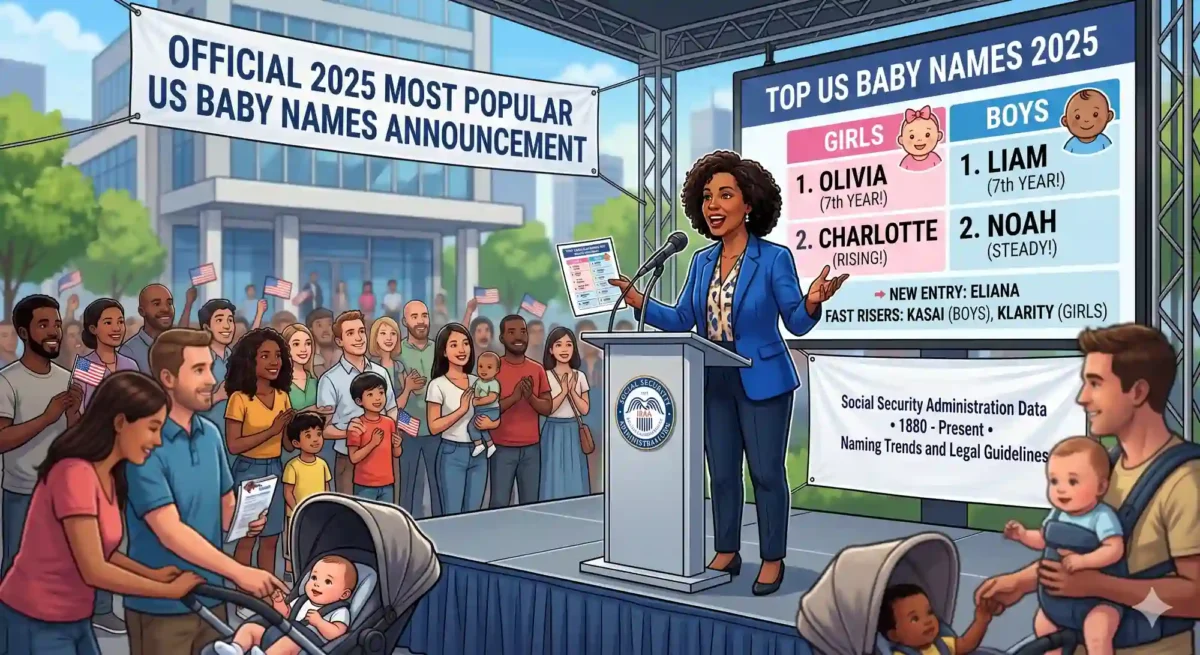
The newly released figures, based on Social Security card applications filed for the 3.6 million babies born in the U.S. in 2025—which represents a slight decrease from the 3.61 million births recorded the previous year—reveal that Olivia and Liam have retained their titles. For the seventh consecutive year, these two traditional yet modern-sounding names have reigned supreme, proving that classic monikers continue to hold a powerful grip on the American imagination.
The SSA has been tracking these naming trends since 1997, with historical records dating all the way back to 1880, providing a fascinating, data-driven window into generational shifts. To commemorate the release, Social Security Commissioner Frank J. Bisignano issued a heartfelt statement tying the data to the holiday weekend: “Happy Mother’s Day to all the exceptional mothers who inspire us and guide future generations.
As Mother’s Day draws closer, I find myself reflecting on the unwavering care, courage and commitment my own mother instilled in my siblings and me as the glue that held our family together.”
When looking specifically at the girls’ list, the top names reflect a subtle but significant changing of the guard. Olivia continues to sit comfortably at number one, a testament to its enduring, vowel-heavy appeal. However, directly beneath it, a major shift has occurred. Charlotte has surged into the number two position.
This upward movement effectively ends Emma’s impressive six-year run as the runner-up name in the nation. Emma now sits at number three, followed closely by Amelia at number four, and Sophia at number five. Mia takes the sixth spot, with Isabella, Evelyn, and Sofia claiming seventh, eighth, and ninth respectively. Perhaps the most notable development in the girls’ top ten is the departure of Ava. After being a dominant, highly favored choice for several years, Ava has finally slipped out of the top ten entirely. Stepping into the vacancy is Eliana, a name that has been steadily climbing the charts and has now successfully broken into the coveted tenth position. These shifts, while minimal, signal changing preferences among American parents who are still leaning heavily into classic, multi-syllabic, and lyrical names for their daughters.
While the girls’ side saw a notable top-tier shakeup, the boys’ top ten list demonstrated a much stronger sense of continuity and tradition. The top four boys’ names—Liam, Noah, Oliver, and Theodore—held their exact same positions from the previous year. This firmness suggests that when it comes to naming sons, American parents are currently favoring stability over novelty at the very top of the charts. Henry comes in at number five, followed by James at number six, and Elijah at number seven. The eighth spot is claimed by Mateo, a name that has seen a powerful rise over the last decade, reflecting the country’s diverse linguistic heritage and the rising influence of Hispanic culture on broader national trends. William and Lucas round out the list at nine and ten, respectively. The steadfast nature of this list reveals that the current generation of parents continues to be drawn to names that possess historical weight and widespread familiarity, pushing back against the rumor that only highly unusual, ultra-modern names are dominating the modern playground.
Moving beyond the top ten, a completely different and far more dynamic story is unfolding in the demographics data. American parents are increasingly gravitating toward distinctive names that carry special meanings or feature unique, individualized spellings. The fastest-rising boys’ name in the past year was Kasai. Meaning “fire” in both Japanese and Swahili, Kasai experienced one of the most dramatic leaps of the year, surging an astonishing 1,108 spots to break into the top 1,000 for the very first time. On the girls’ side, the most rapid riser was Klarity. A modern, creative misspelling of the traditional word “clarity,” this name skyrocketed 1,396 spots into the top 1,000. The rapid rise of Klarity highlights a broader societal trend toward names that symbolize light, strength, and positive virtues, while also enthusiastically embracing creative, non-traditional spellings.
Just as some names experience explosive demographic growth, others inevitably face steep declines. According to the SSA data, several names have suffered significant drops in popularity. Among boys, the names Karim, Khaza, Khai, and Landen have decreased the most in usage over the last year. For girls, monikers like Aubrie, Cattleya, Jaycee, and Zendaya saw the sharpest declines. Furthermore, naming experts at Babycenter have analyzed these overarching trends to predict which names currently in the top 1,000 might become entirely extinct in the near future. The findings indicate that names with highly unique spellings and those directly inspired by geographic locations are rapidly losing their luster. The experts predict that girls’ names such as Charleigh, Mckinley, Prisha, Ezra, Sasha, Mía, Kenna, Kori, Dior, Shaikha, Gabrielle, and Zaylee are at serious risk of extinction. Similarly, boys’ names like Kylian, Atharv, Enoch, Crue, Huxley, Salman, Camilo, Advik, Emmitt, and Garrett are also on the endangered list.
In the realm of news politics and responding to rumors, misinformation frequently circulates regarding what the government actually permits citizens to name their children. While the United States famously champions freedom of expression, it is a common misconception that parents can legally put absolutely anything on a birth certificate. The truth is much more complex, as guidelines vary significantly from state to state. For instance, California and New Jersey explicitly ban the use of obscene names. Conversely, states like Illinois and South Carolina allow parents to use numbers and symbols. New York enforces strict character limits, restricting first names to a maximum of 30 characters and surnames to 40 characters. In Mississippi, a child automatically takes the father’s surname unless an alternative is officially requested. In Louisiana, if a mother is not married, the baby is given her surname unless she weds within 300 days of the birth. Despite these varied state regulations, there are universally recognized limits. According to USBirthCertificates.com, there are 11 specific names that are outright illegal to use anywhere in the United States. These banned names include specific symbols and titles of royalty or religious significance: King, Queen, Jesus Christ, III, Santa Claus, Majesty, Adolf Hitler, Nutella, Messiah, @, and 1069. So, while creativity is largely encouraged across the nation, the rumor that “anything goes” is officially false.
As we look beyond the 2025 statistics, naming experts are already identifying the trends that will undoubtedly define the rest of the decade. Colleen Slagen, a professional baby namer since 2022 who frequently shares her insights on platforms like TikTok and in her book “Naming Bebe,” has highlighted exactly what to expect in 2026. Slagen predicts a massive cultural shift toward “short, four-letter names.” These brief monikers are heavily favored because they feel effortlessly cool and are inherently “nickname-proof.” For girls, names like Indi, Gwen, Lana, and Alba are expected to surge to the top of hospital registries. For boys, Luca, Rome, Elio, Dean, and Bode are the ones to watch carefully. Slagen notes that many families accidentally start this four-letter trend with their firstborn and subsequently stick with it for all their following children to maintain a cohesive sibling set. Another fascinating trend on the horizon for 2026 is the rise of what Slagen calls “Andi Anderson names.” Paying direct homage to early 2000s entertainment—specifically Kate Hudson’s iconic, beloved character in the film “How to Lose a Guy in 10 Days”—parents are increasingly assigning traditionally masculine names to their newborn daughters. This pop-culture-driven nostalgia heavily proves that media consumption continues to directly influence the demographic makeup of future generations.
Ultimately, the annual release of the Social Security Administration’s baby name data offers far more than a simple, alphabetical list of popular words; it serves as a detailed, analytical mirror reflecting the cultural, demographic, and societal shifts of the United States. From the enduring, seven-year dominance of Olivia and Liam to the rapid rise of culturally significant names like Kasai and modern virtues like Klarity, American naming habits reveal a delicate balancing act between upholding deep-rooted traditions and embracing new, personalized identities. Whether expectant parents are actively steering clear of soon-to-be extinct spellings, navigating the complex patchwork of state-by-state legal naming restrictions, or looking ahead to the brief, punchy four-letter trends confidently predicted for 2026, the process of naming a child remains one of the most profound and universally scrutinized decisions a family will make. As the 3.6 million babies born in 2025 grow up to navigate and shape the future of the nation, their carefully chosen names will stand as a permanent historical record of the era they were born into. The complete, fully searchable archive of these names remains accessible to the public on the Social Security website, ready to inform and inspire the next wave of parents awaiting their own new arrivals.