
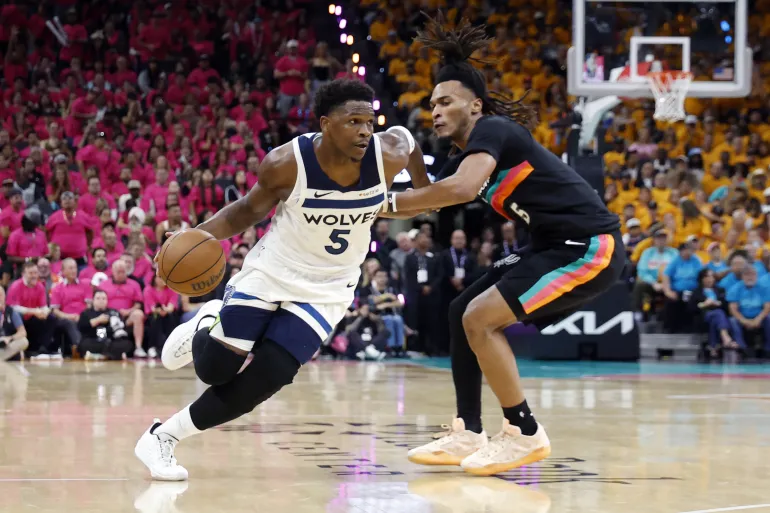
SAN ANTONIO, TX — The 2026 NBA Playoffs have officially shifted into high gear, delivering a level of drama, intensity, and historical anomalies that basketball fans will be dissecting for years. In what will instantly go down as a modern playoff classic, the Minnesota Timberwolves walked into the Frost Bank Center on Monday night and stunned the San Antonio Spurs, securing a 104-102 victory in Game 1 of the Western Conference Semifinals.
The narrow two-point road victory for the Timberwolves flips home-court advantage immediately and sets a staggering tone for a series featuring a clash of colossal rosters. However, as much as the Timberwolves will celebrate their gritty defensive win and the return of superstar Anthony Edwards, the overarching narrative of the evening belonged to San Antonio’s franchise cornerstone, Victor Wembanyama. The French phenom produced a staggering, logic-defying 12-block triple-double in a losing effort, reminding the basketball world of his unparalleled dominance around the rim even when his shot isn’t falling.
Meanwhile, over in the Eastern Conference, the New York Knicks sent an entirely different kind of message, annihilating the Philadelphia 76ers 137-98 at Madison Square Garden in their respective Game 1. But the pulse of the basketball world on Monday was firmly centered in Texas, where a nail-biting finish dictated the early momentum of the Western Conference Semifinals.
Wembanyama’s Defensive Masterclass and Offensive Struggles
When analyzing the San Antonio Spurs’ Game 1 loss, every conversation must begin and end with Victor Wembanyama. The 2026 season has seen Wembanyama ascend to unparalleled heights, and his box score from Monday night is a testament to an impact that borders on the surreal. Wembanyama logged 40 grueling minutes, racking up 11 points, 15 rebounds, and a jaw-dropping 12 blocked shots, adding 5 assists to cement one of the most unique playoff triple-doubles in NBA history.
To record 12 blocks in a high-stakes playoff environment is almost unheard of in the modern era, invoking the ghosts of defensive legends like Hakeem Olajuwon and Mark Eaton. Wembanyama operated as a one-man absolute deterrent in the paint. The Timberwolves’ slashers were constantly forced to alter their trajectories, pass out of high-percentage looks, or face the inevitable rejection at the summit. His 13 defensive rebounds ensured that Minnesota’s frontcourt of Rudy Gobert and Julius Randle had to fight tooth and nail for every second-chance opportunity.
However, despite his monumental defensive heroics, Wembanyama’s offensive rhythm was glaringly out of sync. The Timberwolves deployed a physical, layered defensive scheme that clearly frustrated the young big man. He finished the game shooting just 5-of-17 from the field, a lowly 29.4% shooting performance. His perimeter stroke abandoned him entirely, as he clanked 8 three-point attempts, connecting on absolutely zero.
Furthermore, Wembanyama was limited to just two free-throw attempts, making one. In a game decided by a single possession, the inability of the Spurs’ primary weapon to generate easy points at the charity stripe or stretch the floor effectively with his three-point shot became a critical liability. He also turned the ball over three times. The juxtaposition of a historic 12-block defensive game paired with a highly inefficient 11-point offensive outing perfectly encapsulates the bizarre and dramatic nature of Game 1. Despite the inefficiency, the Spurs still managed to outscore the Timberwolves by 5 points during Wembanyama’s 40 minutes on the floor, indicating just how vital his gravity and rim protection are to San Antonio’s success.
The Timberwolves’ Balanced Attack and Veteran Composure
With Wembanyama turning the paint into a no-fly zone, the Minnesota Timberwolves needed a collective, varied offensive approach to survive Game 1—and their veteran-laden roster delivered precisely that.
Anthony Edwards returned from injury to provide a massive psychological and offensive boost to the visiting team. Logging 25 minutes of action, Edwards paced himself but was highly effective when he chose his spots, scoring 18 points on an efficient 8-of-13 shooting from the floor. He managed to knock down 2 of his 3 attempts from beyond the arc and chipped in with 3 rebounds and 3 assists. While Edwards wasn’t asked to carry the entire offensive load in his return game, his presence alone forced the Spurs’ perimeter defenders to stay honest, creating driving lanes and spacing for his teammates.
The heavy lifting on the interior fell to the newly-acquired Julius Randle, who stepped up as Minnesota’s leading scorer. Randle bullied his way to a hard-fought double-double, registering 21 points and 10 rebounds (including an immense 5 offensive boards) in 41 minutes of action. Randle’s physical brand of basketball was essential in neutralizing some of San Antonio’s length. Though he required 20 field goal attempts to reach his 21 points—hitting 8 shots and converting 2 of 6 from three-point range—his sheer persistence and willingness to absorb contact (earning 6 free-throw attempts) kept the Spurs’ defense occupied. Randle also dished out 2 assists but struggled with ball security, committing 5 turnovers.
The Timberwolves’ depth proved to be the ultimate difference-maker. Naz Reid was utterly spectacular off the bench, proving once again why he is one of the premier reserve bigs in the NBA. Reid poured in 12 points and grabbed 9 rebounds in 30 minutes. More impressively, Reid posted a staggering team-high +15 plus-minus, hitting crucial shots (5-of-8 from the field, 2-of-3 from deep) while matching up physically with the Spurs’ imposing frontcourt.
Veteran floor general Mike Conley was the steady hand guiding the ship. In 24 minutes, Conley scored 12 points—entirely courtesy of a scorching 4-of-7 performance from beyond the three-point line—and dished out a team-high 6 assists without committing a single turnover. In a tense road playoff environment, having a point guard who can manage the game flawlessly while punishing drop coverages from deep was a luxury that propelled Minnesota to victory.
Jaden McDaniels added 16 points and 5 rebounds, playing 36 minutes of suffocating perimeter defense. McDaniels’ length was pivotal in disrupting San Antonio’s wing rotation. Off the bench, Terrence Shannon Jr. played a massive 35 minutes, aggressively attacking the basket to draw fouls. Shannon Jr. scored 16 points, bolstered by a 6-of-8 showing at the free-throw line, compensating for an otherwise rugged 5-of-13 shooting night. Rudy Gobert focused primarily on defense and rebounding against his fellow Frenchman Wembanyama, finishing with 7 points, 10 rebounds, and a crucial blocked shot in 30 minutes, securing a positive +2 plus-minus.
San Antonio’s Supporting Cast Falters Down the Stretch
The Spurs have built a formidable roster around Wembanyama, blending high-upside youth with seasoned veteran acquisitions. But in Game 1, the synergy of their guard play left much to be desired.
The most glaring disappointment for San Antonio was the performance of star point guard De’Aaron Fox. Acquired to be the dynamic engine that pushes the pace and breaks down defenses, Fox struggled immensely against the length and pressure of McDaniels and Edwards. Fox finished with just 10 points on 5-of-14 shooting, completely missing all four of his three-point attempts. Even more devastating to the Spurs’ offensive flow were Fox’s 6 turnovers. For a player known for his clutch play and decision-making, compiling more turnovers (6) than assists (6) while registering a game-worst -13 plus-minus in 33 minutes was a fatal flaw in San Antonio’s game plan.
Rookie sensations and young wings tried to pick up the slack. Dylan Harper had a brilliant playoff debut, scoring 18 points on 7-of-13 shooting off the bench, adding 4 rebounds and 4 assists. Stephon Castle, another highly touted prospect, was equally impressive, providing 17 points, 5 rebounds, and 5 assists. Castle attacked the rim relentlessly, earning 8 trips to the free-throw line (making 6) and shooting 3-of-5 from deep.
Julian Champagnie surprisingly led the starting lineup in scoring alongside Wembanyama and Fox, dropping 17 points largely via his three-point shooting (3-of-7 from deep) in 32 minutes. Devin Vassell contributed 14 points, 5 rebounds, and 3 steals, though he required 11 shots to get there. Keldon Johnson added 11 points off the bench but matched Fox with a dismal -13 plus-minus during his 24 minutes on the floor.
Ultimately, the Spurs couldn’t overcome their collective inefficiency. Aside from flashes of brilliance from Harper and Castle, San Antonio’s inability to establish a reliable secondary scoring option while Wembanyama misfired from the perimeter allowed Minnesota to hang around and execute down the stretch.
An Eastern Conference Bloodbath: Knicks Annihilate 76ers
While the Western Conference treated fans to a grinding, possession-by-possession chess match that ended 104-102, the Eastern Conference Semifinals opened with an absolute massacre.
The New York Knicks sent shockwaves through the league on Monday night by destroying the Philadelphia 76ers 137-98 at Madison Square Garden. A 39-point margin of victory in a conference semifinal game is a rare and terrifying display of dominance. The Knicks’ offense operated with a terrifying fluidity, clearly overwhelming a 76ers defensive unit that looked entirely unprepared for the sheer volume and pace of New York’s attack.
Scoring 137 points in a playoff regulation game indicates a historic shooting night, flawless ball movement, and an aggressive transition game that capitalized on every Philadelphia mistake. The Knicks’ home crowd transformed MSG into a fortress, completely deflating the 76ers early and never allowing them a momentary glimmer of hope. For Philadelphia, going back to the drawing board is an understatement; they will need a fundamental overhaul of their defensive principles before Game 2 if they hope to salvage the series.
Looking Ahead to Game 2
The pressure now shifts squarely onto the shoulders of the San Antonio Spurs. Trailing 0-1 and having surrendered home-court advantage, Game 2 at the Frost Bank Center on Wednesday, May 6, becomes essentially a must-win scenario for Wembanyama and company.
Oddsmakers currently list the Spurs with a 76.7% probability of bouncing back to win Game 2, reflecting the belief that Wembanyama will correct his shooting woes and De’Aaron Fox will deliver a much cleaner, more aggressive performance. However, the Timberwolves have proven they have the personnel to execute against San Antonio. With Anthony Edwards now firmly back in the rotation and shaking off the rust, Minnesota’s confidence will be soaring.
For the Spurs, the adjustments are clear: they must find ways to get Wembanyama high-percentage looks closer to the basket rather than settling for contested perimeter jumpers. Defensively, they must find an answer for the bulldozing presence of Julius Randle and the crucial bench minutes provided by Naz Reid.
If Game 1 is any indication, the 2026 Western Conference Semifinals will be a grueling, unpredictable war of attrition. Basketball fans are in for a treat as two incredibly talented, vastly different rosters clash for a chance to advance to the Conference Finals. Can Wembanyama pair his historic rim protection with offensive efficiency in Game 2? Can Edwards lead the Wolves to a commanding 2-0 lead before returning to the Target Center? The answers await on Wednesday night.
Also read:
Timberwolves Stun Spurs to Take 1-0 Lead: The Night Anthony Edwards Became Mike Conley’s Hero
Country Legend Dolly Parton Cancels Highly Anticipated Las Vegas Residency Amid Health Challenges