
fifa world cup 2026 matches
Seventy-two matches down. Twelve nations eliminated. Thirty-two left standing.
As the dust settles across 16 host cities spanning the United States, Mexico, and Canada, the group stage of the 2026 FIFA World Cup has officially drawn to a close. This tournament—the most sprawling and ambitious iteration in FIFA history—has redefined the calculus of international football. The newly minted 48-team format injected fresh unpredictability into the brackets, yielding a fascinating blend of historical milestones, lopsided scorelines, and jaw-dropping upsets.
With the Round of 32 kicking off today, June 28, the data reveals a tournament sharply divided between ruthless footballing superpowers and scrappy, history-making debutants.
The Core Insights: Who Survived the Group Stage?
To understand the landscape of the knockout rounds, one must look at how the confederations performed under the pressure of the expanded field. The opening stage was brutal for some and a coronation for others.
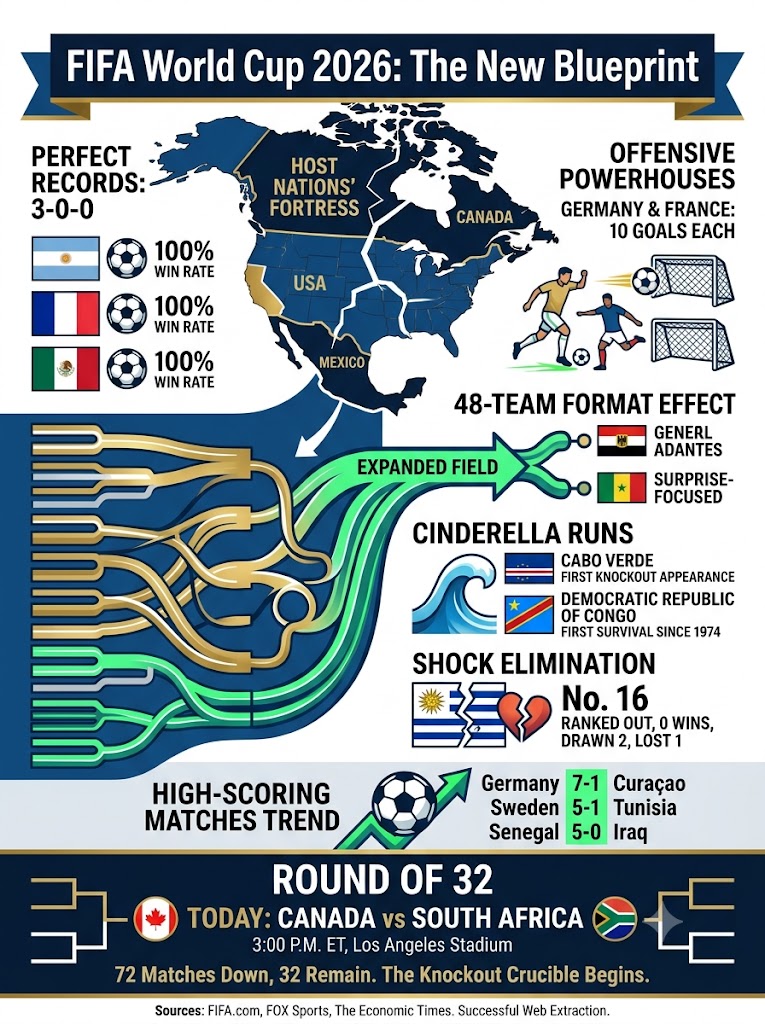
- The Undefeated Elite: Only three sides navigated their groups with a perfect 3-0-0 record: Argentina, France, and co-host Mexico. Looking strictly at attacking metrics, France and Germany led all teams in sheer offensive firepower, netting 10 goals each in just three fixtures.
- The Continental Divide: Europe maintained its structural dominance on the global stage, sending 13 squads into the Round of 32. They are joined by five nations from South America and two from Asia.
- The Host Nation Fortress: The North American co-hosts successfully defended their home turf. The United States, Mexico, and Canada are the only three representatives from the CONCACAF region advancing to the knockout stage.
Also read:
- Are Scotland Out of the World Cup? The 0.5% Miracle Keeping the Tartan Army Alive
- The Final Dust Settles: A Deep-Data Retrospective on the 2026 FIFA World Cup Qualifiers Table
- How Many World Cup Goals Does Kylian Mbappé Have? (2026 Update)
- Why Is Everyone Wearing Pink Cleats at the 2026 World Cup? The Science and Strategy Behind the Turf
Historic Cinderella Runs and A Monumental Collapse
While the heavyweights largely coasted, the group stage was ultimately defined by the teams that defied their historical pedigrees.
World Cup debutant Cabo Verde executed a stunningly resilient campaign. By drawing all three of their Group H matches, the island nation booked an improbable ticket to the Round of 32, setting up a monumental showdown against Lionel Messi’s Argentina. Similarly, the Democratic Republic of the Congo pushed through to the knockouts after a gritty run in Group K, marking their first group-stage survival since competing as Zaire back in 1974.
Conversely, the expanded margin for error wasn’t enough to save Uruguay. Entering the tournament ranked No. 16 in the world, the South American giants suffered the most shocking elimination of the event so far. Failing to secure a single victory in Group H—drawing twice and losing 1-0 to Spain—Uruguay finds itself heading home prematurely.
Why are there so many high-scoring blowouts in the 2026 World Cup?
A glaring statistical trend of the 2026 group stage has been the sheer volume of goals and wide margins of victory. Matches like Germany’s 7-1 demolition of Curaçao, Sweden’s 5-1 rout of Tunisia, and Senegal’s 5-0 victory over Iraq highlight a distinct shift in parity.
The primary catalyst for these blowouts is the 48-team format. Expanding the field inherently introduces federations with fewer resources and lower historical coefficients into the highest-pressure environment in sports. Broadcasters and analysts, including FOX Sports’ Tony Meola and Jimmy Conrad, have openly compared the inflated goals-per-game average of this tournament to historical data dating back to 1966. While the expanded format allows for vital Cinderella stories like Cabo Verde, it concurrently manufactures sheer mismatches when emerging squads face clinical, top-tier European or South American systems.
The Round of 32 Blueprint
The margin for error has now evaporated entirely. All remaining fixtures are sudden death.
The knockout crucible begins today, Sunday, June 28, at the Los Angeles Stadium. Canada will square off against South Africa at 3:00 p.m. ET (broadcast live on FOX). Canada enters the match after a steady second-place finish in Group B, while South Africa narrowly escaped Group A with four points.
From this afternoon until the Final on July 19, the 2026 FIFA World Cup will test whether the traditional powers can maintain their iron grip on the trophy, or if this expanded era will crown an entirely new king.