
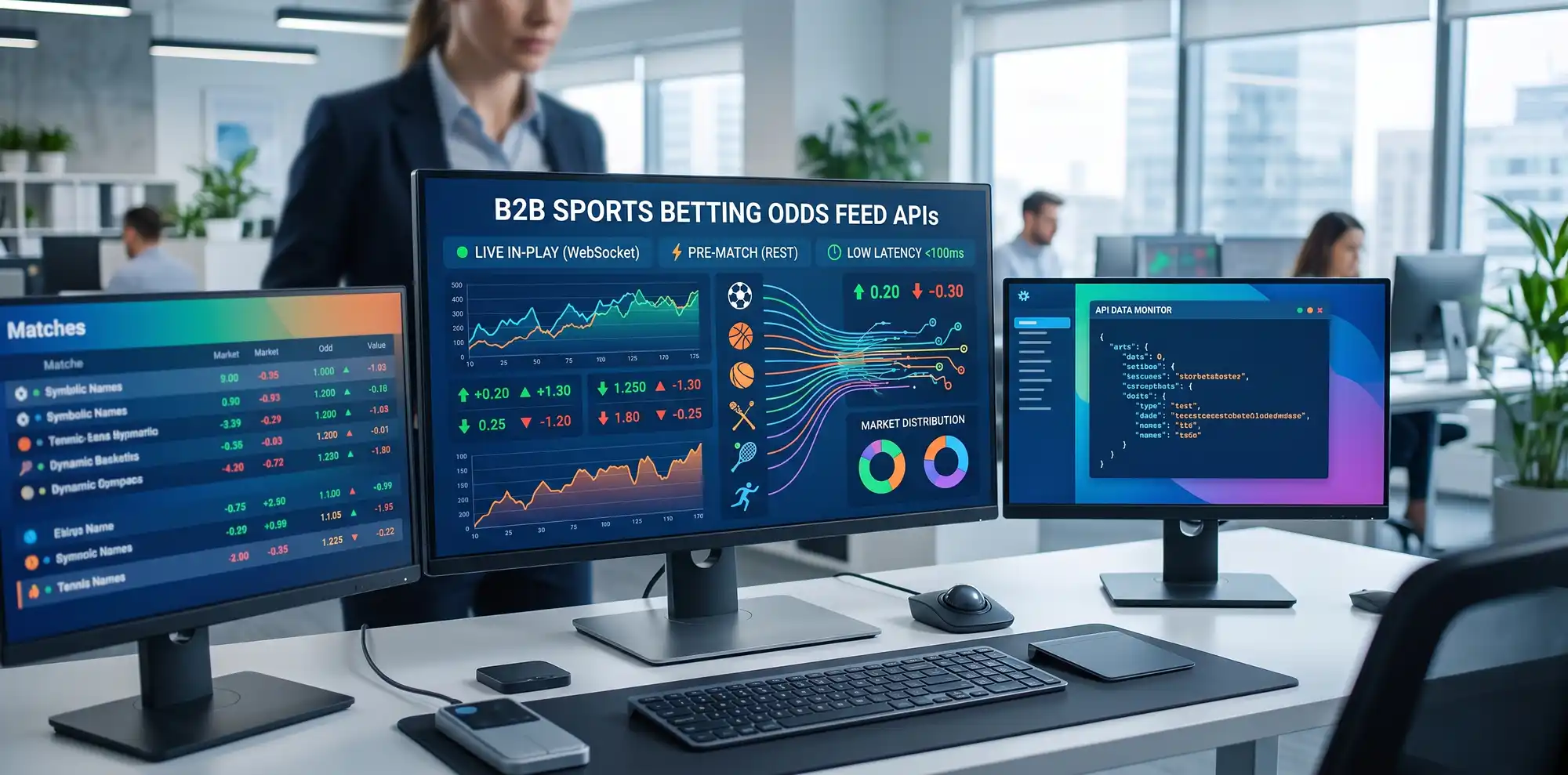
When building a sportsbook, an arbitrage scanner, or a sports media platform, your product is only as good as your data. In the B2B sports betting space, speed and reliability dictate profitability. We analyzed the market to rank the top 10 odds feed APIs and data providers for 2026, evaluating them on latency, market coverage, integration ease, and verified user feedback. Whether you are a solo developer needing a REST API or an enterprise operator requiring official league data via WebSocket, these are the providers driving the industry.
The Comparison Matrix
| Rank | Name | Best For | Average Rating |
| 1 | Sportradar | Global sportsbook operators | 4.8/5 |
| 2 | Genius Sports | Official in-play data | 4.7/5 |
| 3 | SharpAPI | Real-time +EV detection | 9.5/10 |
| 4 | The Odds API | Simple REST integration | 7.0/10 |
| 5 | OpticOdds | Regulated media & platforms | 8.5/10 |
| 6 | OddsPapi | Global coverage & Asian sharps | 6.5/10 |
| 7 | SportsGameOdds | Broad US sportsbook coverage | 6.5/10 |
| 8 | OddsBlaze | Fast raw odds polling | 7.0/10 |
| 9 | Unabated | Professional syndicates | 7.5/10 |
| 10 | LSports | Pre-match European odds | 3.5/5 |
1. Sportradar
The Pitch: Sportradar is the incumbent enterprise data provider for the global sports industry.With official data-rights partnerships across the NBA, NHL, MLB, and European soccer federations, it heavily dominates B2B sportsbook integrations.
Pricing: Pricing is not publicly listed and requires direct enterprise negotiation.
What Users Are Saying:
“Sportradar is the gold standard for official data, but the integration process and contractual obligations are heavily geared toward tier-1 operators, leaving smaller startups priced out.” — Industry Consensus
Pros & Cons:
- Pros: Unmatched official data rights; unparalleled reliability and broadcast integration.
- Cons: Enterprise-level pricing; highly complex procurement cycles.
2. Genius Sports
The Pitch: Genius Sports specializes in delivering ultra-fast, official in-play data directly from the stadium.They hold exclusive rights to distribute data for massive leagues like the NFL and the English Premier League.
Pricing: Pricing is sales-gated for B2B operators.
What Users Are Saying:
“Incredible in-play uptime and latency. Having the official NFL feed is a game-changer for live betting, though you pay a massive premium for the exclusivity.” — Operator Sentiment
Pros & Cons:
- Pros:Achieved 99%+ in-play market uptime during the Premier League season;predictive Monte Carlo models for real-time pricing.
- Cons: Very high barrier to entry for new platforms.
3. SharpAPI
The Pitch: SharpAPI is a highly-rated developer favorite that delivers real-time SSE streaming with sub-89ms latency.It stands out by offering built-in +EV (Expected Value) detection against Pinnacle sharp lines out of the box.
Pricing: Free tier available (12 req/min); Hobby plan starts at $79/mo.
What Users Are Saying:
“The built-in EV detection saves us a massive amount of computational overhead. The TypeScript SDK is clean, and the sub-100ms latency is exactly as advertised.” — Verified Developer Feedback
Pros & Cons:
- Pros:Ultra-low latency via SSE push;robust market coverage including player props.
- Cons: Requires stepping up to higher tiers for heavy enterprise volume.
4. The Odds API
The Pitch: The Odds API is the original, developer-friendly aggregator that powers countless hobbyist projects and startups. It provides a highly accessible REST polling interface to pull odds from over 40 bookmakers.
Pricing: Starts at $30/mo, with a transparent free tier offering 500 credits/mo.
What Users Are Saying:
“The easiest API to learn JSON data shaping on. It’s the go-to for simple use cases, but the polling latency means it’s not suited for high-frequency in-play trading.” — Developer consensus
Pros & Cons:
- Pros: Excellent documentation; highly transparent pricing.
- Cons:Polling only (no WebSocket support);~200ms to 500ms latency makes it too slow for live arbitrage.
5. OpticOdds
The Pitch: OpticOdds is an operator-grade B2B feed engineered squarely for sportsbook operators and regulated media companies.It provides sub-800ms streaming latency across approximately 200 operators.
Pricing: Pricing is sales-gated and aimed at enterprise procurement.
What Users Are Saying:
“A highly reliable alternative to the massive incumbents. The integrated grader and contractual SLAs make it a very safe bet for regulated media companies building out betting hubs.” — Enterprise User Sentiment
Pros & Cons:
- Pros: Contractual SLAs guarantee uptime; massive catalog of ~200 operators including major sharp books.
- Cons: No self-serve API key access for developers.
6. OddsPapi
The Pitch: OddsPapi focuses on covering the “sharps” (Pinnacle, Singbet, SBOBet) alongside a massive catalog of crypto books and betting exchanges. It is built for developers targeting international and unregulated markets.
Pricing: Starts at $49/mo, featuring a free tier of 250 requests/mo.
What Users Are Saying:
“I really liked how easy it was to get the data I needed… I would say ingesting all of the data was a bit of a process because they provide so much data in their response.” — Verified G2 User
Pros & Cons:
- Pros:Deep coverage of crypto books (Stake, 1xBet) and Asian exchanges.
- Cons:Data payloads are massive and require robust ingestion;higher entry-tier latency (~1-2 seconds).
7. SportsGameOdds
The Pitch: Launched publicly in 2024, SportsGameOdds is a modern challenger with clean SDKs aimed at US-focused platforms. It delivers odds via WebSocket push for fast updates across state-licensed sportsbooks.
Pricing: Starts at $99/mo (Rookie tier).
What Users Are Saying:
“The TypeScript and Python SDKs are incredibly modern. It’s highly effective if you only care about US soft books, but the free tier’s 10-minute delay forces you to upgrade immediately.” — Developer Consensus
Pros & Cons:
- Pros:<100ms P50 latency via WebSocket; excellent modern documentation.
- Cons:Free tier has a highly restrictive 10-minute delay;lacks coverage for Asian sharp books.
8. OddsBlaze
The Pitch: OddsBlaze is a straightforward provider focused on delivering raw odds data. It provides extensive market coverage, capturing roughly 480 markets per NFL game.
Pricing: Entry plan starts at $29/mo; real-time polling requires the $249/mo plan.
What Users Are Saying:
“Great market depth for player props, but you get what you pay for on the entry tier. The $29/mo plan has a 2+ minute delay, so you really have to jump to the $249 tier for real-time applications.” — Aggregated User Feedback
Pros & Cons:
- Pros: Excellent market depth for major US sports.
- Cons:Entry-level latency is heavily delayed (>2 minutes);real-time data is significantly more expensive.
9. Unabated
The Pitch: Unabated operates at the highest end of the consumer and pro-syndicate market, offering an enterprise-grade WebSocket feed. It is strictly designed for professional bettors who require instantaneous data.
Pricing: Starts at $3,000/mo.
What Users Are Saying:
“Unabated is strictly for the professionals. The data is flawless and instantaneous, but the cost makes it entirely inaccessible to standard developers or small affiliate sites.” — Industry Consensus
Pros & Cons:
- Pros:Elite-tier data speed and websocket reliability.
- Cons:Prohibitively expensive starting price.
10. LSports
The Pitch: LSports is a veteran global B2B sports data provider offering comprehensive pre-match and in-play feeds. They are heavily utilized by European sportsbooks for trading management.
Pricing: Pricing is sales-gated with tailored enterprise contracts.
What Users Are Saying:
“Extensive global coverage for obscure leagues, but integration can be complex and some users report slow response times from technical support.” — Trustpilot Consensus
Pros & Cons:
- Pros: Massive fixture coverage; strong European sportsbook integration.
- Cons:Below-average Trustpilot sentiment (3.5/5).
Final Verdict
- Best for Global Enterprise:Sportradar or Genius Sports. If you have the budget, their official league data rights and broadcast tools are non-negotiable.
- Best for Developers & Arbitrage:SharpAPI. The sub-89ms latency and built-in +EV endpoints make it the strongest modern choice.
- Best on a Budget:The Odds API. The $30/mo tier is the perfect low-cost starting point to learn the ropes of sports betting data architecture.
What Are B2B Sports Betting Odds Feed APIs? A Complete Technical Guide
Discover how B2B sports betting odds APIs work, the difference between REST and WebSocket data feeds, and how providers deliver real-time data to sportsbooks.
What is a Sports Betting Odds API?
At the center of the modern sports wagering ecosystem, odds APIs serve as the critical technical bridge connecting data suppliers with sportsbooks and end users. Rather than relying on manual updates, an odds API is a software service that continuously feeds probability data directly into a betting platform. This automation ensures that sportsbooks can display highly accurate, real-time prices across mobile apps, websites, and retail betting terminals simultaneously without performance bottlenecks.
How the Data Pipeline Functions
To supply reliable data to developers and platforms, premium odds providers execute three primary operational phases:
- Data Collection: Providers continuously stream or poll real-time feeds from dozens of global sportsbooks. Handling disparate rate limits and authentication protocols, platforms like SharpAPI process over 47 million odds updates daily.
- Normalization: Raw probability data is fragmented. The API converts incoming data into a standardized schema, unifying varying team names, market types, and odds formats (such as converting American to decimal).
- Serving: The standardized data is delivered to the client application as structured JSON, maintaining consistent field names so developers can parse the data effortlessly.
Types of Markets and Data Covered
Modern data providers supply expansive coverage that adapts to regional betting preferences, tracking multiple categories:
- Prematch & Outrights: Lines established before an event starts, alongside long-term futures such as season champions.
- In-Play (Live Betting): Dynamic odds that shift continuously in response to game momentum, time remaining, or specific actions like a goal or foul.
- Player Props: Individual performance wagers (e.g., a basketball player scoring over 25.5 points). These are noted as the fastest-growing markets and the ones containing the most inefficiencies for positive expected value (+EV) bettors.
- Derived Analytics: Server-side computed metrics including no-vig fair odds, arbitrage pairs, and historical line movement data.
Technical Delivery: REST vs. WebSockets
Odds APIs rely on two primary architectural methods to distribute data payloads, depending on the latency requirements of the sportsbook:
- REST APIs: Utilizing a request-response model, REST is highly effective for retrieving historical data or pulling prematch odds.
- WebSockets: For live betting—which currently drives the majority of sportsbook user activity—speed is paramount. WebSockets facilitate continuous, two-way communication, pushing real-time updates instantly to prevent markets from freezing or locking unexpectedly.
Betting Platform APIs vs. Developer Odds APIs
Not all betting APIs serve the same commercial purpose. The B2B market is strictly divided into two tiers:
- Developer Odds APIs: These are read-only services designed for arbitrage scanners, odds comparison sites, and hobbyists. Providers like SharpAPI or The Odds API deliver odds, spreads, and +EV signals but lack regulatory stacks, wallets, or bet settlement features.
- Betting Platform APIs: These represent full-stack, enterprise-grade software powering licensed sportsbooks. Supplied by heavyweights like Kambi or BetConstruct, these APIs handle the entire operation, including risk management, KYC protocols, and liability engines. They require gaming licenses and typically cost five to seven figures annually.
The Enterprise Advantage: Trading Models and Uptime
Top-tier odds suppliers generate distinct operational advantages for tier-1 operators. By utilizing data sourced directly from stadiums rather than television broadcasts—which can suffer delays of up to 10 seconds—sportsbooks achieve near-zero latency.
High-quality feeds rely on advanced trading models and algorithms to set accurate probabilities at scale. For instance, top providers utilize Monte Carlo simulations to model millions of play-by-play eventualities in seconds for hyper-accurate NFL live pricing. This technological depth reduces operational overhead by eliminating the need for massive internal trading teams while simultaneously neutralizing arbitrage threats from sharp bettors. The financial impact is measurable; for example, Brazilian operator Betsul secured 8% trading margins across football markets by integrating premium odds feeds.