This guide covers everything you need to know about esports: what it is, how it works, which games matter, where to watch, and why the rest of the world is starting to take it very seriously.
What Is Esports?
Esports — short for electronic sports — is organised, competitive video gaming. Just like traditional sports have leagues, teams, tournaments, and professional players, esports does too. The difference is the arena: instead of a football pitch or a basketball court, the competition happens inside a video game.
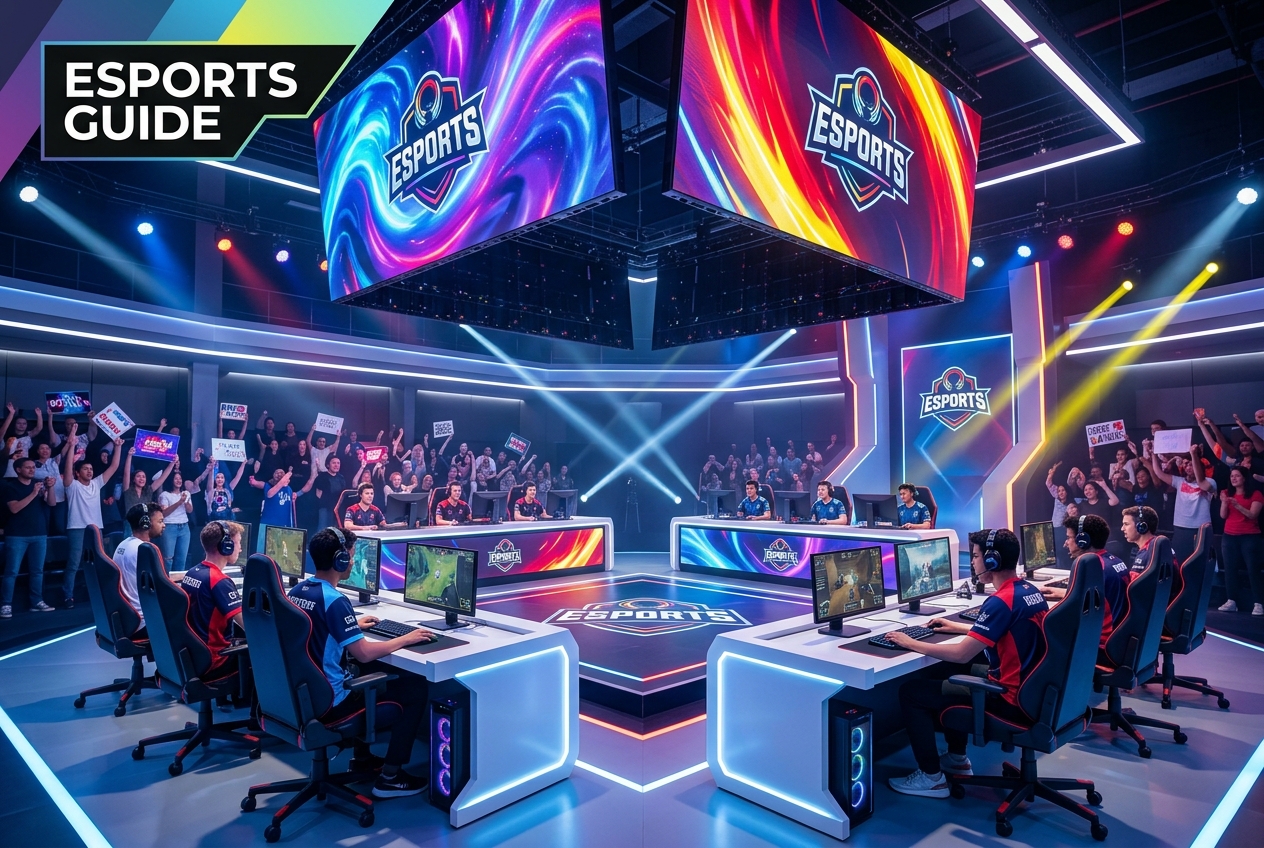
At its simplest: two players or two teams face each other in a game, and the better team wins. At its biggest: 70,000 fans pack a stadium, another 6 million watch online, and the winning team takes home more prize money than most Wimbledon champions.
Esports is not people playing games alone in their bedrooms. It’s a structured global industry worth over $3 billion in 2026, with professional contracts, coaches, analysts, sponsors, and fans on every continent.
How Big Is Esports, Really?
Numbers help put it in context:
- 640 million people worldwide watch esports in 2026 — roughly twice the population of the United States
- The Esports World Cup 2026 offered a $75 million prize pool across 24 games
- League of Legends’ 2026 World Championship peaked at 6.94 million simultaneous viewers — more than most NBA Finals games
- Professional esports players in North America earn an average of $210,000 per year
- Brands like Nike, BMW, and Red Bull collectively invested over $510 million in esports sponsorships in 2025 alone
Still think it’s just a hobby?
Which Games Are Played Professionally?
Not every game becomes an esport. The ones that do tend to share certain traits: they reward skill, they’re easy to watch, and they have a thriving competitive community. Here are the biggest titles in 2026:
League of Legends (LoL)
The undisputed king of esports viewership. Two teams of five champions battle to destroy the other team’s base. The professional scene runs regional leagues across every continent, culminating in the World Championship (Worlds) each October — the single biggest esports event of the year.
Valorant
Riot Games’ tactical shooter where two teams of five compete in round-based combat. It has grown explosively since its launch, with the Valorant Champions Tour and events like Masters Bangkok drawing record audiences of over 4 million viewers.
Counter-Strike 2 (CS2)
The successor to one of the longest-running esports in history. Two teams (Terrorists vs Counter-Terrorists) fight in tactical, round-based matches. CS2 has distributed over $8 million in prize money in 2026 alone, and PGL Major events regularly fill arenas.
Dota 2
Valve’s complex strategy game featuring two teams of five heroes. Known for The International, which pioneered the crowdfunded prize pool model — the all-time total has exceeded $369 million in prizes since the tournament began.
Fortnite
Epic Games’ battle royale colossus. Fortnite’s competitive scene blends pure skill tournaments with a creator-driven economy, and the career prize pool has already surpassed $145 million.
Other Major Titles
- Apex Legends — EA’s battle royale with a growing competitive scene
- Rocket League — football played with rocket-powered cars; uniquely accessible and wildly skillful
- Overwatch 2 — Blizzard’s team-based hero shooter with a long-running world championship
- EA Sports FC (FIFA) — the world’s most popular football game has its own official esports ecosystem
- Mobile Legends: Bang Bang — dominant in Southeast Asia; a medal event at the 2026 Asian Games
How Do Esports Tournaments Work?
Most esports tournaments follow one of four formats:
1. Single Elimination
Lose once and you’re out. Fast and dramatic, but a single bad game ends your run.
2. Double Elimination
You get a second chance after your first loss. The most common format at major events — it balances drama with fairness.
3. Round Robin
Everyone plays everyone. Results are aggregated over the group stage, and the top teams advance. Used in regular seasons and group stages.
4. Swiss System
Teams with similar records face each other each round. Efficient and fair — increasingly popular at large-scale events.
How a typical tournament plays out:
- A group stage (round robin or Swiss) narrows the field
- A bracket stage (double elimination) produces the finalists
- A grand final is played best-of-5, often on a live stage in front of thousands
Matches are “best-of” series: best of 1 (BO1), best of 3 (BO3), or best of 5 (BO5). The higher the stakes, the longer the series.
Who Are the Most Famous Esports Teams?
Think of these like the Real Madrids and New England Patriots of the esports world:
- T1 (South Korea) — the most decorated League of Legends organisation on the planet
- Team Liquid — one of the highest all-time earners across multiple games
- G2 Esports — Europe’s most popular multi-title organisation
- FaZe Clan — global brand recognition across CS2, Valorant, and beyond
- Gen.G Esports — Korean powerhouse in LoL and Valorant
- Team Falcons — emerged as a dominant force at the Esports World Cup 2026
- Natus Vincere (NaVi) — legendary CS organisation from Eastern Europe
Who Are the Players?
Esports players are athletes who train up to 10–14 hours per day, work with coaches, nutritionists, and sports psychologists, and compete under enormous pressure. A few names you’ll hear often:
- ZywOo — French CS2 player, widely considered the best in the world at his peak
- Caps — Danish League of Legends mid laner for G2 Esports
- s1mple — Ukrainian CS legend, one of the most decorated players in history
Top players typically sign contracts, receive salaries, move between teams during transfer windows, and retire by their late 20s — just like traditional athletes.
Where Can You Watch Esports?
You don’t need a cable subscription. Most esports is free to watch online:
- Twitch — the home of live esports streaming. Search any game name and you’ll find streams. Many official tournament channels offer in-stream rewards for watching.
- YouTube Gaming — great for VODs (recorded matches) and highlights if you missed a live event
- Riot Games platforms — League of Legends and Valorant have dedicated watch portals at lolesports.com and valorantesports.com
- Facebook Gaming / TikTok Live — growing platforms, especially for mobile esports
For schedules and results, sites like Liquipedia and HLTV (for CS2) are the industry standard.
Is Esports a Real Sport?
This debate comes up a lot — and the answer is increasingly obvious.
Here’s what’s happening right now:
- 2026 Asian Games (Aichi, Japan) includes 11 esports medal events, including League of Legends, Mobile Legends, and Honor of Kings. Nations are sending official esports teams representing their countries.
- College esports scholarships now exist at hundreds of universities across the US, UK, and Europe
- Esports athletes train with sports scientists, follow strict diets, and deal with repetitive strain injuries — just like traditional athletes
- The International Olympic Committee continues to explore esports’ place in future Games
Whether you call it a sport or not, the prize money, the stadiums, the sponsorships, and the 640 million fans suggest the argument is already settled for most people watching.
How Do Esports Players Make Money?
Several income streams stack up for a professional player:
| Source | Details |
|---|---|
| Salary | Paid by their team organisation. North American average: $210,000/year |
| Tournament winnings | Split among the team; top events pay millions |
| Streaming | Many pros stream on Twitch or YouTube for fan revenue |
| Sponsorships | Personal deals with gaming brands, energy drinks, peripherals |
| Content creation | YouTube videos, social media partnerships |
The business model behind the scenes is similar to traditional sports: team organisations earn revenue from franchise fees, media rights, merchandise, and sponsor deals.
How to Get Into Esports as a Fan
You don’t need to play at a competitive level to enjoy esports. Here’s how to start:
- Pick one game to follow — don’t try to follow everything at once. League of Legends and Valorant have the biggest global communities and the most beginner-friendly broadcast coverage.
- Watch a major event — the LoL World Championship (October) is the ideal entry point. The production quality rivals major televised sports.
- Find a team to support — loyalty makes it more fun. Browse team rosters and find one whose story you connect with.
- Join the community — Reddit, Discord servers, and X (Twitter) are where esports conversations happen in real time.
- Use Liquipedia — it’s the Wikipedia of esports. Every tournament, team, player, and result is documented there.
Quick-Reference Glossary
| Term | What It Means |
|---|---|
| GG | “Good game” — said at the end of a match as a sign of respect |
| Meta | The current strongest strategy or character selection in a game |
| Roster | The players who make up a team |
| LAN | A live, in-person event (vs. online competition) |
| BO3 / BO5 | Best of 3 / Best of 5 — the series format |
| Patch | A game update that can change the entire competitive landscape |
| Org | Short for organisation — the company that owns and manages a team |
| Draft | The phase before a match where teams pick their characters/champions |
| Clutch | A high-pressure play that turns a losing situation into a win |
Final Thoughts
Esports in 2026 is not a niche hobby — it’s a global industry with millions of fans, billion-dollar organisations, and professional athletes who dedicate their lives to competing at the highest level. Whether you’re a casual gamer curious about the competitive world, a parent trying to understand what your kid is watching, or someone who just wants to jump into a new form of entertainment, there has never been a better time to get involved.
Pick a game. Find a team. Watch a match. The rest takes care of itself.
Leave a Reply