
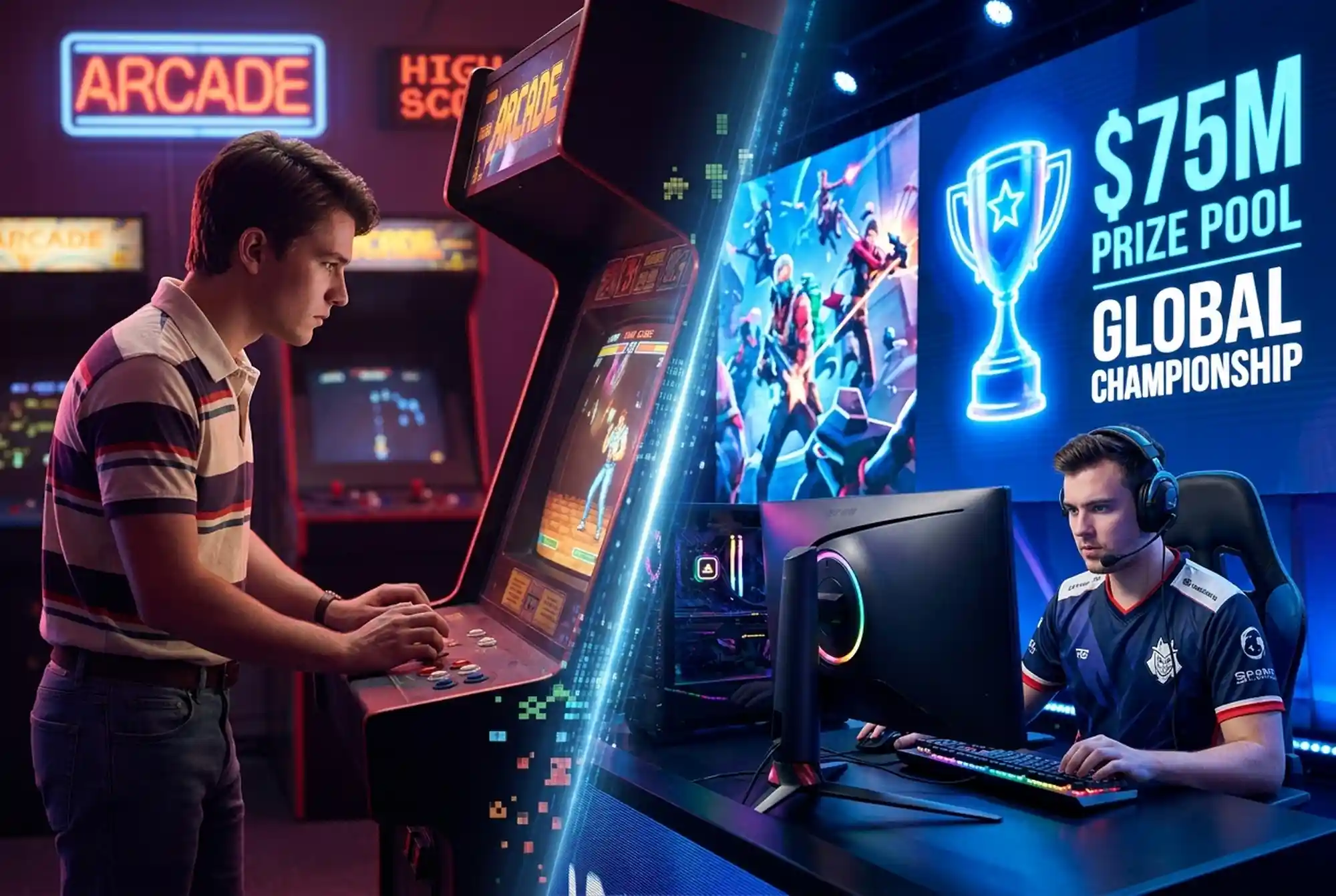
Somewhere in Saudi Arabia right now, thousands of spectators are roaring. Onstage, eight teams from around the world have assembled for one of the most lucrative tournaments in gaming history. The Esports World Cup 2026 carries a prize pool of $75 million across 24 different games. The screens tower overhead, the crowd is on its feet, and the scene looks like — well, like the biggest sporting event of the year.
How did we get here?
The answer isn’t from last month. It didn’t start with streaming. And it certainly didn’t begin with million-dollar contracts. The real story of esports stretches back over fifty years, to a time when video games barely existed, and reaches forward through decades of basement tournaments, dial-up internet, legendary players, and a moment when the entire world suddenly realized that watching people play video games was just as gripping as watching any other sport.
This is the untold history of esports — the journey from the world’s first recorded gaming competition to the mainstream phenomenon we know today.
The Beginning (1972–1980s): When Competition Meant Keeping Score
Before there was professional gaming, there was Spacewar!
In 1972, at Stanford University, someone organized what historians now recognize as the first recorded esports tournament. The game was Spacewar!, a primitive space-combat simulator that ran on a PDP-11 computer the size of a refrigerator. The tournament was small, local, and almost forgotten by history. Dozens of computer science students gathered to see who could rack up the highest score. No prize money. No broadcast. No one knew they were making history.
But the seed was planted.
For nearly a decade, that moment gathered dust in academic records. Gaming was not a thing — it was an curiosity, a hobby for engineers and hobbyists. Then, on November 11, 1980, everything changed.
That day, Atari’s Space Invaders Championship launched in New York City. The tournament wasn’t just a local event. It was a nationwide competition, and the response was staggering. More than 10,000 people showed up. Players from across America converged to compete in one of the first truly mainstream gaming competitions, and the winner — a teenager named Billy Mitchell — became the unlikely first celebrity of esports. He didn’t just win a trophy. He won fame, recognition, and the understanding that video games could be played competitively at a level that gripped the public imagination.
The arcade era had begun.
Through the 1980s, arcades became the battleground for gaming supremacy. High-score chasing became obsessive. Games like Donkey Kong, Pac-Man, and Street Fighter II created hierarchies of skill that were visible and dramatic. Players traveled from arcade to arcade, challenging local champions and building reputations. The culture was pure, untainted by any commercial structure — these were just players who loved to compete.
In 1981, Twin Galaxies was founded to do something revolutionary: officially record and verify gaming records. Twin Galaxies became the keeper of the arcade era’s history, documenting high scores and creating the first formal framework for competitive gaming. That legitimacy mattered. It meant that your achievement wasn’t just bragging rights at the local arcade — it was documented, it was real, it was permanent.
The 1980s were the golden age of arcade culture, but they were also isolating. Players could compete against machines, they could face off against one another in person, but there was no national circuit, no consistent ladder, no way to truly know who the best player in the world was. The internet didn’t exist yet. Television coverage was sparse. Esports existed in pockets and shadows, known only to those who lived inside the culture.
The 90s: The Internet Changes Everything (And Everything Changes)
The 1990s were the turning point. Two things happened that would forever transform gaming competition.
First, the internet arrived. Suddenly, players could compete against opponents they’d never meet in person. Games like Quake and Counter-Strike were built from the ground up with online play in mind. LAN tournaments (Local Area Network) became the new frontier — gatherings where players would bring their computers and compete on a shared network, often filling convention centers and warehouses. The energy was electric. Hundreds of players, thousands of spectators, and a new kind of competition taking shape.
Second, money arrived. The Cyberathlete Professional League (CPL) launched in 1997 and became the first organized professional esports league. It wasn’t huge by today’s standards — early prize pools were thousands, not millions — but it fundamentally changed the equation. Suddenly, you could make a living playing video games. You could go pro.
In 2000, the World Cyber Games launched, bringing together the best players from around the globe for a multi-game tournament across multiple disciplines. WCG became the Olympics of esports, a truly international competition that showed the world esports was becoming a global phenomenon, not just an American arcade culture.
But the real watershed moment came from an unexpected place: Korea.
When StarCraft: Brood War launched in 1998, it landed in a country with high-speed internet infrastructure and a culture that embraced gaming. What followed was unlike anything the world had seen. Suddenly, Korea had 24-hour television channels dedicated to StarCraft competition. Pro players became celebrities. Stadiums filled with thousands of screaming fans. The Korean Esports Association created a professional league structure that was light-years ahead of anything in the West.
Players like “Flash” and “Savior” were household names. They appeared on cereal boxes. They signed lucrative endorsement deals. Kids dreamed of becoming pro StarCraft players the way American kids dreamed of becoming baseball players.
Korea didn’t just embrace esports — it perfected it. And the rest of the world was watching.
The 2000s: Going Global
The 2000s saw esports graduate from arcade culture and LAN party phenomenon to something approaching a genuine sport.
Counter-Strike became the defining competitive FPS (first-person shooter) of the era. At its peak, it wasn’t just a game — it was the game that defined competitive esports. Teams practiced for hours daily. Prize pools grew. Major LAN events like CPL events, DreamHack in Sweden, and QuakeCon drew thousands of competitors and spectators.
The infrastructure was still ad-hoc. There was no unified league structure in most regions. Tournaments came and went. Sponsorships were sparse. But the best players were emerging, and the culture was crystallizing. Teams had names, colors, and legions of fans. Professional players signed contracts, moved to gaming houses, and trained like athletes.
By the end of the 2000s, prize pools had crept into the tens of thousands. The World Cyber Games offered $500,000 in total prize money. The CPL peaked at similar levels. These were real money numbers now — enough to make esports a viable profession for the very best.
What was missing was visibility. Esports was growing, but it was growing in the shadows. Most people in the world had no idea it existed.
The 2010s: The Explosion
Then everything accelerated.
In 2009, Riot Games launched League of Legends, and the first World Championship followed in 2011. Dota 2’s International tournament launched in 2011 as well. These new games brought an entirely new era of competition — and more importantly, a new way to fund it.
The 2013 International’s prize pool was $1.6 million — an eye-watering sum at the time. By 2015, crowdfunding (where fans could add to the prize pool by purchasing in-game cosmetics) pushed it to $18 million. The audience could literally vote with their wallets to make the prize pool bigger.
But the true moment of mainstream breakthrough came from streaming.
In 2011, Twitch launched, and it changed everything about esports visibility. Suddenly, anyone with an internet connection could watch the best players in the world compete, live. You didn’t need television coverage or a print magazine. You didn’t need to attend an event in person. You just needed to click.
By 2014, when League of Legends Season 4 World Championship took place in Seoul, 40,000 spectators filled the Samsung Stadium. Over 27 million people watched online. Mainstream celebrities began showing interest. ESPN started covering esports. Universities offered esports scholarships.
The prize pools followed. By 2015, The International 5 offered a prize pool of over $18 million. Games like Hearthstone, Street Fighter, and Super Smash Bros. developed their own thriving competitive ecosystems. Fighting game tournaments grew from basement events to sold-out convention halls.
Sponsorship money poured in. Organizations that had been scrappy startups were valued in the hundreds of millions. Cloud9, Team Liquid, SK Telecom T1 — these names became household words in gaming culture.
The 2010s wasn’t the birth of esports. It was the birth of esports as a mainstream phenomenon. It was the moment when esports crossed from niche to normal.
The 2020s: Mainstream
The 2020s have brought esports to a scale that previous generations could barely imagine.
COVID-19 accelerated everything. Overnight, billions of people were at home, streaming became ubiquitous, and esports was perfectly positioned to capture that attention. Prize pools that had seemed impossibly large a few years earlier suddenly seemed quaint.
In 2022, esports earned its ultimate legitimacy when it became an official medal sport at the Asian Games. Not a demonstration sport. Not a side event. A medal sport, with medals distributed by the Olympic Committee of Asia.
Franchising followed. Traditional sports organizations — the owners of NBA teams, major soccer clubs — began buying esports organizations or creating their own. Billion-dollar valuations became common. Nike, BMW, Red Bull, and every major global brand entered the space as sponsors.
Prize pools that had been measured in millions became routine. Esports World Cup 2026 carries $75 million. The International has had prize pools exceeding $30 million. Valorant’s global championship offers multi-million-dollar prizes.
The viewership numbers tell the story: 640 million people watched esports in 2026. That’s larger than the viewership of many traditional sports. Esports is now, genuinely and undeniably, a mainstream global phenomenon.
Where It’s Headed
The future is written in the trajectory we’re seeing.
Olympic conversations are underway. The International Olympic Committee has been in discussions about including esports in future Summer Games. It’s not a question of whether, but when.
Mobile esports is exploding. Console esports is thriving. VR esports is emerging. The competitive landscape is expanding faster than anyone can track.
AI and emerging technologies are beginning to create new competitive formats. Esports is no longer confined to traditional game genres — new categories, new games, new ways to compete are emerging constantly.
The infrastructure is becoming world-class. Tournament organizers have decades of experience. Broadcast quality rivals traditional sports. Players train like elite athletes — with coaches, analysts, sports psychologists, and strength trainers. The professionalization is complete.
What remains uncertain is only the scale. How much bigger will esports become? Will it eventually rival football or basketball in global appeal? The trajectory suggests it’s possible.
The Story Isn’t Over
From 10,000 people in a New York arcade in 1980 to 640 million viewers in 2026. From Billy Mitchell chasing high scores on Space Invaders to teams competing for $75 million at the world’s largest esports event. From basement LAN parties to stadiums packed with screaming fans.
The history of esports is the story of a culture that started in the shadows and walked into the spotlight. It’s a story of players, communities, and the relentless drive to compete — to test skill, strategy, and nerve against the best in the world.
We’ve watched video games grow from arcade cabinets to global phenomenon. We’ve seen communities form online and offline, spanning continents. We’ve witnessed the birth of new celebrities, new heroes, new legends.
But the most important chapter of esports history? That’s still being written. It’s written every day by the players competing for the next title, the organizations building the next generation of esports, and the billions of people watching around the world.
The story of esports is the story of competition itself — and it’s just getting started.
Quick Timeline Reference
| Year | Milestone |
|---|---|
| 1972 | First recorded esports tournament: Spacewar! at Stanford University |
| 1980 | Atari Space Invaders Championship: 10,000+ participants, introducing mainstream competition |
| 1981 | Twin Galaxies founded, establishing official record-keeping for gaming |
| 1998 | StarCraft: Brood War launches in Korea; 24-hour esports TV begins |
| 1997 | Cyberathlete Professional League (CPL) launches; first organized pro esports league |
| 2000 | World Cyber Games launched; first truly international multi-game tournament |
| 2011 | League of Legends World Championship begins; Twitch launches |
| 2013 | The International offers $1.6M prize pool; crowdfunding concept introduced |
| 2014 | LoL Season 4 Worlds: 40,000 live spectators, 27M+ online viewers |
| 2015 | The International 5: $18M prize pool (crowdfunded) |
| 2022 | Esports becomes official medal sport at Asian Games |
| 2026 | Esports World Cup: $75M prize pool, 640M global viewers |
Learn More
Interested in diving deeper? Explore these related articles:
Leave a Reply