
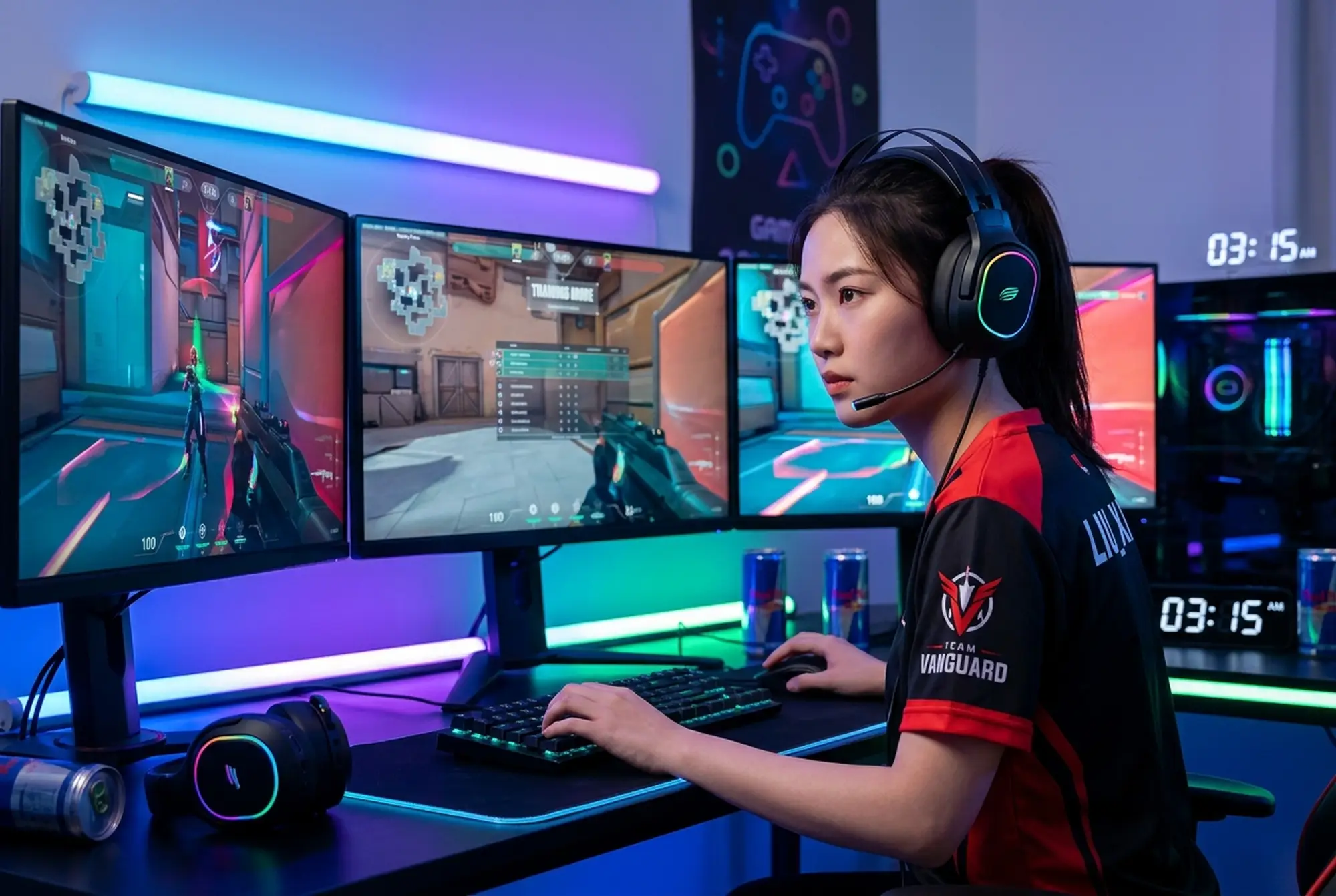
Most people won’t make it. That’s not meant to discourage you—it’s meant to be honest. The scene is competitive. The odds are long. But the ones who do make it follow a remarkably clear path. This guide shows you exactly what that path looks like, what it costs, and what you need to decide before you even start.
The Reality Check
Professional esports isn’t a shortcut to fame. It’s a sport. Elite players train 8–12 hours a day, sometimes 15 in Korea. They study demos, review footage of opponents, drill aim mechanics, and play thousands of matches. They deal with wrist injuries, mental burnout, and career lifespans that are often measured in years, not decades. The median pro salary isn’t what Twitch highlights suggest. And once you stop playing competitively, the options narrow fast.
What Is Esports? A Complete Beginner’s Guide (2026)
But if you’re reading this, you probably know all that already. You’re not looking for permission to dream—you’re looking for a map. Here’s one.
Step 1: Pick Your Game (and Stick with It)
Specialism wins in esports. The players who go pro are almost never the ones trying to be good at three games. They’re the ones who picked one and spent 2–5 years grinding it until they couldn’t get better in that game anymore—that’s when they went pro.
Your game choice is your biggest career decision. You need to pick based on:
- Your mechanical ceiling. Can you see yourself grinding to world-class in this game’s core mechanics? League of Legends demands map awareness and macro play. CS2 is pure aim and positioning. Valorant needs both. Pick the one where the game’s demands match how you learn.
- The scene’s size. A smaller game means fewer players competing for pro spots, but also a smaller prize pool and fewer orgs willing to invest. A bigger game is harder to break into, but the money and opportunities are real.
- Your realistic window. Reaction time matters less as games evolve, but it still matters. If you’re past 25, a game that heavily rewards snap reaction time is harder. Some games age better than others—MOBA sense and strategy hold up; pure mechanical twitch degrades.
Once you pick, stop trying other games seriously. Smurfs are fine. Trying the new shooter beta is fine. But your main account, your main grind—that’s one game, for the next 3–5 years. This is where most people fail early. They’re the guy who’s Platinum in three different games instead of Diamond in one.
Esports Glossary: 100 Terms Every Fan Should Know
Step 2: Climb the Ranked Ladder Seriously
Ranked is your resume. You can’t get on a team without one. Here’s what teams actually look for by game, and what you need to prove:
League of Legends / Valorant:
- Minimum: Diamond rank (top 2%)
- Target to go pro: Master tier or Radiant (top 0.02%)
- What it proves: You can mechanically compete
CS2:
- Minimum: FACEIT level 9-10 or rank G in competitive matchmaking
- Target to go pro: FACEIT level 10, high rating
- What it proves: Aim, positioning, and game sense under pressure
Dota 2:
- Minimum: 6500+ MMR
- Target to go pro: 8000+ MMR (top 100–200 players globally)
- What it proves: Deep hero and game knowledge
These aren’t suggestions. Orgs don’t develop players from Diamond or level 7. They look for players who are already at the mechanical threshold. You need to prove you can keep up before they spend money on you.
Getting here takes most people 2–4 years of serious grind. Serious means:
- Quality beats quantity. 200 games of grinding while watching Netflix is not the same as 100 games of focused, deliberate practice. VOD review, meta study, one-tricking champions or agents until you understand them completely—this is how the people ahead of you got there.
- One-trick into a champion pool. Pick one champion/agent and master it to death. Learn every matchup, every combo, every edge case. Then expand to 2–3 that have similar patterns. This is slower than playing random, but faster than trying to learn 15 champions at once.
- Track your performance. Keep a sheet. What killed you? What won you the game? Replay the games you lost and find the moment that lost you the match. This is boring and essential.
How Esports Tournaments Work: Formats, Brackets & Prize Pools Explained
Step 3: Transition to Scrimmages and Amateur Leagues
At Platinum/Gold, ranked is enough. At Diamond/Master, it’s not. You need to see how your play stacks up against actual teams with coordination. This is where scrimmages and amateur leagues come in.
Scrimmages are basically ranked games between teams. Both teams have a name, a comp, coordination. You get stomped, or you hold your own. You learn faster in one scrim than in five ranked games because everyone’s trying to win as a team, not just padding their KDA.
How to find them:
- Your region’s esports Discord (search “[Game] [region] esports” or “[Region] amateur esports league”)
- League websites—ESL, BLAST, Esports Stadium (varies by game)
- Smaller orgs that run weekly 5v5s or online tournaments
- Discord servers of streamers in your region who play competitively
Amateur leagues are the next step. These are organized weekly leagues with an actual bracket, playoff system, and at least some prize pool. Winning or placing high in these gets you noticed. Losing and placing mid doesn’t hurt, but it doesn’t help either.
Examples by game:
- LoL: Regional amateur leagues (varies by region; EU has lower.gg, etc.)
- Valorant: Circuits, Challengers, NSG tournaments
- CS2: ESEA, Mythic League, regional competitions
The goal here is two-fold: prove you belong in a real team environment, and build a track record someone can point to.
Step 4: Build Your Reputation
At this stage, ranking up alone won’t move the needle. You need people to know who you are. Not famous—known.
Streaming is the easiest tool. You don’t need to be entertaining. Pro streamers get viewers because they’re interesting to watch, but scouts watch streams at 2x speed looking for raw skill. If you’re Master tier, someone will click your stream and stay for 20 minutes just to see how you play. Stream 15–20 hours a week if you’re grinding hard, let it run in the background. The algorithm will find people.
Clips matter more than views. One clean 1v5 clip or an insane play in a scrim gets clipped, posted to Twitter, and circulates. This is how unknown players get noticed by orgs. You’re not trying to go viral—you’re trying to be the person clips people associate with a specific play style or role.
Local presence is underrated. Know the people in your regional scene. Play in their tournaments. Post in their Discord. Show up to LANs if they happen. Orgs scout regionally first. Being a name in your region is worth more than being unknown globally.
Play the meta. If the meta is tank supports, be the best tank support. If it shifts to carry supports, pivot. Orgs want players who understand the game, not players locked into a playstyle. Showing flexibility and meta awareness is a scouting signal.
Step 5: Get on a Team
This is where most people stop grinding. The jump from solo queue to organized team play is real. You need to join a team while you’re still climbing ranked, not after.
Start here:
- Open tryouts: Most amateur orgs post tryouts in regional Discord servers. It’s free, competitive, and the bar is lower than pro teams. Get one season with a real team under your belt.
- Tier 2/Academy teams: Once you have one season, apply to academy or tier 2 teams. This is the actual development pipeline. Tier 2 teams play tier 2 tournaments, develop players, and occasionally feed into tier 1 if they prove themselves.
- Showcase at Lans: If your region has LANs, qualify and play. One LAN run where you stand out against known players changes the conversation around you fast.
What scouts look for in scrims and tournament play:
- Sub-200ms reaction time (game-dependent; some games less important)
- Game sense: Do you understand why your team is winning/losing in the early game? Can you adapt?
- Team chemistry: Do you comm well? Do you listen? Do you adjust based on your teammates?
- Consistency: Are you always at that level, or just sometimes?
The team contract for tier 2 usually covers:
- Academy: $0–2k/month (unpaid or stipend)
- Regional tier 2: $2–5k/month
- Tier 1 (second squad): $5–15k/month
- Tier 1 starting: $15–50k+/month (only the top orgs and top players)
These are floor numbers. Orgs are also paying for housing, bootcamp, gear, and training staff. Your contract is one piece of a larger investment.
Step 6: Turn Professional
By this point, you’re not reading a guide anymore—scouts are talking to you. But here’s what to expect:
Contract terms:
- Salary range: varies wildly by region, game, and org prestige. See Step 5 above.
- Buyout clauses: If another org wants you mid-contract, they pay your current org a fee. This protects their investment.
- Length: Usually 1–2 years, sometimes with options for a third year.
- Streaming restrictions: Many orgs restrict when and where you can stream, or take a cut of your streaming revenue.
- Sponsorship conflicts: Your org may say you can’t use certain peripheral brands.
What teams actually measure:
- Performance in scrims (more reliable than tournament play because of sample size)
- Tournaments (playoffs are what matter; groups are about potential)
- Interviews and personality (you’re a brand asset, not just a player)
- Trajectory (are you improving or plateauing?)
The unsexy part: Most pro contracts end without anyone being re-signed. If you’re not top 3 on your team, you’re probably getting dropped after one split/season. Even if you are top 3, the meta might shift and someone’s kit becomes less valuable. This happens to good players constantly.
The Stuff Nobody Tells You
Burnout is real. The difference between 8-hour grinding and 12-hour grinding is the difference between a hobby and a career. Some players peak at 10 years in, then can’t look at the game for two years. Plan for it. Take breaks. You’re not weak if you can’t play 15 hours a day for five years—you’re normal.
Wrist injuries are common. Most pros have tweaked a wrist, tendonitis, or carpal tunnel at some point. This isn’t a small risk. Use a proper desk, stretch, take breaks, and treat pain seriously. One month of rest beats six months of pain.
Mental health matters. The pressure of ladder grinding, the toxicity of online play, the stress of contract negotiations—it adds up. If you’re depressed or anxious about the game, talk to someone. Your org should have access to sports psychologists. Use it.
Your peak is short. Even if you go pro at 20, your window is maybe 8–10 years if you’re lucky. Some people last three years. Plan what comes next. Stream, build a brand, learn the business side, get educated. The players who transition smoothly after are the ones who built something beyond just their raw skill.
Orgs aren’t your friends. They’re businesses. They’ll drop you when your performance drops or the meta shifts, regardless of how long you’ve been there. This doesn’t mean they’re evil—it means you should be looking out for yourself. Build your own stream, your own brand, your own income streams outside the org.
Realistic Timeline
Here’s what a path to pro actually looks like:
| Year | Milestone | Rank Target |
|---|---|---|
| 0–1 | Pick game, grind solo queue | Gold/Platinum |
| 1–2 | Serious grind, VOD review | Platinum/Diamond |
| 2–3 | Diamond/Master, first scrims | Master/peak rank |
| 3–4 | Amateur league, local presence | Maintain peak, win tournaments |
| 4–5 | Tier 2 academy team, trials | Top performance in scrims |
| 5+ | Tier 2 season, then tier 1 trials | Offer or tier 2 promotion |
Most people don’t make it past year 2. Of those who do, most plateau at amateur level. Of those who go pro, most don’t stay pro past their third contract.
This isn’t failure. This is the shape of the game.
Your Quick-Reference Checklist
- Picked one game and committed to it
- Ranked to at least Diamond/level 9 (or regional equivalent)
- Started reviewing your own VODs weekly
- Joined Discord servers for your regional scene
- Played in at least one amateur league or tournament
- Set up streaming (even just ranked games)
- Clipped at least three plays from scrims or tournaments
- Played in at least one team environment (amateur org or 5-stack)
- Built relationships with other players in your scene
- Applied to tier 2 organizations
- Played in a LAN event or qualifier
The History of Esports: From Arcade Halls to $75M Prize Pools
The Bottom Line
You can do this. People do. But you need to understand what you’re signing up for: thousands of hours of grinding, likely multiple years before anything happens, real physical strain, and a short peak if you make it.
The ones who go pro aren’t the ones with the most natural talent. They’re the ones who picked a game, stuck with it, got brutally honest about their progress every single day, and kept grinding even when the progress got small.
If you can do that—if you can grind ranked for two years and still care about ranking up slightly—then you have a shot. The players ahead of you right now aren’t more talented. They’re just further along the same path.
Get ranked. Get in a team. Get known. Everything else follows.
Want to dig deeper? Check out our guides on What Is Esports and our Esports Glossary for the terms pros use every day.
Leave a Reply