
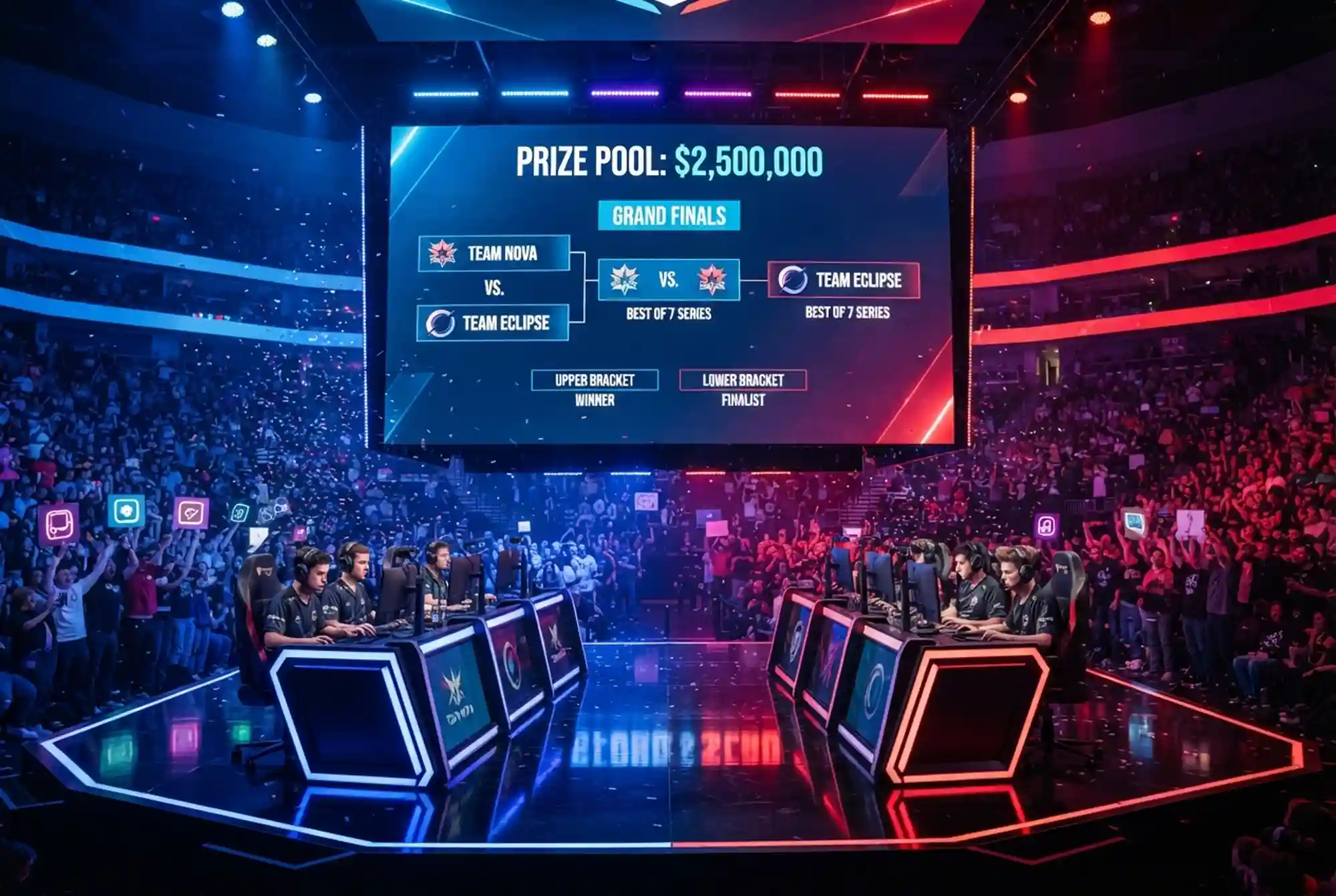
Welcome to the wild world of competitive gaming—where understanding the format can make you appreciate every play, upset, and championship moment even more.
This guide breaks down everything you need to know about how esports tournaments actually work, from the moment qualifying teams are seeded to the final trophy lift.
The Two Phases That Run Every Tournament
Nearly every esports tournament follows the same basic blueprint: a group stage (or qualifying round) where teams prove themselves, followed by a playoff bracket where the strongest rise to the top.
Group Stage is where volume meets consistency. Teams play multiple matches against different opponents under the same conditions. This phase weeds out the weak, builds storylines, and usually determines which teams get higher seeding in the playoffs. It’s the hardest stage to get through because there are no second chances for many teams.
Playoff Bracket is the main event—the knockout phase where every match matters. One loss might mean elimination, or it might drop you to a secondary bracket where you fight for a second chance. This is where drama peaks, where underdogs make their runs, and where champions are crowned.
The split between these two phases lets tournament organizers balance fairness (everyone gets group-stage experience) with drama (playoffs are sudden-death intensity).
The Four Tournament Formats Explained
Not all tournaments are built the same way. Four main formats dominate competitive gaming, each with distinct advantages and tradeoffs.
1. Single Elimination: Fast, Brutal, One Chance to Shine
What it is: You lose once, you’re out. Your tournament is over.
How it works: Teams are arranged in a bracket (often 8, 16, or 32 teams). The bracket fills in like a pyramid—losers drop off completely, winners advance to the next round. The last team standing wins the tournament.
Pros:
- Crystal clear. Everyone understands who won and who lost.
- Fast. A 16-team single-elimination tournament finishes in four rounds.
- Exciting. Every single match is a must-win. The stakes never stop climbing.
- Cost-effective for organizers (fewer matches = lower production costs).
Cons:
- Brutal to the unlucky. A world-class team that happens to run into the tournament’s strongest opponent in round one goes home empty-handed.
- One bad day can end a season. A crucial mistake in a single best-of-one match can eliminate years of preparation.
- Less data. Playing only 3-4 matches doesn’t tell you much about a team’s consistency.
When it’s used: Local qualifiers, early-round online tournaments, occasional championship finals where the drama of sudden death sells tickets.
Real example: Many regional esports championships use single elimination to move fast through qualifying rounds.
2. Double Elimination: The Mercy Bracket That Built Trust
What it is: You get to lose once and live to fight another day. Lose twice, and you’re out.
How it works: The bracket splits into two paths—an upper bracket for undefeated teams, and a lower bracket for teams with one loss. Winners of each bracket meet in the grand finals. Winners of the lower bracket have to beat the upper bracket winner twice to claim the trophy (if they didn’t already play each other).
Pros:
- Forgiving. A single mistake doesn’t end your tournament run. One bad match doesn’t erase months of preparation.
- High-quality finals. The best two teams are almost guaranteed to meet, because the lower-bracket winner has proven they can beat anyone.
- More matches. Teams get more opportunities to show their skill, and storylines develop. Comebacks from the lower bracket are legendary.
- Competitive integrity. The champion truly earns it by proving they can beat the field.
Cons:
- Longer. A 16-team double-elimination tournament can take two full days of matches.
- Complexity. New viewers don’t immediately understand how the lower bracket works.
- Bracket reset risk. In some formats, if the lower-bracket winner makes the grand finals, they might need to beat the upper-bracket winner twice (once in finals, then again if they lose)—this can feel unfair to some.
When it’s used: This is the standard for major esports championships. The International (Dota 2), Valorant Champions, League of Legends Worlds, and most fighting-game majors use double elimination. It’s become the gold standard for competitive integrity.
Real example: Valorant Champions 2026 used double elimination to ensure the championship was won by the best team on the day, not the luckiest.
3. Round Robin: Everyone Plays Everyone
What it is: Every team plays every other team once (or multiple times). Points accumulate, standings are built, and seeding is determined.
How it works: If eight teams enter, each team plays seven matches. A win earns 2-3 points, a tie earns 1 (depending on the game and ruleset), a loss earns 0. After all matches, teams are ranked by total points. Top teams seed into the bracket, lower teams might go home or drop to a secondary bracket.
Pros:
- Fairest group stage. You can’t get lucky draw opponents or run into the field’s strongest team early—you face everyone equally.
- Tons of data. Teams play 7-15 matches, and you get a crystal-clear picture of who’s strongest.
- Drama throughout. With every match mattering for seeding, tension builds across the entire group stage.
- No surprises. The standings reflect true strength (mostly).
Cons:
- Time-intensive. An eight-team round robin is 28 matches. With multiple groups, that’s a lot of play time.
- Predictable. The strongest teams usually finish predictably at the top.
- Can feel like filler. When a team is mathematically out of contention, their final matches lose some intensity.
When it’s used: Group stages at major tournaments (League of Legends Worlds, The International). Sometimes used as the entire format for league play (franchised esports leagues like LEC, LCS).
Real example: League of Legends Worlds 2026 used round robin in group stages, with each team in a four-team group playing 6 matches (3 matches per day, 2 days).
4. Swiss System: The Efficient Middle Ground (Growing Fast)
What it is: Teams play multiple matches (usually 4-6 rounds) against opponents of similar strength. You’re not locked into a single bracket; you play “to your level.”
How it works: After round 1, teams are paired off based on their records. If you’re 1-0, you play another 1-0 team (if possible). If you’re 0-1, you play another 0-1 team. This continues for a set number of rounds. At the end, standings are final, and the best teams are crowned—often without a single-elimination bracket at all.
Pros:
- Efficient. You get 4-6 rounds of meaningful competition in one day, which is faster than double elimination and less repetitive than round robin.
- Fair to mid-tier teams. You’re not guaranteed to crush weaker teams or get crushed by the strongest. You play teams at your level, so strength becomes clear.
- Dynamic. Teams can improve or drop in seeding as rounds go on. Underdog runs are possible.
- Scalable. Swiss works for 8 teams or 200 teams without structure changing much.
Cons:
- Less familiar. Most esports fans grew up on single/double elimination. Swiss feels “different.”
- Tie-breaking can get messy. If two teams finish 4-2, how do you break the tie? Head-to-head? Strength of schedule? Different organizers use different rules.
- Not as high-stakes. It’s a bit less dramatic than elimination—you can survive three losses and still place well.
When it’s used: Some esports leagues and online tournaments are starting to experiment here. Magic: The Gathering uses Swiss heavily. Some fighting-game majors now use Swiss for side events. It’s becoming more common as organizers realize how efficient it is.
Real example: Some esports world championships and open online tournaments are testing Swiss formats to handle large player bases more fairly.
Format Comparison Table
| Aspect | Single Elim | Double Elim | Round Robin | Swiss |
|---|---|---|---|---|
| Matches per team | 3-5 | 5-15 | 7-15 | 4-6 |
| Time to complete | Fast (1 day) | Slow (2-3 days) | Slow (2 days) | Medium (1-2 days) |
| Fairness | Low (one bad day ends you) | High (second chance) | Very high (everyone equal) | High (play to your level) |
| Drama level | Very high | Very high | Medium | High |
| Fan-friendly | Yes | Yes | No (predictable) | No (unfamiliar) |
| Best for | Quick events, qualifiers | Major championships | League play | Large fields, online |
How Seeding Works: Why Some Teams Skip Group Stage
Before the tournament even starts, teams are ranked and assigned seeds. The highest seed is the team most likely to win (based on ranking, recent form, and strength).
Why it matters: In a 16-team tournament, the #1 seed usually avoids facing the #2 seed until the finals. The bracket is drawn so strong teams are spread apart. Seed #1 plays seed #16, seed #2 plays seed #15, and so on. This creates the best possible path to a championship: you face stronger teams as you advance, not randomly early.
Double elimination + seeding: Seeded teams often enter the upper bracket directly, while unranked or lower-seeded teams start in a play-in or the lower bracket. At Valorant Champions, the top 4 seeds go to the upper bracket. The other four teams have to earn their spot.
Why this matters to viewers: Seeding explains why certain matchups feel significant. When seed #3 faces seed #5 in round two, it’s not arbitrary—the bracket designer deliberately created that path based on their strength.
Best-of Series Explained: BO1, BO3, BO5
Every match in a tournament is a “best-of” series, shortened to BO1, BO3, or BO5. This number tells you how many games need to be won to claim the match.
BO1 (Best-of-One): First to 1 win takes the match.
- Used in: Group stages, online qualifiers, early-round matches.
- Pro: Fast, exciting, upsets happen.
- Con: Luck matters more. A single bad game eliminates you.
- Example: League of Legends group stage is BO1.
BO3 (Best-of-Three): First to 2 wins takes the match.
- Used in: Playoff brackets, most championship tournaments.
- Pro: One bad game doesn’t end you. Skill shines through.
- Con: Longer, but not exhausting.
- Example: Valorant Champions playoffs are BO3.
BO5 (Best-of-Five): First to 3 wins takes the match.
- Used in: Championship finals, grand finals of majors.
- Pro: The absolute best team almost always wins. Skill is undeniable.
- Con: Takes 3-4 hours. Mentally grueling.
- Example: The International grand finals are BO5 (Dota 2).
Why format changes: Early rounds are BO1 because organizers need matches to move fast. Playoffs shift to BO3 or BO5 because a world championship can’t be decided by one unlucky game.
How Prize Pools Work: Where the Money Comes From
Esports tournaments award serious money. In 2026, the Esports World Cup topped $75 million across 24 different games. But where does all that money actually come from?
Organizer-Funded Tournaments
Game publishers like Riot Games, Valve, and ESL put their own money behind tournaments.
- League of Legends Worlds 2026: Riot Games funded the entire prize pool from their esports budget. Millions in salary, per-game prizes, and performance bonuses.
- The International (Dota 2): Valve seeds the prize pool (~$1.6 million baseline), then adds community contributions (see crowdfunding below).
- Esports World Cup 2026: Backed by Saudi Arabia’s Public Investment Fund, with partnerships from major brands. $75 million is currently the largest single esports prize pool.
Pros for players: Guaranteed money. No matter what happens, the tournament runs and pays out.
Pros for viewers: Stable, high-quality production. No surprises.
Crowdfunded Prize Pools
Players and fans contribute directly to the prize pool, and the more money flows in, the bigger the pool grows.
- The International 2013: The first crowdfunded esports prize pool. Valve added $1 to the pool for every $25 spent on in-game cosmetics (battle pass skins). Fans contributed enough to grow it from $1.6 million to $2.87 million—a record at the time. In 2026, The International’s crowd funding regularly pushes pools above $30+ million.
- Esports World Cup 2026: Not crowdfunded, but players and orgs contribute via qualification point systems and partnership deals.
Pros for players: The bigger the crowd involvement, the bigger the payout. Players are incentivized to market their games.
Pros for viewers: You directly support your favorite game by buying cosmetics.
Cons: If the community doesn’t engage, the pool stays small.
Sponsored & Partnership-Based Tournaments
Brands invest in tournaments to reach esports audiences.
- Valorant Champions 2026: Riot Games organizes; sponsors like energy drinks, hardware makers, and betting sites help fund the multi-million-dollar operation.
- Fighting-game majors: Often sponsored by arcade manufacturers, snack brands, and esports orgs themselves.
Pros: Stable, predictable funding.
Cons: Sponsors may influence format or restrictions (some sponsors don’t want their brands associated with certain games or regions).
How Prize Money Is Split
A $10 million prize pool doesn’t mean $10 million goes to the winning team. Prize pools are distributed across all placing teams, with the largest chunks reserved for the champion.
Typical distribution for a 16-team double-elimination tournament:
| Placement | Prize |
|---|---|
| 1st | $2,000,000 |
| 2nd | $1,000,000 |
| 3-4 | $500,000 each |
| 5-8 | $250,000 each |
| 9-16 | $125,000 each |
Total: $10 million distributed across all teams.
Team vs. Player: Most esports operate under a team structure. The organization (team owner) receives the prize, then distributes it to:
- Salary (players, coaches, analysts)
- Operational costs (scrim servers, facilities, travel)
- Investor returns
- Reinvestment back into the team
The exact split varies wildly. Some orgs give 50% of prize money directly to players; others keep 70%. It’s negotiated per contract.
Regional prize pools: Some tournaments allocate prize money per region. If a European team and a Korean team make top 8, they might compete for different regional prize splits on top of the global pool.
Real-World Tournament Formats: Three Current Examples
League of Legends Worlds 2026
Format: Group stage (round robin) + double-elimination playoffs.
Details:
- 4 groups of 4 teams. Each team plays 6 matches (BO1).
- Top 2 teams from each group advance to playoffs.
- Playoffs are double-elimination, BO3 matches.
- Grand finals are BO5.
Why: Round robin ensures the four best teams from each group are tested equally. Double elimination in playoffs ensures the #1 and #2 teams meet in the finals (almost always). BO5 grand finals elevate the championship moment.
Peak viewership 2026: 6.94 million concurrent viewers. (League of Legends Worlds is one of the most-watched esports events globally.)
Valorant Champions 2026
Format: Double-elimination bracket with seeding.
Details:
- 16 teams seeded by regional ranking and performance.
- Top 4 seeds start in upper bracket.
- Seeds 5-16 start in a play-in round (BO3).
- Winners of play-in join upper bracket.
- Full double-elimination playoffs (BO3 all rounds).
- Grand finals are BO5 with bracket reset.
Why: Valorant is region-locked (Americas, EMEA, Pacific, China), so all regions attend one championship. Top seeds get a bye to reduce travel/matches. Double elimination ensures the best team wins. BO5 grand finals hype the championship.
Peak viewership 2026: 4.3 million concurrent viewers. (Valorant is second only to League of Legends among tactical shooters.)
The International 2026 (Dota 2)
Format: Double-elimination with group stage lead-in.
Details:
- Group stage: 8 teams seeded by ranking, play round robin, top teams get upper bracket byes.
- Playoffs: Double elimination, BO3 until grand finals.
- Grand finals: BO5.
Why: Dota 2 tournaments are structured to build storylines across days. Group stage determines seeding, but anyone can win playoffs. The International is the sport’s World Cup, and the format respects that (no flukes, best team wins).
Prize pool 2026: $35+ million (crowdfunded).
Glossary: 8 Tournament Terms You Need to Know
Bracket: The visual tree showing matchups. Upper bracket = winners’ path. Lower bracket = losers’ path. Grand bracket = final round.
Seeding: The ranking of teams before the tournament starts (e.g., #1 seed is the strongest team). Affects where teams are placed in the bracket.
Group stage: The opening round where teams play multiple matches to qualify for playoffs. Also called “qualifying round” or “pool play.”
Grand finals: The championship match (usually BO5). Winner is crowned tournament champion.
Upper bracket: The bracket path for undefeated teams. Losing here drops you to the lower bracket.
Lower bracket: The bracket path for teams with one loss. Winning the lower bracket gets you to the grand finals, but you usually need to beat the upper bracket winner.
Bye: A free pass to the next round (usually given to high seeds). “He got a bye” means he doesn’t play this round.
Bracket reset: If the lower-bracket winner beats the upper-bracket winner in grand finals, they must play again (a reset). This ensures the upper-bracket winner gets a second chance after going undefeated.
How to Follow a Tournament from Start to Finish
You’ve got the vocabulary. Here’s how to actually watch a tournament and feel like you know what’s happening.
Pre-tournament:
- Check the bracket. See who’s seeded where. Note potential dream matchups.
- Read team rosters. Know the players and their names.
- Watch some pre-tournament hype videos. Teams and casters build narratives.
Group stage (if there is one):
- Watch the opening matches to see which teams look sharp.
- Pay attention to which teams scrim with each other. (Teams play practice matches before tournaments.)
- Notice upsets early. A lower-seeded team playing above their head is a red flag they might make a run.
Playoffs:
- Every match is knockout. The stakes are highest.
- Watch for lower-bracket resurrections. A team fighting back from losers’ bracket is compelling drama.
- Grand finals is the main event. Block out the time and don’t miss it.
After the tournament:
- Check final standings and prize distribution.
- Watch highlight reels of the best plays.
- Read post-game interviews with winning teams and coaches.
Final Thoughts
Esports tournaments are complex, but they’re designed to be fair, dramatic, and exciting. Whether it’s the brutal single-elimination of a regional qualifier or the forgiving double-elimination of a world championship, each format serves a purpose. Understanding how brackets work, why seeding matters, and where the money comes from transforms watching from passive entertainment into genuine sports fandom.
Next time you’re watching Valorant Champions or The International, you’ll see past the names and rankings. You’ll understand why that upper-bracket upset matters, why the grand-finals reset just happened, and why a team from the lower bracket has a real shot at lifting the trophy. That’s when esports goes from exciting to unforgettable.
Want to dive deeper?
- What Is Esports — A beginner’s guide to competitive gaming.
- Esports Glossary — A full dictionary of esports terms.
Leave a Reply