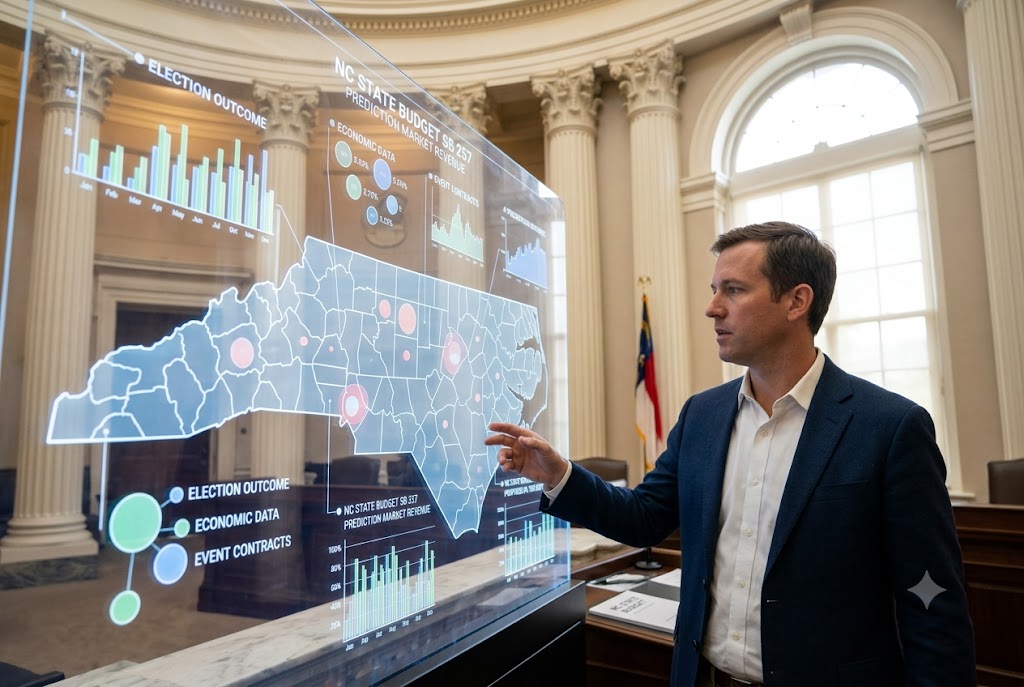
North Carolina is quietly positioning itself at the absolute frontier of modern wagering. Tucked away on page 626 of a sweeping 634-page, $34 billion state budget bill (SB 257) lies a provision that could redefine the national gambling landscape. If enacted, North Carolina will become the first state in America to formally authorize and tax prediction market betting.
For years, platforms like Polymarket and Kalshi have operated in a gray area, trading event-based contracts tied to political elections, economic data, and pop culture outcomes. The Commodity Futures Trading Commission (CFTC) regulates them federally as futures markets, but state-level oversight has remained virtually non-existent. Now, the North Carolina General Assembly is stepping into the void.
Also read: Kalshi Sues Illinois Over 15% Prediction Market Tax in Escalating Jurisdiction War
The Financial Blueprint: Taxation Without Heavy Regulation
The speed of this legislative maneuver caught many industry insiders off guard. While the legalization of sports betting in North Carolina was the product of agonizing, years-long debate, the prediction market provision materialized on a Tuesday and cleared both legislative chambers by Thursday.
At the core of the strategy is a dual-track taxation model that uniquely favors event-contract trading over traditional sportsbooks. Here are the definitive financial parameters outlined in the new legislative push:
- Prediction Market Tax Rate: Operators will be subject to a 6% tax on net trading fee revenues generated from transactions within the state.
- Sports Betting Tax Hike: Conversely, the state’s online sports betting operators will see their gross wagering revenue tax skyrocket from 18% to 23%.
- No Centralized Rulebook: Unlike the heavy compliance and $1 million licensing fees required for traditional sportsbooks, the bill introduces zero new operational rules for prediction markets.
House Speaker Destin Hall articulated the pragmatic calculus behind the move. “A lot of it’s going on in this state anyway, in terms of the prediction markets, and so [it’s] just time to deal with it,” he stated. In short: North Carolinians are already using these platforms; the state intends to capture the revenue rather than fight the tide.
Also read: What is Kalshi? How the Regulated Prediction Market Works in CA & TX
The Industry Backlash and University Revenue Threat
Not everyone views this legislative pivot as a masterclass in revenue generation. The discrepancy in regulatory scrutiny has provoked fierce backlash from traditional gambling advocates and consumer protection groups.
Mick Mulvaney, the former White House Chief of Staff who now directs the advocacy group Gambling Is Not Investing, didn’t mince words. “There’s no reason a state should favor these rogue operators over the licensed sportsbooks who fully comply with regulations and tax structures,” Mulvaney stated in a written release, criticizing the proposal as a “sweetheart deal.”
Furthermore, the mainstreaming of prediction markets introduces a genuine threat to higher education funding. Under the current financial structure, the state’s massive sports betting tax revenues are distributed to the general fund and specific universities. This year’s budget finally allows major athletic powerhouses—UNC and NC State—to receive up to $5.8 million annually from these funds.
However, if a significant volume of domestic gamblers migrates away from 23%-taxed sportsbooks to 6%-taxed prediction markets, that multi-million-dollar university pipeline could severely diminish.
Advanced State Tax Enforcement: SB 595
The budget is not the only legislative hammer dropping on the wagering sector. A companion bill, Senate Bill 595, currently awaits the signature of Democratic Governor Josh Stein. This legislation represents a monumental shift in state-level tax auditing.
Under SB 595, the North Carolina Department of Revenue will be empowered to directly request bettors’ personal information and wager histories from platforms for anyone registering over $2,000 in winnings during the prior calendar year.
Nathan Goldman, Dean’s Professor of Accounting at NC State’s Poole College of Management, noted the unprecedented nature of this enforcement mechanism. While other states permit gaming authorities to access such data, North Carolina aims to “cut out that middleman” by routing authority directly to the revenue department. “It’s not really clear that they’re going to face audit or they’re going to have to pay additional amounts in tax because of this—but the threat that they will has gone up substantially,” Goldman explained.
Why is North Carolina taxing prediction markets but not regulating them?
State lawmakers are employing a revenue-first strategy. Because prediction markets like Kalshi assert they are federally regulated commodity markets overseen by the CFTC, North Carolina is bypassing the creation of a complex state-level regulatory framework. Instead, by implementing a low 6% net revenue tax, the state captures immediate income from an already active user base without assuming extensive regulatory liability.
Will the prediction market tax impact traditional sports betting in NC?
Yes, it is highly likely to cause market friction. While prediction markets face a 6% levy, sportsbooks are seeing their tax burden increase to 23%. Industry analysts and critics argue this disparity creates an uneven playing field, potentially drawing bettors away from licensed sportsbooks to prediction markets. This shift could inherently threaten the state revenues currently earmarked for public university athletic programs.
The $34 billion budget now sits on Governor Josh Stein’s desk. Whether he signs it, vetoes it, or allows it to pass into law without his signature, North Carolina has officially fired the starting gun on the state-level battle over prediction markets.
Sources Quoted: WRAL News (quotes from NC House Speaker Destin Hall and Mick Mulvaney of Gambling Is Not Investing); Bloomberg Tax via NC State Poole College of Management (quotes from accounting professor Nathan Goldman).