
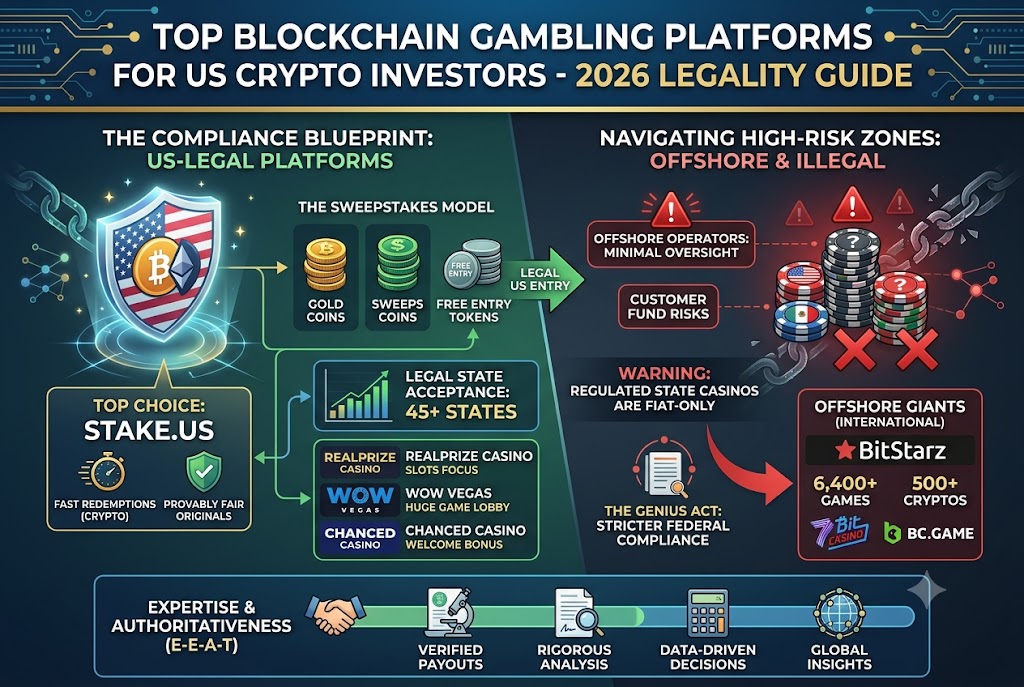
The intersection of Web3 liquidity and online gaming is booming, but for US-based crypto investors, the space remains a regulatory minefield. While international players enjoy frictionless on-chain betting, American gamblers face a complex web of state regulations and federal scrutiny.
Here is the unvarnished reality for 2026: fully regulated, real-money US online casinos do not accept cryptocurrency. However, a specialized tier of crypto-compatible “sweepstakes” platforms offers a fully legal backdoor for US players.
Based on our extensive analysis of the current legal frameworks, payout speeds, and operator reliability, here is exactly how the blockchain gambling market operates in the US today—and which platforms are leading the charge.
The 2026 Regulatory Reality: State Laws vs. The GENIUS Act
The legal status of crypto gambling in the United States cannot be answered with a simple “yes” or “no.” It is a fragmented gray zone dictated by state boundaries and federal payment processing statutes.
While states like New Jersey, Pennsylvania, and Michigan offer robust, fully regulated online casino markets, they are strictly fiat-only. As noted by industry analysts at SportsLine, the Pennsylvania Gaming Control Board requires payment processors to pass rigorous Anti-Money Laundering (AML) and Know Your Customer (KYC) audits. Because cryptocurrencies are decentralized and semi-anonymous, they inherently clash with these strict oversight requirements. Even in Wyoming—the only state allowing crypto transactions for sports betting—assets must be converted to USD before a wager is placed.
Furthermore, federal statutes are actively tightening. While the Unlawful Internet Gambling Enforcement Act (UIGEA) of 2006 has long targeted payment processors, 2026 introduces a new hurdle: The GENIUS Act. This new federal framework applies directly to platforms facilitating stablecoin purchases and redemptions, adding a heavy compliance layer for crypto casino operators targeting American markets.
State-by-State Risk Profiles for Crypto Gamblers:
- Regulated but Fiat-Only (Low Risk): New Jersey, Pennsylvania, and Michigan. Online gambling is legal, but strictly regulated.
- Illegal & High Risk: States like California and Texas heavily restrict online gambling.
- Severe Criminal Liability: Washington state classifies online gambling as a Class C felony, creating exceptionally high risk for participants. Utah enforces a total ban.
The Legal Loophole: Sweepstakes Crypto Casinos
Because traditional state-licensed casinos reject blockchain payments, US investors have pivoted entirely to “sweepstakes” casinos. By utilizing a dual-currency system (typically “Gold Coins” for fun and “Sweeps Coins” for redemptions) and offering a “no purchase required” entry method, these platforms legally operate outside traditional gambling definitions in the vast majority of US states.
Top US-Legal Crypto Sweepstakes Platform:
- Stake.us: Widely considered the premier legal option for US crypto enthusiasts. Stake operates as both a social casino and sportsbook under the sweepstakes model. It features 31 provably fair “Stake Originals,” offers free Stake Cash daily, and most importantly, processes fast redemptions directly in cryptocurrency.
Top Fiat-Alternative Sweepstakes Platforms:
- RealPrize Casino: Highlighted as a top all-around platform in 2026, offering hundreds of slots and a highly reliable prize redemption process without requiring an initial purchase.
- WOW Vegas: Features a massive 2,515-game lobby. While it does not process crypto payouts natively, it allows seamless redemptions to Visa and Mastercard with a low 50 Sweeps Coin ($50) minimum.
- Chanced Casino: Offers an attractive welcome bonus of 70 free SC with a strictly enforced 1x playthrough requirement before redemption.
The Offshore Giants: High Liquidity, High Risk
Outside the sweepstakes model, the broader crypto gambling market is dominated by offshore operators. These platforms offer unmatched game volume and withdrawal speeds, but they require players to operate in a legal gray area, usually under minimal oversight from jurisdictions like Curaçao.
For international investors—or those navigating the offshore landscape—the 2026 market is led by established veterans:
- BitStarz (Best Overall History): Operating since 2014 under Dama N.V., BitStarz sets the industry benchmark for reliability. It accepts over 500 cryptocurrencies, boasts a verified library of over 6,400 games, and consistently processes Bitcoin withdrawals in under 15 minutes.
- 7Bit Casino (Best for Slots): With a staggering library of over 9,000 titles, 7Bit excels with its daily, no-buy-in slot tournaments. It accepts major coins including BTC, ETH, LTC, and DOGE.
- BC.Game & Cloudbet: These platforms cater heavily to high-volume bettors, offering massive crypto deposit matches and high-percentage VIP rakebacks (up to 30% all-cash, no-rollover on Cloudbet).
Investigative Note: When evaluating offshore sites, investors must prioritize three metrics: verifiable operating history (5+ years minimum), transparent licensing (e.g., Curaçao Gaming Control Board), and network-only fee structures for withdrawals.
Are crypto casinos legal in the US?
Real-money online casinos licensed in US states strictly mandate USD transactions and forbid cryptocurrency to comply with Anti-Money Laundering (AML) regulations. The only legally protected way to gamble with crypto in the US is through sweepstakes casinos (like Stake.us), which use a dual-currency model to bypass traditional gambling classifications. Pure crypto casinos operate offshore; while no federal law explicitly criminalizes the individual player, utilizing them carries heavy consumer risk and violates specific state laws.
How do you pay taxes on crypto gambling winnings in the US?
The IRS treats crypto gambling winnings as a two-step tax event. First, when you win crypto, you must report it as ordinary income on Schedule 1 based on its Fair Market Value (FMV) at the exact time of receipt. Second, when you eventually convert that crypto to USD or trade it for another digital asset, you trigger a secondary tax event. You must report the capital gain or loss on Schedule D, calculated by subtracting the FMV at the time you received the winnings from the FMV at the time of the sale.
Sources Quoted: Data, regulatory insights, and operator statistics in this report were extracted and verified via Zipmex (The Complete 2026 Legal Guide), Northeast Times, SportsLine, CryptoSlate, Esports Insider, Webopedia, Gaming America, and RotoWire (July 2026 Sweepstakes Rankings).