
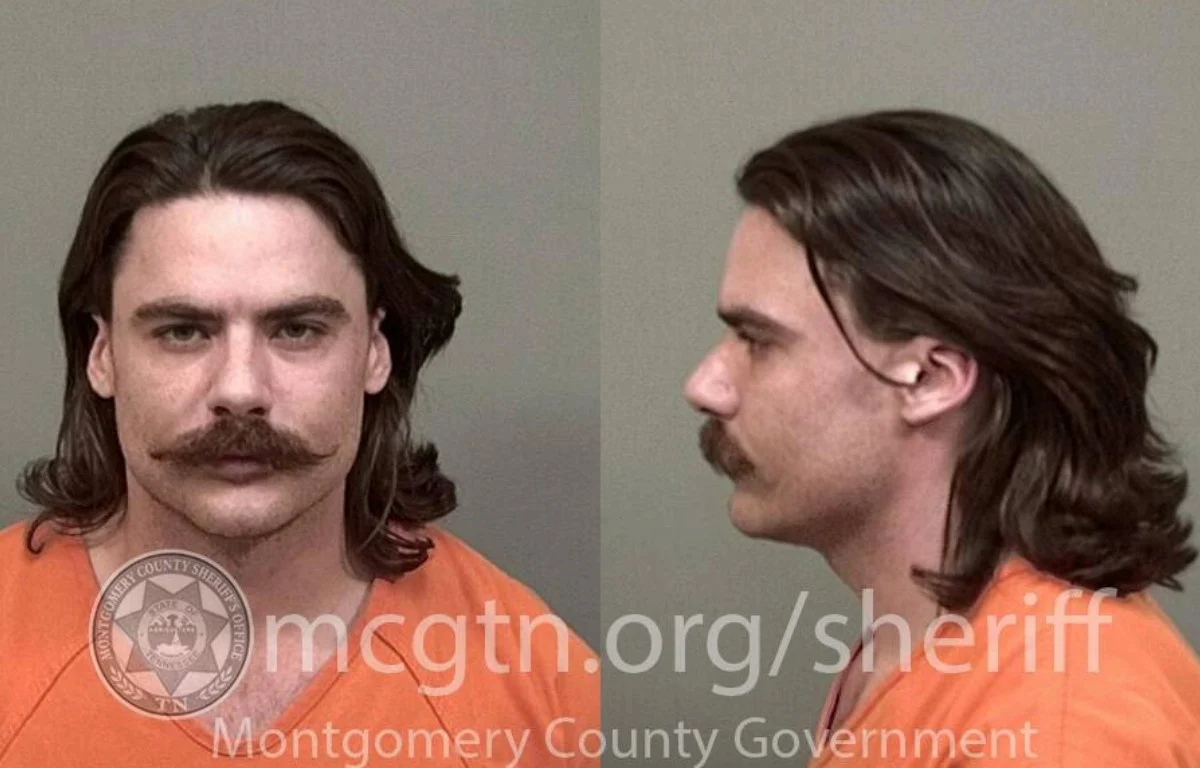
The Day Violence Erupted in Millennium Plaza
On the afternoon of Wednesday, May 13, 2026, the bustling environment of the Montgomery County Courthouse in Clarksville, Tennessee, was shattered by the sound of gunfire. The incident, which prompted an immediate lockdown of the area, involved a notorious internet livestreamer whose digital vitriol violently spilled over into the real world.
Dalton Eatherly, widely known online by his moniker “Chud the Builder,” was at the center of the chaos. The 28-year-old social media personality, whose content revolves around instigating racially motivated confrontations, was taken into custody following the shooting.
According to law enforcement and eyewitness reports, the incident was the violent climax of a long-standing pattern of provocative and dangerous behavior.
This event has not only shocked the local community but has also sparked intense national debates. The chud the builder shooting raises urgent questions about the limits of free speech, the dark side of livestreaming culture, and the legal complexities of claiming self-defense when the shooter is the primary instigator.
Who is Dalton Eatherly, aka ‘Chud the Builder’?
To understand the severity of the shooting, one must first examine the digital footprint of the man pulling the trigger. Dalton Eatherly is not a traditional content creator. Operating under the name “Chud the Builder,” Eatherly built a highly controversial following by weaponizing racial slurs for shock value.
His livestreaming strategy, often referred to as “hate-baiting,” involved seeking out Black individuals in public spaces. Eatherly would then film himself hurling horrific racial slurs at them, actively attempting to provoke a physical response.
The strategy was designed to generate outrage, which in the twisted economy of fringe social media platforms, translates directly to views, engagement, and notoriety.
However, Eatherly’s actions were not merely offensive; they were aggressively antagonistic. He operated in a gray area of the internet where extremism is often disguised as “trolling” or First Amendment auditing. By continuously pushing the boundaries of public decency, Eatherly was playing a dangerous game of odds, waiting for the day someone would take his bait.
The Anatomy of the Courthouse Shooting
The events of May 13 unfolded rapidly. Eatherly was scheduled to appear in General Sessions Court that Wednesday as a defendant in a civil case involving Midland Credit Management Inc.
At approximately 1:15 p.m., while outside the Courts Center in Millennium Plaza, a confrontation ignited. According to witnesses at the scene, Eatherly engaged in an altercation with an unnamed individual. During this heated exchange, the individual reportedly threw a punch at Eatherly.
It was at this moment that Eatherly introduced lethal force. Witnesses reported hearing three to four gunshots echo through the plaza.
District Attorney General Robert Nash later confirmed that Eatherly was the individual who opened fire. In the chaotic process of drawing and discharging his weapon, Eatherly allegedly managed to shoot himself in the arm while simultaneously striking the other man.
The Immediate Aftermath and Medical Response
The sound of gunfire triggered an immediate and massive law enforcement response. The Montgomery County Courthouse, along with surrounding government buildings, was placed on strict lockdown.
Deputies from the Montgomery County Sheriff’s Office swarmed Millennium Plaza, swiftly taking both the injured Eatherly and the victim into custody and securing the scene.
Medical personnel arrived shortly after. The unnamed victim, who sustained severe injuries from Eatherly’s gunfire, required critical care. He was stabilized at the scene before being flown via a LifeFlight helicopter to Vanderbilt University Medical Center in Nashville. As of the initial reports, he was listed in stable condition.
Eatherly, suffering from the self-inflicted gunshot wound to his arm, was transported by ambulance to Vanderbilt Clarksville Hospital for treatment. Following his medical discharge, he was immediately transported to the Montgomery County Jail.
Attempted Murder: The Charges Against Chud the Builder
The Montgomery County Sheriff’s Office did not take the incident lightly. After reviewing the evidence and the chaotic scene at the courthouse, authorities brought the hammer down on the livestreamer.
Dalton Eatherly was officially charged with attempted murder.
But the charges did not stop there. He was also hit with employing a firearm during a dangerous felony, aggravated assault, and reckless endangerment with a deadly weapon.
Sheriff John Fuson released a stern statement following the arrest. “It’s unfortunate that incidents like this are happening in our community,” Fuson said. “This kind of violence won’t be tolerated, and our office will work to make sure those responsible are held accountable to the fullest extent of the law.”
The District Attorney’s Office has stated they are conducting a thorough review of the law enforcement investigation to formalize and potentially expand these criminal charges.
A Trail of Escalating Legal Troubles
The courthouse shooting was not Eatherly’s first brush with the law; rather, it was the explosive culmination of a rapidly accelerating crime spree.
In November 2025, Eatherly was arrested in Clarksville on harassment charges. During one of his livestreamed instigations, he bizarrely and falsely claimed to be affiliated with the Clarksville Police Department (CPD). The CPD was forced to issue a public statement denying any association with him, condemning his behavior, and clarifying that they were seeking legal advice on how to handle his actions.
His legal troubles escalated just days before the shooting. On May 10, 2026, Eatherly was arrested in Nashville following an incident at a restaurant. According to Davidson County court records, he was charged with disorderly conduct, resisting arrest, and theft of property valued at $1,000 or less.
He was essentially out on the streets with multiple pending criminal cases when he arrived at the Montgomery County Courthouse on May 13.
Technical Analysis: The Premeditation of “Self-Defense”
When analyzing the phrase “chud the builder shoots someone,” the most critical element for legal experts is the concept of premeditation.
Did Eatherly intend to kill someone all along? Evidence suggests the answer might be yes.
Less than a week before the shooting, on May 7, Eatherly took to his X (formerly Twitter) account to make a chilling declaration. He wrote: “I will defend my life with lethal force. Do not approach me with intent to threaten bodily harm.”
He followed this up with a highly disturbing, racially charged post: “Series finale is dead chimp on the pavement and you monkeys rioting when I walk free. Stay tuned.”
This digital footprint completely unravels any standard claim of self-defense. In legal terms, this is a smoking gun. It demonstrates a pre-planned desire to provoke an altercation specifically so he could utilize lethal force and claim he was the victim.
Contrasting Viewpoints: The “Stand Your Ground” Debate
The internet reaction to Eatherly’s arrest has highlighted deeply concerning contrasting viewpoints regarding self-defense laws in the United States.
On fringe, extremist forums, some of Eatherly’s supporters have attempted to frame him as a victim. Their argument relies heavily on the witness testimony that the unnamed man threw a punch first. In their view, Eatherly was simply exercising his right to self-defense under Tennessee’s “Stand Your Ground” laws, which do not require a citizen to retreat before using deadly force to protect themselves from serious bodily injury.
However, mainstream legal analysts completely dismantle this viewpoint using the “Provocation Exception.”
Deep Dive: The Provocation Exception in Tennessee Law
Under Tennessee Code Annotated (TCA) § 39-11-611, the justification of self-defense is explicitly denied if the individual provoked the other person’s use of unlawful force.
Because Eatherly’s entire online persona—and specifically his stated intentions just days prior—revolved around aggressively antagonizing Black individuals to the point of physical retaliation, he essentially forfeits his right to claim self-defense.
You cannot legally light a fire, wait for someone to try and put it out, and then claim they attacked you. The premeditated nature of his posts proves that he was not an innocent victim caught off guard, but an active participant who engineered the confrontation to justify a shooting. This is precisely why the District Attorney elevated the charge to Attempted Murder.
The Algorithm of Radicalization: Why Do Streamers Hate-Bait?
Beyond the legal courtroom drama, the Dalton Eatherly case requires a deeper technical analysis of the systems that enabled him. Why does “Chud the Builder” exist in the first place?
The answer lies in the algorithmic structure of modern content creation. “Hate-baiting” is a highly effective, albeit sociopathic, growth hack.
Mainstream platforms have sanitized their ecosystems, pushing controversial creators to the fringes. On these alternative platforms, the audience actively demands escalation. A streamer cannot simply walk around town; they must engage in conflict to retain viewers.
This creates a dangerous feedback loop. The creator uses slurs to get a reaction. The audience rewards the reaction with monetary donations and views. To keep the money flowing, the creator must escalate the behavior. Eatherly’s May 7th tweet referring to a “series finale” is a tragic indicator that he viewed his life, and the lives of the public, as nothing more than an episodic television show designed for his viewers’ entertainment.
The Impact on Clarksville and Public Spaces
The concept of In-Real-Life (IRL) streaming has effectively turned public squares into non-consensual movie sets. Citizens going about their daily business—attending court, walking through a plaza, or eating at a restaurant—are suddenly thrust into a radicalized livestreamer’s narrative.
The Montgomery County government felt the immediate impact of this reality. Following the shooting, critical infrastructure was shut down. The Historic Courthouse, the Courts Center, and the Montgomery County Annex Building were all forced to close their doors to the public the following Thursday.
Sheriff Fuson noted that the quick actions of the courthouse deputies likely prevented a mass casualty event. When an armed, radicalized individual begins firing in a crowded public square, the potential for collateral damage is astronomical.
The Path Forward: Holding Extremism Accountable
The arrest of Dalton Eatherly serves as a critical stress test for the judicial system. It forces courts to address the intersection of digital hate speech and physical violence.
While the First Amendment protects a wide array of abhorrent speech, it does not protect “fighting words” intended to incite an immediate breach of the peace, nor does it protect premeditated violence.
As Eatherly sits in the Montgomery County Jail facing the reality of a lengthy prison sentence, the broader internet culture watches closely. A conviction for attempted murder would send a powerful, chilling message to the network of hate-baiting livestreamers: the “series finale” of this behavior is not viral fame, but a prison cell.
Frequently Asked Questions (FAQ)
“Chud the Builder” is the online pseudonym of Dalton Levi Eatherly, a 28-year-old internet livestreamer. He gained notoriety for recording himself aggressively harassing Black individuals in public, using severe racial slurs in an attempt to provoke violent reactions for his online audience.
The shooting occurred on May 13, 2026, outside the Montgomery County Courthouse in Clarksville, Tennessee. Dalton Eatherly was involved in a physical altercation with an unnamed individual. During the fight, Eatherly drew a firearm, shooting the other man and accidentally shooting himself in the arm.
As of the latest law enforcement reports, the identity of the victim has not been publicly released. The victim is described as an adult male who engaged in an altercation with Eatherly before being shot. The victim was flown to Vanderbilt University Medical Center and was listed in stable condition.
Following the Montgomery County courthouse shooting, Dalton Eatherly was charged with attempted murder, employing a firearm during a dangerous felony, aggravated assault, and reckless endangerment with a deadly weapon.
While Eatherly was reportedly punched first, legal experts point to the “Provocation Exception” in self-defense laws. Furthermore, Eatherly posted on social media days before the incident indicating a premeditated desire to use lethal force against Black individuals he provoked, which legally nullifies standard self-defense claims and led to the attempted murder charges.
Following treatment for his self-inflicted gunshot wound at a local hospital, Eatherly was booked into the Montgomery County Jail where he awaits trial on his attempted murder charges.