
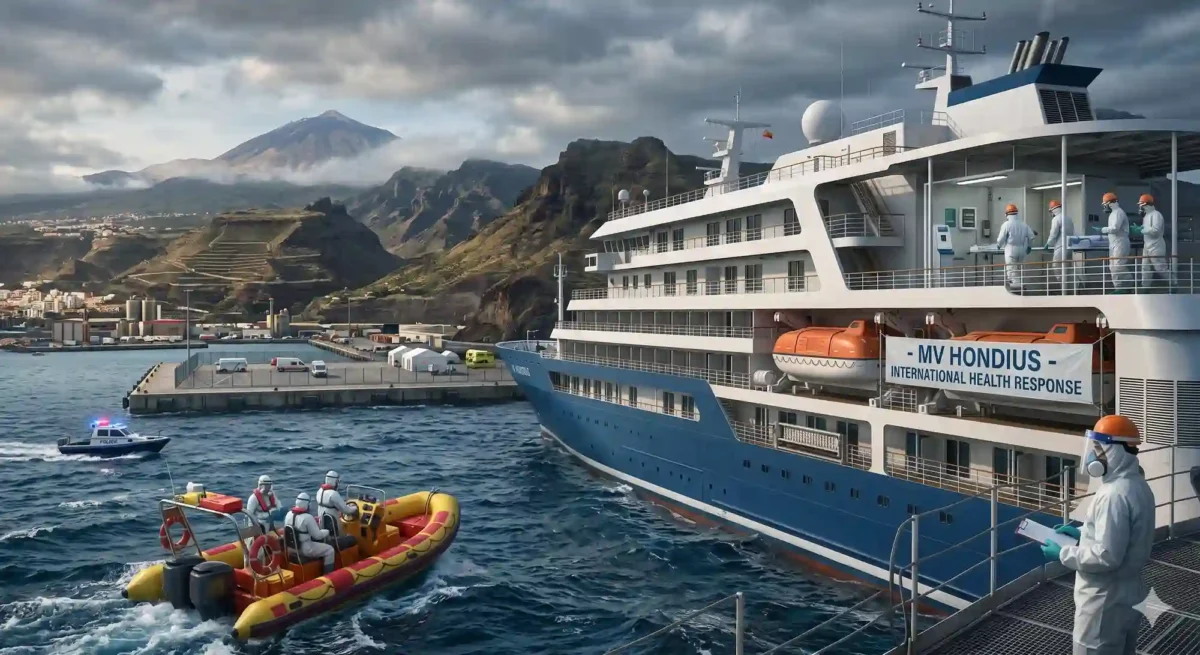
Tragedy at Sea: The MV Hondius Hantavirus Outbreak
When the MV Hondius set sail from Ushuaia, Argentina—the southernmost city on Earth—on April 1, 2026, the 88 passengers and 61 crew members onboard were anticipating the journey of a lifetime. The 35-day Atlantic expedition was meant to be a scenic voyage traversing through some of the most remote and breathtaking islands on the planet, including South Georgia, Tristan da Cunha, and St. Helena, before concluding in Cape Verde. Passengers marveled at humpback whales, dolphins, and black-browed albatrosses as the polar-class vessel sailed into the open ocean.
However, a little over a month later, this dream vacation turned into an unprecedented maritime medical emergency. An outbreak of a rare and highly dangerous pathogen began claiming lives onboard, thrusting a relatively obscure illness into the global spotlight. This marks the first recorded onboard outbreak of hantavirus in the history of the cruise industry. As health authorities scramble to contain the spread and trace exposed individuals across multiple continents, the public is left with pressing questions: what is hantavirus, and how much of a threat does it pose to the rest of the world?
This comprehensive report breaks down the timeline of the hantavirus infections cruise ship crisis, the biology of the virus, its symptoms, how it is transmitted, and the ongoing international response to ensure global safety.
The Anatomy of an Outbreak: How the Crisis Unfolded
The tragic sequence of events began quietly. On April 6, just days into the expedition, a 70-year-old Dutch passenger began exhibiting severe respiratory symptoms. Initially, there seemed to be no obvious cause for alarm beyond standard medical concern. Sadly, his condition rapidly deteriorated, and he passed away on April 11. Believing the death to be the result of natural causes, the ship’s captain informed the passengers, and the voyage continued.
On April 24, the Hondius arrived at St. Helena, a remote volcanic outpost in the South Atlantic Ocean. Here, the deceased passenger’s body was removed from the ship, and his 69-year-old wife disembarked, along with 28 other passengers of various nationalities.
Just three days later, as the ship reached Ascension Island, devastating news arrived: the 69-year-old widow had fallen critically ill after leaving the ship and passed away. On that very same day, another passenger—a British man—became severely ill onboard and required an emergency medical evacuation to South Africa. The crisis escalated further when an 80-year-old German woman died onboard the ship shortly afterward.
It was South African medical specialists treating the evacuated British man who finally identified the invisible culprit: hantavirus. By early May, the MV Hondius arrived off the coast of Cape Verde, but local authorities, prioritizing the protection of the Cape Verdean population, refused to allow the ship to dock. Medical teams in protective gear were sent out to the anchored vessel to assess additional patients who had begun showing symptoms.
After intense negotiations involving the World Health Organization (WHO) and the Spanish government, an agreement was reached to allow the ship to anchor off the coast of Tenerife in the Canary Islands. The vessel’s arrival has been met with both anxiety and protests from local dock workers demanding strict safety protocols, though the government has assured the public that passengers will be isolated at the industrial port of Granadilla, completely separated from residential populations.
What is Hantavirus?
To understand the severity of the situation, we must first answer a fundamental question: what is hantavirus?
Hantaviruses are a family of viruses spread mainly by rodents. These viruses are found globally and can cause varied diseases in humans, depending on the specific strain of the virus and the geographic region. In Europe and Asia, certain hantaviruses cause Hemorrhagic Fever with Renal Syndrome (HFRS), which primarily attacks the kidneys. In the Americas, however, hantaviruses are known to cause Hantavirus Pulmonary Syndrome (HPS), a severe and sometimes fatal respiratory disease.
The virus is completely dependent on its animal hosts to survive in nature. Each strain of the hantavirus is tied to a specific rodent carrier. For instance, in North America, the primary carrier of the Sin Nombre hantavirus is the deer mouse. In South America, carriers include the rice rat and the vesper mouse. The rodents themselves do not get sick from the virus; they merely act as reservoirs, carrying the pathogen in their bodies and shedding it into the environment.
In the case of the MV Hondius outbreak, the pathogen involved has been identified as the Andes virus, a specific strain of hantavirus endemic to South America, particularly Argentina and Chile. Health officials believe that at least one passenger was exposed to the Andes virus while spending time in Argentina prior to boarding the ship in Ushuaia.
How Does Hantavirus Spread?
Understanding how does hantavirus spread is crucial for public health and outbreak containment. Under normal circumstances, hantavirus is not contagious between humans. People typically become infected through a process called aerosolization.
The virus is present in the urine, feces, and saliva of infected rodents. When fresh rodent droppings or urine dry out, or when nesting materials are disturbed (such as when sweeping a dirty shed or cleaning an abandoned cabin), the microscopic viral particles become airborne. Humans who breathe in this contaminated air can become infected. Less commonly, transmission can occur if a person eats food contaminated with rodent saliva or urine, touches a contaminated surface and then touches their nose or mouth, or is directly bitten by an infected rodent.
However, the MV Hondius outbreak involves the Andes virus strain—and this strain represents a terrifying exception to the rule. The Andes virus is the only known hantavirus strain capable of person-to-person transmission.
While human-to-human spread of the Andes virus is incredibly rare, it is documented. It requires prolonged, extremely close contact with an infected person, such as caring for a sick family member or sharing confined, poorly ventilated living quarters. A cruise ship, with its enclosed spaces, shared dining facilities, and close-contact environments, unfortunately provides the specific conditions necessary for this rare type of transmission to occur.
This unique transmission vector explains why health authorities are racing to trace the 29 passengers who disembarked in St. Helena, as well as anyone they may have come into contact with during their subsequent travels. Already, a KLM air steward who interacted with the 69-year-old Dutch victim at a Johannesburg airport before she died has been hospitalized after showing symptoms.
Hantavirus Symptoms: Recognizing the Threat
One of the factors that makes hantavirus so dangerous is its deceptive onset and long incubation period. The time from initial exposure to the first sign of illness can range anywhere from two to eight weeks, making contact tracing a complex and time-consuming endeavor.
When a person develops Hantavirus Pulmonary Syndrome (HPS), the disease typically progresses through two distinct stages. The initial hantavirus symptoms closely mimic a severe case of the flu, which often leads to delayed diagnoses. During the first stage, which lasts for several days, patients typically experience:
- High fever and intense chills
- Severe muscle aches and pain, particularly in large muscle groups like the thighs, hips, and back
- Debilitating headaches
- Profound fatigue
In addition to these core symptoms, many infected individuals also suffer from severe gastrointestinal distress, including nausea, vomiting, diarrhea, and intense abdominal pain.
As the virus multiplies, it enters the second, much more dangerous stage. The hantaviruses reach the lungs and invade the tiny blood vessels known as capillaries. The virus causes these capillaries to become highly permeable and leak. As a result, the patient’s lungs rapidly fill with fluid—a condition known as pulmonary edema.
During this second stage, the hantavirus symptoms escalate to critical levels:
- A persistent, fluid-filled cough
- Severe difficulty breathing, often described as feeling like one is suffocating or drowning from the inside
- Dangerously low blood pressure
- Irregular heart rate and cardiovascular distress
Because the symptoms can worsen so suddenly, patients requiring medical attention must act immediately. What appears to be a standard respiratory infection can become a life-threatening emergency within a matter of hours.
Hantavirus Mortality Rate and Medical Treatment
The public health alarm surrounding this cruise ship outbreak is heavily driven by the staggering hantavirus mortality rate. Unlike seasonal influenza or even COVID-19, hantavirus is remarkably lethal.
According to medical experts and the Mayo Clinic, the mortality rate for HPS caused by the North American deer mouse strain ranges from 30% to 50%. The Andes strain, responsible for the current maritime outbreak, carries a similarly high fatality rate. Nearly half of all individuals who develop severe pulmonary symptoms from these specific strains do not survive.
Complicating matters further is the lack of targeted medical countermeasures. There is currently no widely available vaccine to prevent hantavirus infection, nor is there any specific antiviral medication designed to cure it.
Treatment is entirely supportive and focuses on keeping the patient alive while their immune system fights off the infection. Patients diagnosed with Hantavirus Pulmonary Syndrome require immediate intensive care. They are often placed on ventilators for respiratory support to help them breathe through the fluid in their lungs. In the most severe cases, patients may require Extracorporeal Membrane Oxygenation (ECMO)—a highly invasive treatment where a machine takes over the function of the heart and lungs, pumping and oxygenating the blood outside the body.
The Climate Change Connection: The Situation in Argentina
A crucial piece of the puzzle lies in where the MV Hondius began its journey: Argentina. In recent years, public health officials have noted a troubling trend: hantavirus cases have been doubling in parts of Argentina. Epidemiologists heavily attribute this surge to the accelerating impacts of climate change.
Climate change in Latin America is fundamentally altering regional ecosystems. Unpredictable shifts in temperature, combined with erratic rainfall patterns, directly impact the natural habitats of the rodent populations that carry the hantavirus. Unusual periods of heavy rainfall lead to an abundance of vegetation and food sources, which in turn triggers a massive population boom among carrier rodents like the long-tailed pygmy rice rat.site:hackmd.io
As these rodent populations explode and their natural habitats shift, they inevitably encroach upon human settlements, agricultural zones, and even popular tourist areas. This ecological overlap creates vastly more opportunities for humans to come into contact with aerosolized rodent droppings, driving the spike in Andes virus infections in the region. The tragedy onboard the MV Hondius is likely a downstream effect of these broader environmental changes happening on the South American mainland.
Global Containment and Reassuring the Public
As the MV Hondius prepares to disembark its remaining passengers in Tenerife, international health organizations are working around the clock to contain the fallout. The European Centre for Disease Prevention and Control (ECDC) and the WHO are coordinating a massive public health response.
To prevent any spread to the local population in the Canary Islands, the Spanish government has mandated that passengers will be transferred from the port to isolation zones at the airport using dedicated, heavily protected vehicles. There will be absolutely no contact between the passengers and the local public.
Passengers who test positive or show symptoms will be treated in specialized intensive care isolation units. Those without symptoms are currently classified as close contacts. Rather than flying commercially, they will be repatriated to their home countries via specially chartered flights organized under the European Civil Protection Mechanism. Upon returning home, such as the 23 British nationals aboard, passengers will be required to self-isolate for up to 45 to 42 days to ensure they outlast the virus’s long incubation period.
Despite the high hantavirus mortality rate and the terrifying nature of the disease, experts stress that the general public should not panic.
Dr. Maria Van Kerkhove, the WHO’s director for epidemic and pandemic preparedness, has been unequivocal in her reassurance to the global community. “This is not the start of an epidemic. This is not the start of a pandemic. This is not Covid,” she firmly stated. Because the Andes virus requires incredibly close and prolonged contact to spread between humans, and because the host rodents do not natively exist in Europe or most other parts of the world, a sustained community outbreak outside of South America is highly unlikely.
Conclusion
The hantavirus outbreak on the MV Hondius serves as a sobering reminder of our vulnerability to nature’s microscopic threats, particularly as global travel and climate change intersect. While the hantavirus infections cruise ship incident has undoubtedly caused tragic loss of life and massive disruptions, swift international cooperation, stringent isolation protocols, and robust contact tracing are actively working to contain the threat. For now, public health officials remain confident that this deadly pathogen will remain isolated, bringing a terrifying chapter of maritime history to a safe and controlled close.
Sources: The Guardian, Mayo Clinic, ECDC, and BBC