
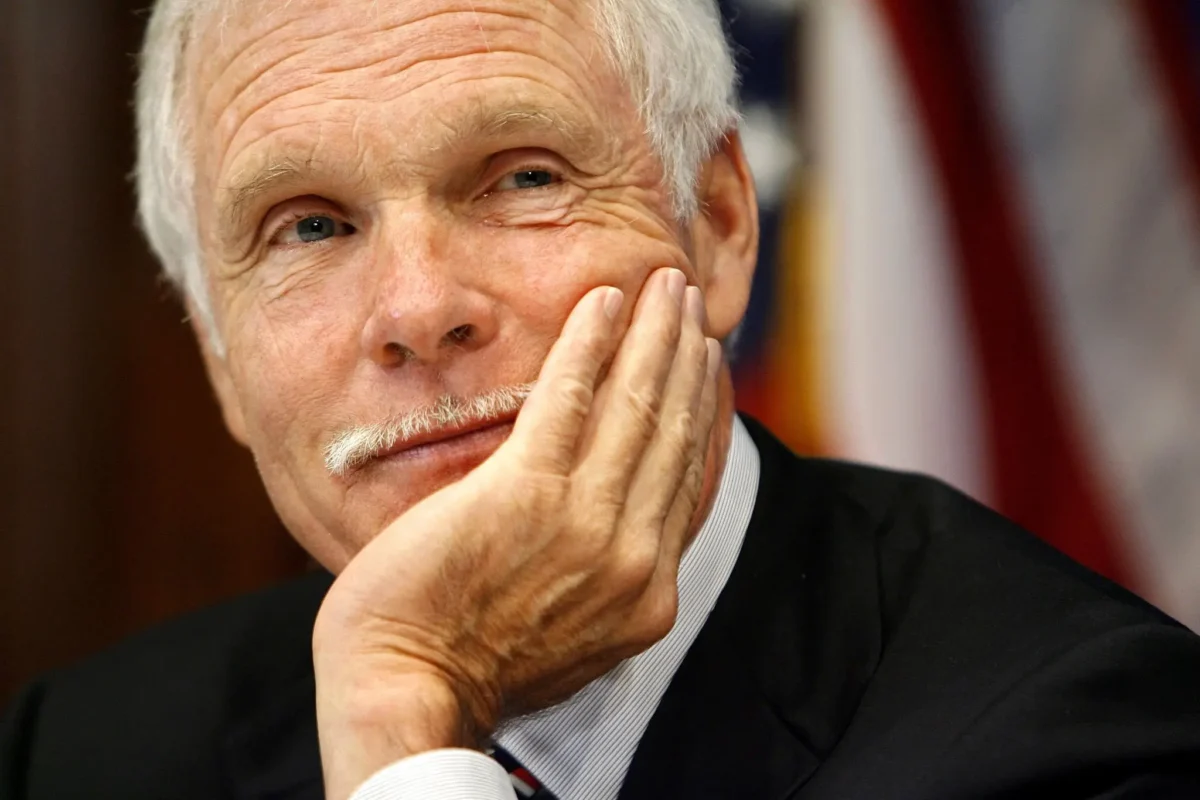
Ted Turner, CNN Founder and Media Mogul, Dies at 87
Ted Turner, the brash and outspoken American media entrepreneur, philanthropist, and sportsman who revolutionized television news by founding the Cable News Network (CNN), has died at the age of 87. Turner passed away on Wednesday, May 6, 2026. According to a news release from Turner Enterprises cited by CNN, the billionaire media pioneer died surrounded by his family.
Ted Turner Cause of Death
While an immediate, specific cause of death was not detailed in the initial announcements, Turner’s health struggles in his later years were public knowledge. In 2018, Turner revealed that he had been diagnosed with Lewy body dementia, a progressive brain disorder. The condition had slowed him down significantly in recent years. Following his passing, CNN chairman and CEO Mark Thompson issued a statement calling Turner “the presiding spirit of CNN,” adding that “Ted was an intensely involved and committed leader, intrepid, fearless and always willing to back a hunch and trust his own judgment.”
Early Life and the Billboard Business
Born Robert Edward Turner III on November 19, 1938, in Cincinnati, Ohio, to Robert and Florence Turner, his early years were marked by frequent moves. When the United States entered World War II, his father joined the U.S. Navy and relocated to the Gulf Coast, leaving the young Turner at a boarding school. After the war, the family moved to Savannah, Georgia, and Turner was placed in the McCallie School, a military academy in Chattanooga, Tennessee. Known for his erratic behavior—and an unusual penchant for taxidermy—he earned the nickname “Terrible Ted,” though he also emerged as a student leader.
In 1956, Turner enrolled at Brown University, where he captained the sailing team. However, his college career ended three years later when he was expelled for a school policy violation involving having a woman in his dormitory room. Following his expulsion, Turner went to work for his father’s billboard-advertising company. In 1960, his father made him the general manager of a branch office in Atlanta, where he found immediate success expanding the business and buying out competitors.
Tragedy struck in 1963 when his father, worried that his son’s aggressive business practices had placed the company in financial danger, died by suicide. Taking control of the Turner Advertising Company at just 24 years old, Turner turned down offers to sell the struggling enterprise. As president and chief executive officer, he managed to bring the company out of debt, restoring it to profitability and laying the groundwork for his future empire.
Building a Media Empire: From Superstation to CNN
Turner transitioned from billboards to broadcasting in 1970 when he purchased WJRJ, a financially troubled, low-power UHF television station in Atlanta. The station initially specialized in broadcasting old movies, network reruns, and professional wrestling. By 1975, Turner utilized a new communications satellite to broadcast his station—later renamed WTBS, or the Turner Broadcasting System (TBS)—to a nationwide cable television audience. This pioneering “Superstation” concept transformed local programming into a nightly cable fixture across the United States.
His most defining venture launched in 1980 with the creation of the Cable News Network (CNN). Dismissed by many critics at the time as an unrealistic concept, CNN became the world’s first 24-hour, all-news television network. By breaking traditional broadcast schedules, CNN revolutionized global journalism and established a template for worldwide news coverage of wars, trials, and natural disasters. Turner’s innovation earned him recognition as Time magazine’s Man of the Year in 1991 for “influencing the dynamic of events and turning viewers in 150 countries into instant witnesses of history.”
Turner’s media conglomerate continued to expand rapidly. In 1986, he purchased the MGM/UA Entertainment Company. Although the massive debt burden forced him to quickly sell off the studio and a share of Turner Broadcasting, he astutely retained ownership of MGM’s library of more than 4,000 classic Hollywood films. This library formed the foundation for his later ventures, including Turner Network Television (TNT), launched in 1988, Turner Classic Movies, and the Cartoon Network. In 1993, he oversaw the purchase of motion-picture production companies New Line Cinema and Castle Rock Entertainment.
In 1996, the media giant Time Warner Inc. acquired the Turner Broadcasting System for a staggering $7.5 billion, creating the world’s largest communications company at the time. As part of the agreement, Turner became a vice-chairman of Time Warner, heading all of the merged company’s cable television networks. Following the merger with AOL in 2001, he served as vice-chairman and senior adviser of AOL Time Warner Inc.
Ted Turner Net Worth
At the time of his death, Ted Turner’s net worth was estimated at around $2.2 billion, according to Celebrity Net Worth. While his fortune was somewhat diminished from its peak following the AOL Time Warner merger, his wealth was deeply tied to his massive landholdings, philanthropic endowments, and enduring business legacy.
Who Was Ted Turner Married To?
Ted Turner was married three times and earned a reputation as a charismatic but demanding partner. His first marriage was to Judy Nye, whom he met while pursuing his lifelong passion for sailing. They married in 1960 and divorced in 1962. In 1964, he married his second wife, Jane Smith. However, his most high-profile relationship was his third marriage to two-time Oscar-winning actress and activist Jane Fonda.
Turner and Fonda were married on December 21, 1991. Following the wedding, Fonda shelved her acting career, moved to Atlanta, and became a dedicated stepmother to Turner’s children. She encouraged Turner to foster closer relationships with his five adult children and his growing number of grandchildren. The high-profile pair separated in January 2000, and with little fanfare, Fonda was granted a divorce on May 22, 2001.
Fonda’s divorce petition cited that the marriage was “irretrievably broken.” Following the split, Turner revealed to The New Yorker that Fonda’s decision to become a Christian played a significant part in the breakup. “She just came home and said, ‘I’ve become a Christian,’” Turner stated. “Before that, she was not a religious person. That’s a pretty big change for your wife of many years to tell you. That’s a shock.” Fonda confirmed the tension, noting that she chose not to discuss her conversion with him beforehand because he would have tried to talk her out of it, and adding that she also wanted to spend more time with her daughter and new grandchild.
Despite the divorce, Fonda remained close to Turner and his family, affectionately referring to him as “my favorite ex-husband.” Until his dementia diagnosis prevented him from doing so, Turner steadfastly supported Fonda’s Georgia-based teen pregnancy prevention nonprofit, G-CAPP, frequently donating luxury trips to his Montana properties for live auctions.
Turner is survived by his five children, 14 grandchildren, and two great-grandchildren.
Sports Ownership: “America’s Team” and Yachting
Beyond media, Turner left an indelible mark on the sporting world. In 1976, the same year he launched his Superstation, he purchased the Atlanta Braves Major League Baseball team. He famously spent one day as the team’s manager before MLB officials ordered him from the dugout. By broadcasting Braves games nationwide on TBS, Turner transformed a regional franchise into “America’s Team,” building a massive fan base in areas without local clubs.
Under his ownership, the Braves experienced one of the greatest sustained runs of success in MLB history, securing a record 14 consecutive division titles from 1991 to 2005, five National League pennants, and the 1995 World Series championship. He also purchased the National Basketball Association’s Atlanta Hawks in 1977 and later the National Hockey League’s Atlanta Thrashers, moves credited with keeping professional sports entrenched in Atlanta.
An avid sportsman himself, Turner was a champion yachtsman who piloted the Courageous to win the prestigious America’s Cup in 1977. Believing in the power of sports to bridge global divides, he also founded and sponsored the Goodwill Games (1986–2001) in an effort to ease Cold War tensions through friendly international athletic competition.
Philanthropy and Environmental Conservation
Turner was a titan of philanthropy and environmentalism. In 1997, he made international headlines by pledging a historic $1 billion gift to the United Nations. This donation—believed to be the largest by a single private individual in the organization’s history—established the United Nations Foundation, a charitable entity dedicated to advancing U.N. objectives. Alongside former Georgia Senator Sam Nunn, Turner also co-founded the Nuclear Threat Initiative in 2001, a nonprofit aimed at preventing the proliferation of weapons of mass destruction.
A fierce advocate for conservation, Turner leveraged his vast wealth to become the largest private landowner in the United States, a title he held until 2011. By 2003, he owned approximately 1.9 million acres of land across more than 25 parcels in 10 states and two countries. He utilized these vast tracts to foster sustainability, ecotourism, and wildlife preservation. Most notably, he spearheaded efforts to rebuild the North American bison herd. This passion for bison preservation led to his co-founding of Ted’s Montana Grill in 2002, a restaurant chain designed to create a commercial market for bison meat to ensure the species’ continued survival.
His commitment to environmental education even extended to children’s programming; he co-created and co-wrote the animated series Captain Planet and the Planeteers (1990–1996), which focused on ecological advocacy. His philanthropic achievements earned him numerous honors, including a Peabody Award in 1997, the Delta Prize for Global Understanding, and induction as a Georgia Trustee in 2010.