
The NBA Playoffs are often defined by moments of sheer grit, unexpected heroics, and players pushing their bodies beyond conceivable limits to deliver when their team needs them the most. In Game 1 of the 2026 Western Conference Semifinals, Minnesota Timberwolves superstar Anthony Edwards etched his name into that storied playoff lore.
Returning to the floor a mere eight days after suffering a hyperextended left knee and a bone bruise in the opening round against the Denver Nuggets, Edwards defied all medical expectations. He came off the bench to help orchestrate a thrilling 104-102 road victory against the San Antonio Spurs. The miraculous return not only secured a crucial 1-0 series lead but also earned the profound respect of his teammates—most notably veteran point guard Mike Conley, who saw a reflection of his own legendary playoff resilience in the young guard’s performance.
A Heroic Return Against All Odds
To fully appreciate the magnitude of Anthony Edwards’ return, one must rewind just over a week prior. During the Timberwolves’ grueling first-round series against the defending champion Denver Nuggets, a collective gasp echoed across Minnesota when Edwards went down clutching his left knee. The diagnosis—a hyperextension combined with a bone bruise—seemed like a death knell for the Timberwolves’ championship aspirations. It is an injury that typically sidelines players for weeks, demanding rest, rehabilitation, and careful minute management.
Heading into Game 1 against the San Antonio Spurs, the general consensus across the league was that Edwards would be wearing street clothes. Nobody expected him to play. The Timberwolves were prepared to battle a rising Spurs dynasty, anchored by the generational talent of Victor Wembanyama, without their primary offensive engine.
Yet, when the injury report was finalized ahead of tip-off, Edwards was miraculously upgraded to available.
He didn’t just dress; he produced. In 25 highly efficient minutes off the bench, Edwards tallied 18 points, three rebounds, and three assists. He was incredibly sharp, shooting 8-for-13 from the floor and 2-for-3 from beyond the arc. Despite playing at less than 100 percent, the 24-year-old superstar showed absolutely no fear in attacking the basket, cutting through the defense, and challenging the colossal presence of Wembanyama in the paint.
Mike Conley’s Ultimate Compliment: “I Called Him My Hero”
Timberwolves veteran leader Mike Conley is no stranger to playoff battles. The 38-year-old point guard has seen everything the NBA has to offer, from deep postseason runs to heartbreaking eliminations. Yet, even Conley was left in awe of what Edwards managed to accomplish in Game 1.
Speaking to reporters following the narrow 104-102 victory, Conley offered the highest possible praise for his young teammate, highlighting the sheer willpower it took for Edwards to even suit up.
“I called him my hero before the game,” Conley said, his admiration evident. “And it’s like, somebody to look up to, for what he just put himself through in the last week just to get ready for Game 1. I mean, nobody expected him to play.”
For Conley, the performance was about much more than the 18 points Edwards put on the scoreboard. It was a testament to his character, his leadership, and his unwavering dedication to the franchise.
“Just his level of commitment to the game, not only to the game, but to his teammates,” Conley continued. “I think it showed a lot of respect that he has for us, the opportunity that we have in front of us. Speaks volumes for how he came out there.”
Echoes of 2015: Conley Sees Himself in Edwards
When asked by the media if he had ever seen a teammate push themselves to play through such a severe injury in such a short timeframe, Conley smiled and offered a deeply personal reflection.
“Probably me,” Conley explained. “I’ve had a couple of them. I broke my face one time and, like, played, like, four days later.”
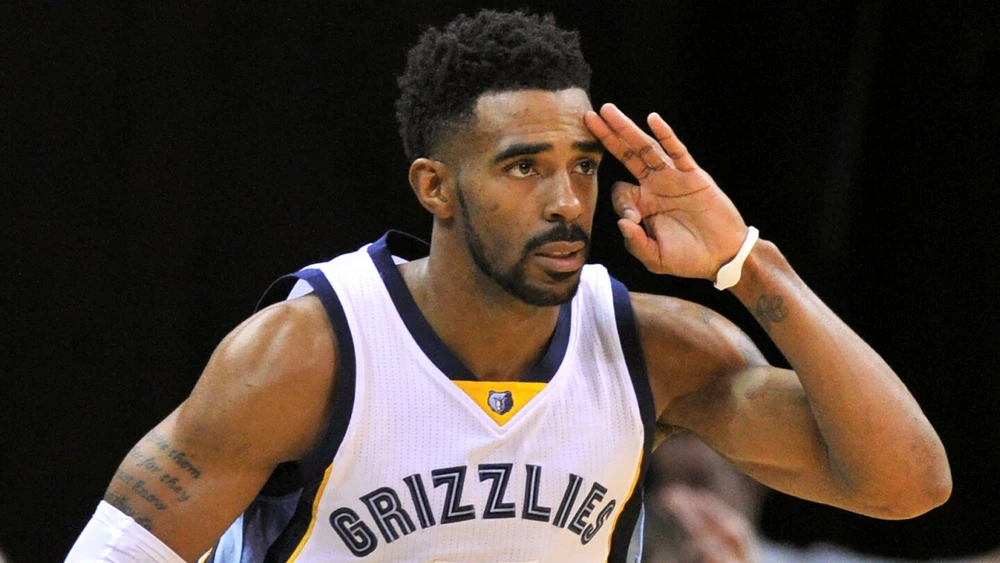
Conley was referring to his own iconic playoff moment during the 2015 Western Conference Semifinals. As a member of the “Grit and Grind” Memphis Grizzlies, Conley suffered multiple facial fractures in the opening round against the Portland Trail Blazers. He underwent surgery and was expected to miss significant time. However, trailing 1-0 to the eventual champion Golden State Warriors in the second round, Conley famously returned for Game 2 just eight days after his injury (and four days post-surgery). Wearing a clear protective mask, a swollen-faced Conley poured in 22 points and dished out three assists in 27 minutes, sparking the Grizzlies to a monumental road victory.
“It’s a warrior scene, right?” Conley noted, connecting his 2015 experience to Edwards’ current situation. “Yeah, that was probably similar where you know you shouldn’t be playing, but you do anyway. You win the game and just march your team to something else. So I think that, you know, like I said, him doing that, I think I saw a lot of myself in that. So I’m like super proud of him and excited that he was able to come back.”
Conley knows firsthand the psychological boost a team receives when a star player sacrifices his own physical comfort for the collective goal. In 2015, Conley’s return galvanized the Grizzlies. In 2026, Edwards’ return did the exact same for the Timberwolves, injecting the roster with an undeniable surge of adrenaline and belief.
Masterful Minute Management by Chris Finch
While Edwards’ heart was willing to play 48 minutes, Timberwolves head coach Chris Finch and the medical staff had to be strategic. Throwing a player coming off a bone bruise into the fire against a hyper-athletic Spurs team required a calculated approach.
Finch opted to bring Edwards off the bench—a rarity for the franchise cornerstone whose regular-season averages sit at a dominant 28.8 points, 5.0 rebounds, and 3.7 assists per game. The goal was to heavily monitor his usage early on, ensuring he had enough gas left in the tank for the game’s decisive moments.
Hall of Famer Tracy McGrady, speaking on “NBA Showtime,” broke down the brilliance of Minnesota’s rotational strategy.
“Ant-Man was going in increments of minutes in the first half to reserve him for the fourth quarter,” McGrady observed. “He was extremely aggressive in that fourth quarter, taking over the game.”
The strategy paid off brilliantly. Edwards was held back just enough in the first three quarters, allowing his knee to stay warm without overexerting the joint. When the fourth quarter arrived, trailing on the road in a hostile San Antonio environment, Finch unleashed his superstar.
Edwards responded by playing with an intensity that completely shifted the momentum of the game. He dropped 11 crucial points in the final frame, adding a key assist that kept the Minnesota offense humming. Fueled by Edwards’ aggressive drives and clutch shot-making, the Timberwolves outscored the Spurs 35-30 in the fourth quarter, mounting a comeback that stunned the home crowd.
Surviving Wembanyama’s Historic Night
Edwards’ heroic return was essential because the Timberwolves found themselves up against a truly historic individual performance from San Antonio’s Victor Wembanyama. The French phenom was an absolute terror on the defensive end, turning the paint into a no-fly zone for Minnesota’s forwards.
Wembanyama finished the night with a staggering 11 points, 15 rebounds, and an astonishing 12 blocked shots. In doing so, he shattered a 41-year-old NBA postseason record for the most blocks in a single playoff game. Every time the Timberwolves attempted to score inside, they were met by the towering reach of the Spurs’ franchise center.
Despite Wembanyama’s defensive dominance, the Timberwolves relied on their collective grit. Julius Randle put the team on his back for large stretches of the contest, finishing with a team-high 21 points and repeatedly challenging the Spurs’ frontcourt with physical, bruising interior play. Jaden McDaniels, whom Edwards recently dubbed his “favorite player in the NBA,” continued his stellar postseason by making timely defensive rotations and hitting key shots.
The game went down to the absolute wire. Minnesota managed to build an eight-point lead with just over three minutes left in regulation, but a late surge by the Spurs quickly erased the cushion. The final possession of the game saw San Antonio’s Julian Champagnie launch a potential game-winning shot as time expired. The arena held its breath, but the shot ultimately missed the mark, allowing the Timberwolves to escape with a 104-102 victory.
Accountability and Looking Ahead
Even in victory, and even while playing through immense pain, Anthony Edwards remained his own harshest critic. He made a few critical errors down the stretch of the fourth quarter, turning the ball over and missing a defensive rotation. Rather than using his injury as a crutch or an excuse, Edwards took full accountability for his mistakes in the post-game press conference.
It is exactly this type of maturity that has endeared him so deeply to veterans like Mike Conley. Edwards is not just a high-flying scorer; he is evolving into a true leader who understands the weight of playoff basketball.
With a 1-0 lead secured on the road, the Timberwolves have snatched home-court advantage away from the Spurs. More importantly, they have proven that their resolve is unbreakable. They survived a historic 12-block masterclass from Victor Wembanyama, they executed their game plan down the stretch, and they welcomed back their superstar far earlier than anyone anticipated.
If Mike Conley’s 2015 heroics are any indication, a playoff team rallied by a wounded warrior is a dangerous entity. The Memphis Grizzlies used Conley’s return to push the mighty Golden State Warriors to the brink in a hard-fought six-game series. Now, with Anthony Edwards playing the role of the masked hero, the Minnesota Timberwolves look poised to do much more than just put up a fight. They look like legitimate, undeniable championship contenders.
As the series moves toward Game 2, the San Antonio Spurs will have to head back to the drawing board to figure out how to stop a Minnesota team that is riding high on emotion, veteran leadership, and the seemingly superhuman resilience of Anthony Edwards.